I can never resist a touch of the dramatic. Perhaps I’ve read too much Sherlock Holmes, or maybe I simply summon these instances by way of wanting them to occur. The latter took place a couple of hours before the commencement of Memorial Day for the Fallen, when I sat down on a park bench in Jerusalem’s Independence Park to have a cup of coffee with Elazar Gold, an ultra-Orthodox friend of mine.
Elazar dresses in typical haredi fashion, albeit casual in stature and approachable in manner. His glasses and haircut are modern; he has kind eyes, a warm smile, and subtle mannerisms that portray the friendliest of characters. This predisposition softened the air between and around us, fermenting the conditions that are crucial for two individuals of polar worlds to sit on the same bench and create a genuine dialogue between them, free from judgmental frustration.
Elazar, I’m really happy we’ve finally found the time to sit down together. How have you been?
I must say that you couldn’t have found a more symbolic time and place to meet [Independence Park] – well done, my friend.
I’ve been thinking quite a lot about the future of late. Everything feels very uncertain for me at this moment in time. The political atmosphere in the country is shifting quickly, and I know those changes are going to affect my life directly.

I’m also in a personal stage of transition. I’m still single, not yet settled down, and the decisions I make now will shape the entire direction of my future. It appears I’m at a double crossroads. Thank you for the coffee, by the way; it’s excellent.
If I’m completely honest, I feel like I’m caught between two very different worlds: the one I grew up in, and the one I’m still figuring out. This moment in my life is forcing me to think seriously about where I stand and what kind of life I want to build. It’s a time full of questions, and not many clear answers. I suppose I’m no different than many others in the country at this time in history.
Everything is uncertain at the moment, you’re not alone on that front. Let’s start somewhere certain – the past. Do you mind telling me a little about yourself? Who is Elazar Gold?
I was born and raised in Jerusalem. My father is a lawyer of hassidic upbringing and part of a family that’s been in the city for seven generations. My mother, originally from America, grew up in a traditional Jewish home and became more religious before meeting my father. I often feel like a blend of the two, caught somewhere between my father’s inherited, somewhat blind manner of faith, and my mother’s more conscious channel of belief.
The haredi community, much like planets with their own gravitational pull, used to be smaller and more subject to the outside world. There was a time when ideas from beyond were always considered, at times embraced, and at least understood.
That’s the world my father came of age in. He grew up in Geula, a Jerusalem neighborhood that once had a majority of Zionist Jews from all backgrounds. Back then, many believed the haredim would slowly be absorbed into the national Israeli narrative; that the sheer presence of the Zionist majority and state would reshape the ultra-Orthodox world.
But somehow, the opposite occurred. Rather than dissolve, the haredi community in Geula held its ideological ground. Over time, it not only resisted the cultural shifts around it but became more insulated and more defined, perhaps in an act of self-preservation. Today, Geula is almost entirely haredi, a symbol of how the hope for natural integration failed to materialize. Instead of merging, the haredi world expanded and raised cultural barriers in response to the modern influences developing around it.
It seems like what happened in Geula exemplifies the entire national frictional relationship between our two ways of life. We’ll no doubt come back to this. Could you share some more about your haredi adolescence?
I was a very curious child. Alongside our religious studies, we were also taught general knowledge about the world, like any other child. I spent my teenage years in a yeshiva ketana [middle/high school Torah seminary for boys ages 13-17] that included elements of a non-haredi curriculum. But in truth, this wasn’t done out of genuine interest in broader education, it was more of a statement; a rebellious gesture of frustration at the limitations of the haredi system rather than an effort to truly engage with the wider world. It felt impure, performative – a cheap knockoff.
Everything changed when I entered the yeshiva gedolah [post-high school]. There, I found something deeper. I found people who genuinely wanted to learn, to engage in thoughtful, open conversations. The rosh yeshiva [principal] wasn’t just a scholar; he was like a conductor, setting the tone for how we learned and spoke.
The yeshiva world is complex. On the personal level, it can be diverse and intellectually rich; but the higher you go in the hierarchy, the narrower and more rigid the system becomes.
Historically, the now-dominant Lithuanian tradition in haredi Judaism took many diverse Ashkenazi communities under its wing. And because religion in this world governs nearly every aspect of life, from law to education to family, the religious leadership effectively became political leadership, too.
There are real contrasts within the haredi world. In classic haredi circles, emotion has little importance. The Torah and the Talmud are our codes of conduct. Hassidism, by contrast, gives more space to feeling. Your personal interpretation matters; your emotional and spiritual connection plays a role in how you relate to the law. The diversity in religious belief is evident, as are our political stances.
In my yeshiva, there was a strong awareness of these different approaches and of the evolution of the Jewish world at large. My belief today comes from choice, not inheritance. I don’t judge others who don’t feel the same way; but for me, Jewish faith aligns with who I am. I know that makes me a minority. Most of my peers chose this path as a framework for living: a place where knowledge, tradition, and understanding bring a kind of intellectual joy. For me, it’s that – and more.
That sounds like quite the journey, Elazar. How did it affect your relationship with the State of Israel?
I feel the need to express something that is often misunderstood, and I say this sincerely, without any intention of causing offense or stirring animosity toward myself or my community.
According to the State of Israel, I am indeed an Israeli citizen. But personally, with full awareness and a clear conscience, I do not feel like one. I have no spiritual or social connection to the state as a political entity. I understand that the current system is different from what existed under British or Ottoman rule, but to me, and to many others, it remains a human structure.
It may be Hebrew-esque and very accommodating for Jews, but it does not resonate with us on a deeper ethical level. This is not the kingdom of God that the Torah envisions. Any system that distances us from that vision challenges the foundation of our way of life. We live according to God’s kingdom. We study His laws and commandments every single day. That is where our loyalty lies.
I have no hostility toward the State of Israel, but I also do not feel a particular sense of love or national belonging. My citizenship itself holds little meaning to me, and I believe this is true for many in the haredi community. Our political leaders take part in the Knesset not out of ideological identification with the state but out of a practical need to ensure the well-being of our community. This political involvement is the result of the democratic system that was created by the founders of the state; it is not something we would have chosen independently.
The haredi community has, since its creation, always taken care of itself, even before the establishment of robust civic welfare from the relatively new concept of states. The haredi leaders have utilized their Israeli citizenship and political representation to collect as much as possible from the state, a notion that I disagree with and fault as one of the main sources of animosity between the two worlds.
However, I don’t think our leaders, and many of their believers, understand or perhaps pay much attention to their growing power and the resulting resentment that’s permeating among the other Jewish factions in the country due to the increasing indulgence of the haredi leadership’s political agency at the expense of their fellow parties. In truth, it appears to me that they justify their behavior by playing the victim’s role in Israel’s unfolding story. I say this to you with much sadness in my voice.
I can’t fault you for the social damage that your leaders are currently doing. Many of our leaders suffer from the same disease. Could drafting into the army potentially atone for their political sins?
I did not choose to live under this flag, and I struggle with the idea that simply sharing a flag creates an obligation to fight or die for it. That is not a value I live by, nor is it a framework I ever agreed to.
In my view, both sides would benefit from a clearer political separation. If we could renounce our formal citizenship in exchange for exemption from military service, it would create a more honest and respectful arrangement, offering a new equilibrium between our communities where our interactions are based solely on mutual respect, not dependency of any kind. We have survived for many centuries without the civic welfare that the Israeli state provides, and so we will adapt once more to a life without it. This current relationship has never served any of us well – none of us.
What I would truly welcome is the creation of an autonomous haredi authority – that could provide a real solution. It would allow us to live freely according to our values, to remove unnecessary friction, and perhaps even rebuild trust between our worlds through mediums that serve us both, such as the ZAKA organization, which has done wonders for the public perception of the haredi community; and effective government-led programs for integrating haredi women into Israel’s robust tech world.
Our connection is not to the state; it is not to the government or to the flag. Our connection is to the Jewish laws of land and people: That is where our identity begins and ends. What I seek is not national aspiration but religious autonomy and a harmonious society. Those tenets, more than anything, give my life meaning and direction.
While we are on the subject of our land and people, how did Oct. 7 affect you?
I was overwhelmed with sadness and grief. I immediately imagined myself in their shoes and became ashamed by my inability to hold a gun and defend myself, my loved ones, my community, my people. I felt hopeless. It was a difficult moment to realize that when danger arrived at our doorstep, I was unprepared and unable to do what others were doing instinctively.
Since then, I’ve found myself feeling more belief in, and empathy for, the secular side of Israel. Oct. 7 showed me how we are all bound together, despite our differences. As a Jewish people, we are different from the rest of humanity and are perceived as one entity in their eyes, just as we were during and after the Holocaust. That reality and its realization has only strengthened my belief in our shared destiny.
I do feel a stronger inclination to be a part of that collective, to feel more connected. It doesn’t mean I’ve abandoned my beliefs, but I can no longer ignore the sense of shared fate: I can no longer live my life in haredi isolation.
At the same time, I still believe that I am upholding Jewish life by learning Torah. That is my role. It’s not just about studying texts, it’s about preserving who we are, spiritually and morally. I may not serve in the army, but I serve the Jewish people in a different way. I contribute by maintaining the soul of our people through Torah. That, too, is a form of protection, a form of responsibility and continuity.
Leaving your family behind to protect your people
I THEN told Elazar about a close friend of mine, a newly married National Religious law student, who was called up yesterday for three months of reserve duty. He had just returned from Gaza three weeks prior. His firstborn son is only nine months old. He asked me, with a sad, curious smile, whether I thought his son would forget who he is by the time he returns. This man is leaving behind his new family to fulfill his duty as an Israeli, as a Jew, to protect his people.
I ask myself, and now you, Elazar: With so many young men in the haredi world struggling to truly connect with the yeshiva lifestyle, why is it seen as such a stain on their suit to join the army? Why is helping their Jewish brothers carry this unwanted burden worse than simply falling through the cracks of haredi society?
It pains me to hear stories like his – it truly does. I wrestle with the reality that my situation causes such pain to others.
But if we want to remove that stain, one of two separate, non-contingent conditions must materialize. First, there is the question of pikuach nefesh – the preservation of life at all costs. Oct. 7 was a horrific and tragic event, but not, in our eyes, a long-term existential crisis for the Jewish state.
Israel is strong. It has a thriving, capable population. It has enough sons and daughters to face its enemies, and so it simply needs to take action, just like it did in Gaza, Yemen, Syria, and Lebanon. The haredi community won’t serve to ensure the survival of the State of Israel, but it will serve in order to save the Jewish people from disaster.
Second, and just as crucial, is the safeguarding of religious integrity. The army, as it stands today, has not upheld its side of the bargain. If you want haredim to serve, you must prove to us, tangibly and sincerely, that our spiritual level and religious way of life will not be compromised. If you can show that a haredi man will leave the army at the same level of faith and observance that he entered with, you will see many of our lost young men in uniform.
The haredi community would much prefer that their men who haven’t found their place in yeshiva can find purpose in protecting the Land of Israel, something that all can take pride in. This reality must simply resonate with the other laws of God, which are no less sacred. This is the real step toward a viable solution.
The ultimate litmus test for haredim
The new Hasmonean haredi brigade established after Oct. 7 may very well be the ultimate litmus test. And if these haredi men come out more religious than before, well you’ll have to build a lot more military bases, I can promise you that!
Yonatan, ever since the rise of global nationalism and the subsequent fall of religious dominance, the haredi world has been on the defensive. The real challenge is that the modern world has dismissed the comprehensive traditional Jewish lifestyle as something of the past, which is in direct conflict with what we stand for. We don’t want to be absorbed into that world. We don’t want our intrinsic values eroded.
Our guard is up, and our armor is on. We are afraid to lose our Jewish identity and practices. If the state can create a reality where there is no hostility toward the organic haredi way of life, then perhaps something new can grow.
If this modern world can agree to coexist without trying to change us, if there can be mutual respect between our distinct ways of life, then we can start lowering our guard and begin learning and utilizing the amazing opportunities that this modern way of life can provide. From lifesaving medication to AI – artificial intelligence – there is so much good to be found in the secular world, even for us dusty book-loving haredim.
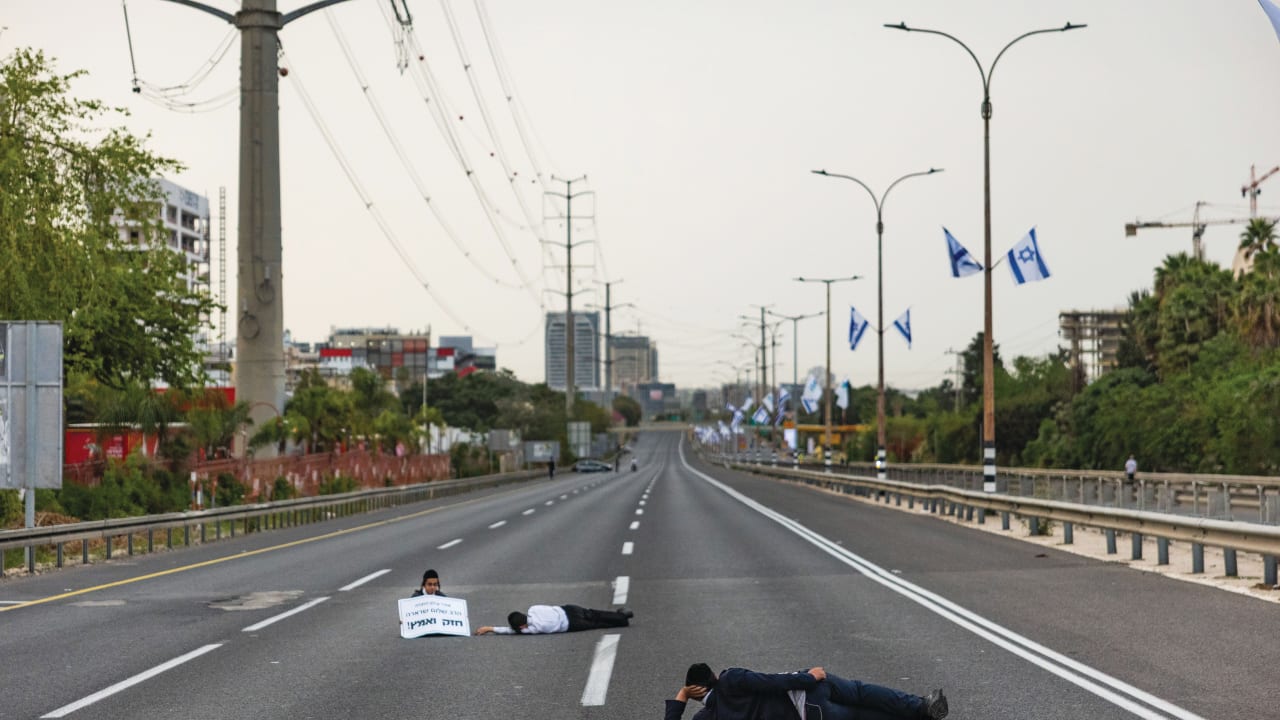
Well, Elazar, I’ve still got a lot of questions to ask you, but I think we’ve touched on a great deal this evening. The siren announcing the beginning of Memorial Day will sound any minute now, and I do apologize for the dramatic setting of this final question: Will you stand with me when the siren sounds?
Of course I will. These victims and soldiers died so that I could live in this land as a free Jew. They will always have my respect for their eternal sacrifice. I may disagree with some of the values they fought for and lived by, but they died in the names of us all. I mourn for every single one, just as they mourned for the Jews who were murdered in the Holocaust death camps, regardless of their ideological divides. We are one people, then, now, and always.
AND THEN the deafening siren pierced the empty park, echoing through the city, across the benches, along the stone paths, and up the dark trees. Elazar and I stood silent and solemn, and for one full minute there was no anger, no politics, and no ideology. Just one pure minute of mutual respect, the kind Elazar hopes could one day become a timeless reality.