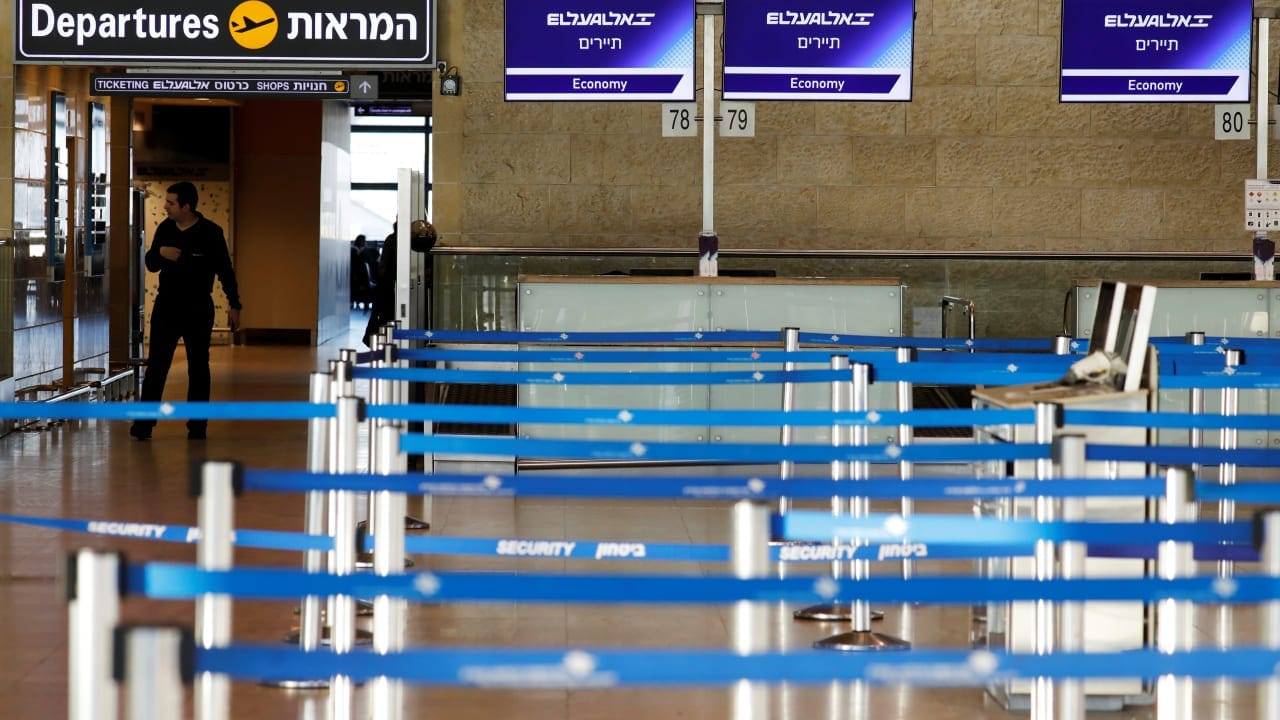
As hundreds of thousands of Israelis are trapped overseas due to the blanket airspace closure,there are thousands of others inside Israel who need to get out, whether for business, medical reasons, or personal ones.
The Movement for Quality Government organization petitioned the government on Tuesday, demanding that it refuse to accept the decision banning airlines from flying out of Israel, and at the very least reconsider its decision to close the skies, it announced on Wednesday.
The Israeli airspace was closed by the government on Friday, after the Thursday night Israeli attacks on Iran, over what the leadership said was concern that civilian planes might be targeted, and to limit large gatherings.
On Tuesday, Democrats MK Efrat Rayten requested that Cabinet Secretary Yossi Fuchs and Attorney-General Gali Baharav-Miara examine the legality of such a decision.
On Monday, the Transportation and Defense Ministries announced that they had established a plan for rescue planes for the tens of thousands of stranded Israelis currently abroad. The flights were scheduled to begin operating within 72 hours, with a maximum of two flights landing per hour, and only during daylight hours.
The MQG asserted that “this appears to be a limited and gradual outline that still does not meet all the needs of this crisis.”

The organization warned that if a decision like this passes, it “will seriously violate the constitutional right of Israeli citizens to leave the country,” referencing Article 6 of the Basic Law: Human Dignity and Liberty.
The article, titled “Departure from the State of Israel, and entry into it,” contains two clauses. The first is that every person is free to exit Israel, and secondly, that every Israeli citizen who is abroad is entitled to enter Israel.
A violation of constitutional rights
According to the MQG, a government decision limiting such movement violates this constitutional right.
“It is highly doubtful as to whether such sweeping restrictions can be put into force based solely on a government decision,” said the organization, urging that a right founded on such a sound legal basis be taken as seriously as it should be, and that a balanced decision be proposed instead.
A Supreme Court ruling from March 21, 2021, which was dealing with the restrictions put in place due to the coronavirus pandemic at the time, stated that entry and exit restrictions are “unconstitutional because they do not pass the proportionality test.”
Then-Supreme Court chief justice Esther Hayut highlighted the importance of the right of citizens to movement.
She said that this was “one of the foundations of constitutional life.” Current Chief Justice Isaac Amit added at the time, “Even in hard times... human and civil rights do not get shelved... sensitivity and creativity are required in the broad scheme of things.”
The MQG said on Tuesday that “although the right to movement is not absolute, significant weight must be given to the fact that this is a violation of the freedom of movement and citizens’ constitutional right.”
There is a need to “act as much as possible to achieve a proportionate solution that will balance the purpose of maintaining the security of citizens and the violation of the constitutional rights,” it added.
The Israel Hofsheet civil movement, which works to change policy and legislation in religious-state relations, sent an “exhaustion of remedies” letter to the A-G as well as to the Transportation Ministry on the matter on Wednesday.
An exhaustion of remedies letter is an attempt to settle legal issues outside of court before resorting to litigation.
Procedurally, this is the first step taken before filing a court petition, and it is traditionally considered a prerequisite to filing a petition. It also allows the other side time to respond in kind.
Filed through the Kalai, Rosen & Co. law firm, Israel Hofsheet asked that the authorities provide widespread means of transportation throughout the week, including on Shabbat, and in particular to the approximately 150,000 Israelis who are stuck abroad.
It argued that essential travel must be provided, as the Transportation Ministry already vowed to do. The letter referenced several High Court of Justice decisions in its favor that were handed down around the time of the Hamas October 7 massacre attack.
On Tuesday, Transportation Minister Miri Regev and El Al, which has taken charge of the rescue flights, asked for a religious ruling from Sephardi Chief Rabbi David Yosef regarding operating the rescue flights on Shabbat.
Yosef said that, in this particular case, it is not a matter of life and death, so the flights are not to operate on Shabbat.
“We will say what should be wholly obvious to decision-makers: There cannot be a debate over whether there is an immediate and critical need to provide essential transport right now,” Israel Hofsheet said.
“Israel is at war on different fronts,” it continued, “and Israelis wish to be with their loved ones. This includes parents who want to reach their children, as well as those who are working to fight for Israel’s safety,” it continued.
“The religious ruling will bring about a grave violation of rights for thousands of people,” Israel Hofsheet said.