
On Election Day, Yashar’s party leader, Gadi Eisenkot, delivered a speech that suggested he could already see himself in the Prime Minister’s Office.
He was not the only one. The first exit polls pointed to a clear victory for the opposition bloc and the approaching end of Prime Minister Benjamin Netanyahu’s tenure.
In the rooms where politicians awaited the results, however, the picture gradually changed. Likud climbed to 27 seats, Yashar settled at 21, and the gap between the blocs narrowed.
Eisenkot discovered what former prime minister Shimon Peres had learned long ago: Exit polls are excellent at generating headlines but somewhat less effective at transferring power.
Netanyahu, for his part, can breathe a sigh of relief. His party is once again the largest, and he remains prime minister.
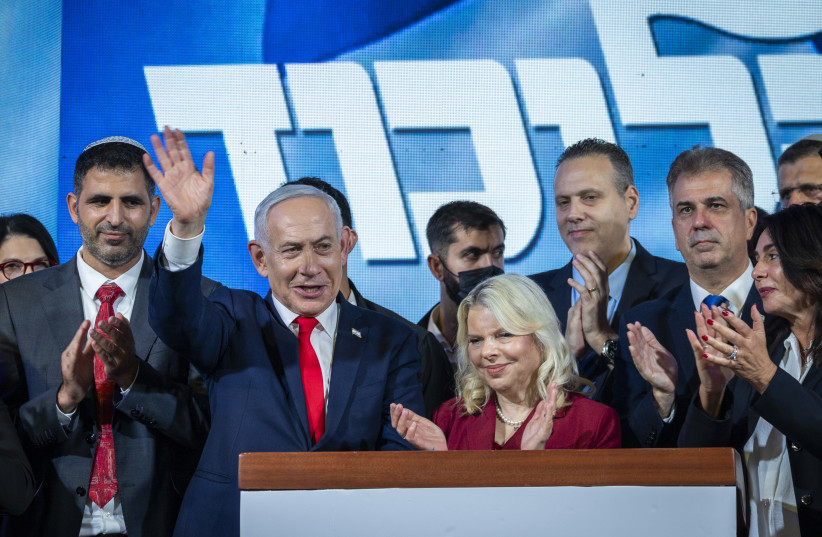
But the good news ends there. The outgoing coalition bloc holds just 53 seats, eight short of the 61 needed for a majority.
The opposition bloc has 48, while the Arab parties, Ra’am and the Joint List hold 19 between them. Anyone looking to form a government will need to bring something else to the table: partners willing to sit together.
Voters weakened the outgoing coalition but did not give the opposition parties a majority that would allow them to form a government without reaching new agreements. Netanyahu can remain in office as long as no alternative government is established.
Eisenkot must find a way to form one.
The incumbent prime minister’s advantage is already clear: He does not need a new agreement to remain in office.
While his rivals try to resolve their differences, Netanyahu can use his political connections, maintain his partners’ loyalty, and examine who in the opposing camp might prefer a compromise over holding another election.
The equation Eisenkot must solve begins with the 48 seats held jointly by Yashar, B’Yachad, The Democrats, and Yisrael Beytenu. Ra’am has eight seats, and the Joint List has 11. With Ra’am alone, the opposition bloc would reach 56 MKs; with both Arab factions, it would reach 67.
The arithmetic of a minority government
These are mathematical combinations, not coalition agreements.
Eisenkot does not necessarily need 61 votes in favor of his government for it to be sworn in, but he does need a majority in the confidence vote.
If all 48 members of the opposition bloc support their proposed government, 53 members of Netanyahu’s bloc oppose it, and all 19 members of the Arab factions abstain, the government will fail to win the Knesset’s confidence.
To change that outcome, Eisenkot will have to secure additional support or ensure that some of the 53 opponents do not vote against him.
Support from Ra’am, for example, could be sufficient numerically if the remaining Arab faction abstains and all 48 opposition-bloc MKs vote in favor.
But that calculation depends on agreements that B’Yachad’s Naftali Bennett and Yisrael Beytenu’s Avigdor Liberman opposed during the campaign.
Although a total of 67 MKs do not belong to Netanyahu’s bloc, they have not agreed to form a government together. They may, however, manage to unite around certain measures in the Knesset without agreeing on the identity of the next prime minister.
Netanyahu could remain at the head of the executive branch while his rivals assemble a majority against him in parliamentary votes.
Eisenkot faces resistance from his own allies
For Eisenkot, the challenge is to turn agreement against Netanyahu into agreement for a particular government.
These are two different political tasks.
Netanyahu ran a familiar election campaign: He placed himself at the center, relegated his partners to supporting roles, and portrayed every vote for a small right-wing party as a risk to his continued rule. Likud benefited far more from this approach than did its partners.
Itamar Ben-Gvir’s Otzma Yehudit party won seven seats, United Torah Judaism (UTJ) seven, Shas six, and the Religious Zionist Party-Zehut won six. With them, Netanyahu reaches 53 seats, eight short of the majority he needs.
No party in the opposition bloc has pledged to join his government, and any attempt to recruit an outside partner could require concessions that anger his existing allies.
Yisrael Beytenu has already made clear that even an offer allowing Liberman to serve first in a rotation arrangement would not change his refusal to join a government with Netanyahu.
Relations within the Right could also shift. During the campaign, National Security Minister Itamar Ben-Gvir and Finance Minister Bezalel Smotrich had to find a way to stop Likud from attracting voters to choose Netanyahu’s party over theirs. They may now have to choose between loyalty to Netanyahu and concern that a unity government could be formed without them.
The prime minister needs them to preserve his bloc, but if he wants to form a government, he may have to seek additional partners who would not necessarily agree to sit alongside them. The more Netanyahu signals that he is exploring a broad government, the greater is their incentive to make clear what they will not accept.
They could complicate his efforts just as he tries to expand his room to maneuver. From their perspective, however, threatening to dissolve the partnership too early could leave them outside any new arrangement.
Eisenkot faces resistance from his own allies
For Eisenkot, the story begins with success. He entered the election as the leading candidate to replace Netanyahu, pushed Bennett into second place within the camp, and built a party that won 21 seats.
His personal success does not solve the coalition problem. The opposition parties’ 48 seats provide a starting point for negotiations, but a long road remains before a government can be sworn in.
The disagreements began months earlier, when Eisenkot raised the possibility of forming a minority government. Liberman publicly opposed the idea, while those close to Bennett also viewed it as an attempt by Eisenkot to draw voters from within the bloc.
All three wanted to replace Netanyahu but did not agree on how to establish the government that would succeed him.
The Democrats’ Yair Golan was quick to propose a course of action. While his partners remained silent, he called on them to include Ra’am and the Joint List in the calculation of the 67 MKs outside Netanyahu’s bloc and to establish a government in partnership with Israel’s Arab citizens.
Golan also criticized the distinction between Jewish and Arab votes.
Yet his call did not produce agreement among the factions. Bennett and Liberman did not join the initiative, and support from both Arab factions for any particular government is far from guaranteed.
Ra’am’s Mansour Abbas has already served as a coalition partner in a government headed by Bennett. The Joint List, by contrast, holds different positions on diplomatic and security issues, and cooperating with it would require Bennett and Liberman to cross a political line they have pledged not to cross.
Any agreement to rely on Ra’am would not necessarily indicate a willingness to rely on the Joint List as well. To swear in a government, the parties will have to agree on the confidence vote and then on budget, security policy, and government decisions.
Even outside support will require clarifying the conditions imposed by the factions asked to provide it.
Claims of “election theft,” voiced in Likud circles after the polls closed, point to a possible line of attack against a government dependent on the Arab parties: challenging its legitimacy.
Bennett and Liberman, who pledged not to rely on those factions, would be particularly vulnerable to such criticism.
Senior Yisrael Beytenu figures have spoken of “the sin of arrogance by Gadi and his people” and the “selfish campaign” he conducted.
They argue that talk of a minority government supported by Arab parties drove away voters who had already moved to the opposition bloc, and accuse Eisenkot and Golan of returning approximately seven seats to Netanyahu’s camp by such talk.
That anger is complicating the negotiations before they have even really begun. Liberman spent years building his political strength around a hardline toward the Arab parties and, ahead of the election, even sought to disqualify Ra’am.
Now, after his party blamed talk of a minority government backed by Arab parties for losing seats, it would be difficult for him to agree to such a move.
His refusal would not necessarily rule out every possibility of forming an alternative government. Still, it would leave Eisenkot without Yisrael Beytenu’s seven seats and force him to find another combination.
Bennett faces a similar problem, though his political history complicates it differently. He already formed a government with Ra’am in the past and paid a political price.
He now leads a party with 12 seats, significantly smaller than Yashar’s. Joining an Eisenkot-led government could give him influence, but it could also cement his position as the junior partner of the man who overtook him.
For Bennett, the decision also concerns his political future. If he joins Eisenkot’s government, he will have to show his voters why they should still see him as an independent alternative.
If he stays outside, he risks being remembered as the politician who held the power needed to change the government but chose not to use it.
In August, Eisenkot spoke of presenting a government with 58 or 59 seats, without asking anything of the Arab parties. Now the opposition bloc only has 48 seats.
If all 19 Arab MKs abstained and all 53 members of Netanyahu’s bloc voted against such a government, Eisenkot would lack a majority in the confidence vote. Conversely, support from Ra’am and abstention by the Joint List could allow a government to be sworn in with 56 votes in favor and 53 against.
Herzog’s decision and the battle for the Knesset
Even before that, Eisenkot must deal with President Isaac Herzog.
The president is expected to receive the official results this week, hold consultations with the factions, and decide whom to task first with forming a government. Likud is the largest faction, but the central question will be who can demonstrate a realistic chance of forming a government.
If 61 MKs unite in recommending a candidate, that will carry political significance, but recommendations do not guarantee a majority in the confidence vote.
Herzog will have to assess which MK has a chance of forming a government within the rights of his authority under the Basic Law: The Government.
A faction could recommend Eisenkot to prevent Netanyahu from receiving the mandate, while still refusing to support Eisenkot’s government. Conversely, a faction could decline to recommend him but later allow his government to be sworn in through support or abstention.
The number of recommendations will therefore matter, but it cannot substitute for the agreements needed to win the confidence vote.
Herzog has already called on party leaders to approach consultations with an open mind and avoid another election.
The president can encourage compromise and hold talks, trying to identify a formula for a unity government, but he cannot impose one on the lawmakers who would have to vote for it.
Then there is the timetable, which must be taken into consideration. Whoever receives the mandate will have 28 days to negotiate, with the possibility of an extension of up to 14 additional days. If that attempt fails, further procedures stipulated by law will become available.
Throughout this period, the outgoing government will remain in office until another is formed. Netanyahu will not be required to leave the Prime Minister’s Office after 28 days, even if his rival receives the mandate.
During the mandate period, Eisenkot could try to change the parliamentary balance of power while Netanyahu still serves as caretaker prime minister.
Success in such an effort could restrict the outgoing government’s ability to control the legislature and give Eisenkot a political achievement even before he reaches agreement on the composition of a government.
Netanyahu would continue to run the executive branch, but he might struggle to control the parliamentary agenda.
Eisenkot could show his voters that the majority opposed to the outgoing government can deliver results even without a coalition agreement. To do so, he would have to bring MKs into the plenum repeatedly and ensure that they vote together. If he succeeds in replacing the Knesset speaker or advancing significant legislation, he could point to a tangible achievement and strengthen his position in coalition negotiations.
Failure in the first votes would expose his weakness precisely in the arena where he appears to enjoy a numerical advantage.
As long as Netanyahu’s rivals argue over forming a government, he benefits from incumbency. If they begin cooperating in the Knesset, he will have to contend with a majority whose effectiveness does not depend on agreement over the distribution of ministerial portfolios.
Netanyahu has a clear interest in deepening the divisions between them, particularly over the matter of cooperating with the Arab parties.
Eisenkot also faces a trap. Bennett and Liberman may agree to act against Netanyahu in the Knesset precisely because such votes do not require them to support a minority government under Eisenkot.
Eisenkot could claim parliamentary achievements and apply pressure on the government, but those successes would not necessarily bring him closer to the Prime Minister’s Office.
Netanyahu can remain in office as long as no alternative government is formed, even if he struggles to advance his parliamentary agenda.
Unity, Trump, and the possibility of another election
And what of a unity government?
The math makes this notion tempting. Likud and Yashar hold 48 seats together. With B’Yachad, they reach 60 even before adding other partners.
But the numbers do not answer the disagreements awaiting the leaders around the negotiating table.
Who would serve first in a rotation? Would Netanyahu agree to a state commission of inquiry into the events of October 7? Would Eisenkot agree to serve under him? What would happen to the military conscription law? Would Ben-Gvir and Smotrich be left out? And what would guarantee that any agreement signed would survive the first crisis?
Eisenkot and Bennett have pledged not to sit in a government with Netanyahu.
Breaking that promise would carry a heavy price, but outright refusal does not guarantee a way out of the deadlock either.
Another election could return all sides to the same position, or even give Netanyahu the eight seats he currently lacks. The leaders will have to consider that risk as well.
The political price of a unity government would not be shared equally by the Likud and Yashar leaders.
Netanyahu could frame it as expanding his government’s support base and reducing his dependence on existing partners.
Eisenkot would have to explain how joining a government headed by the man he sought to replace could be reconciled with breaking the central promise he made to voters.
The rotation question would be central to any such negotiations: Who would serve first, and what would ensure that the other side receives the position when its turn comes?
Even if Eisenkot secures significant policy commitments from Netanyahu, ensuring the agreement is honored would remain difficult, particularly if Netanyahu serves as prime minister during the first stage.
Then there is US President Donald Trump.
Trump supported Netanyahu before the election, and he may try to influence the formation of the next government as well.
Washington carries weight in security relations, the Iran issue, and the possibility of offering an Israeli government a shared agenda with the US administration.
If Trump proposes a significant diplomatic or security initiative to Netanyahu and Eisenkot that requires a broad government, he could change their calculations.
Netanyahu could argue that unity is necessary to seize a diplomatic opportunity, while Eisenkot would have to decide whether the opportunity justifies a partnership with Netanyahu.
American pressure could give both leaders a public explanation for a compromise they had initially resisted.
But for that argument to be convincing, a concrete American initiative would be needed, not merely Trump’s desire to see a broad Israeli government.
Yet even Trump, for all his influence, does not hold the key to the 61 seats.
Public support for Netanyahu does not turn Liberman into his coalition partner. A meeting at the White House does not resolve the question of a commission of inquiry, and Herzog’s decision on whom to entrust forming a government remains subject to Israeli law, whatever the White House’s preferences.
In the coming days, it will first become clear whether Eisenkot can assemble recommendations broad enough to present to the president.
Next, the Israeli voters will see whether that same majority can act together in the Knesset and whether either leader is prepared to pay the political price of a minority or unity government.
If no agreement is reached, another election remains a possibility.
Netanyahu will continue to head the caretaker government until an alternative government is formed.
Eisenkot, meanwhile, will have to persuade those voters who have already voted for change but have not given his camp a clear path to achieve it.
Netanyahu can wait in the PMO. Eisenkot must persuade those politicians who struggle to agree even on how to replace him.
This is not the result of an exit poll. It is the election’s political outcome.