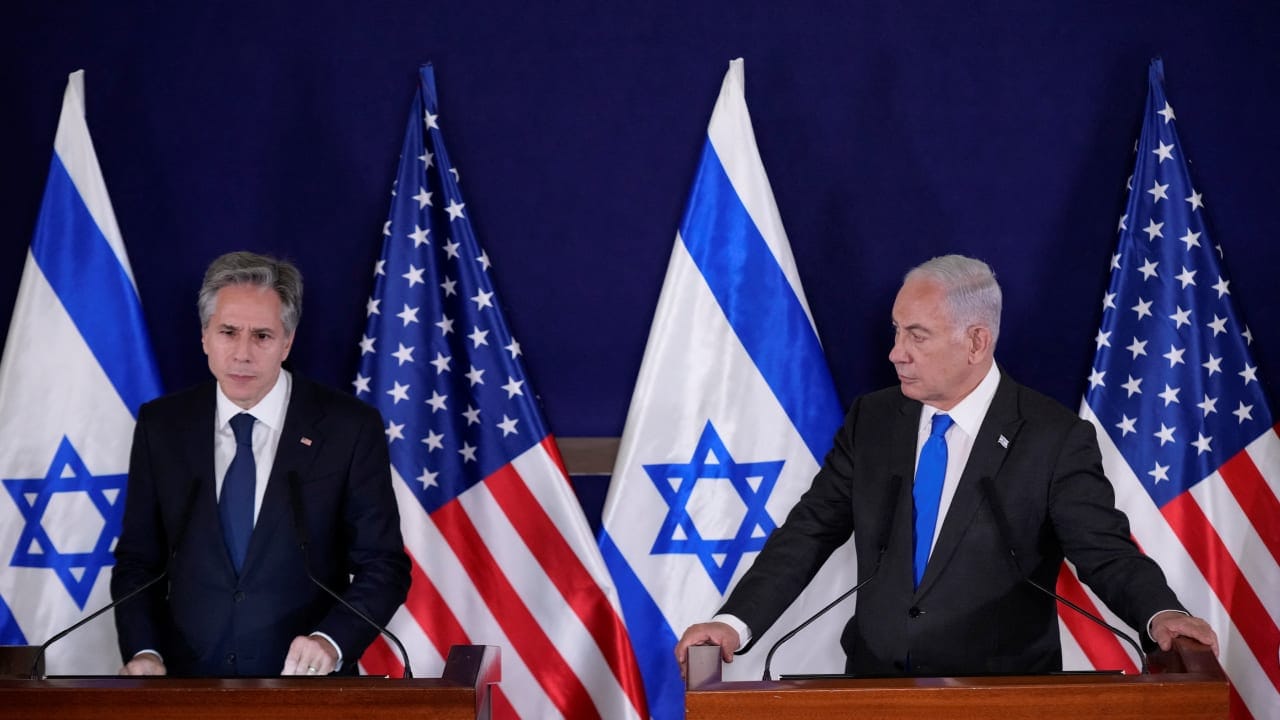
Former US secretary of state Antony Blinken said Sunday that he warned Prime Minister Benjamin Netanyahu during the Gaza war that Israel risked losing support among young Republicans and young evangelicals, alongside its mounting difficulties within the Democratic Party.
Speaking at the Jewish Federations of North America’s General Assembly in Washington, Blinken recalled a conversation with Netanyahu in the spring of 2024 about the political consequences of the war.
“You are not only losing the Democratic Party, and that may be fine from your perspective. You’re going to be losing young Republicans, young evangelicals,” Blinken said he told Netanyahu.
Blinken appeared alongside former secretary of state Mike Pompeo in a discussion moderated by ABC News journalist Juju Chang. The two defended the value of the US-Israel relationship while differing over Iran, Palestinian statehood and Israel’s response to criticism of its conduct in Gaza.
Blinken said the image of Israel had changed profoundly between generations. He recalled growing up when Israel was broadly seen as David facing a surrounding Goliath; for the generation now coming to the fore, he said, that perception had reversed.

He described the shift as a strategic challenge for Israeli leaders, with consequences for American politics and future arrangements between the two countries.
Discussing military assistance, Blinken said Israel appeared to recognize that American funding would not continue indefinitely and was preparing its public for paying for its own weapons purchases. He said the relationship’s underlying value would remain.
Pompeo argued that the strength of the partnership depended heavily on its institutional ties, including intelligence cooperation. He described the relationships he had encountered as CIA director and secretary of state as “deep and unbreakable and really solid.”
The security assistance memorandum signed in 2016 covers fiscal years 2019 through 2028 and provides a framework for $38 billion over that period, comprising $3.3 billion annually in military financing and $500 million annually for missile defense.
Pompeo says Israeli intelligence helped protect him
Pompeo offered a personal example of the intelligence relationship, saying Israel had helped protect him as he faced threats from Iran.
“The Israeli intelligence has been very helpful at making sure that I’m where I need to be and I’m not where I ought not be,” he said.
He said there was a million-dollar bounty on his head, joking that his wife, Susan, thought the amount was low.
Pompeo said Israeli intelligence regularly helped save American lives through cooperation that received little public attention. He also praised Israel’s technological capabilities and stressed that American intelligence and military personnel contributed to Israeli security.
“We couldn’t do the intelligence work we need to do without them,” he said.
Disagreement over Iran
The former secretaries differed sharply over how to confront Iran and secure shipping through the Strait of Hormuz.
Pompeo expressed deep skepticism that a negotiated settlement could be reached with Iran’s current leadership. He advocated increasing pressure on the regime, maintaining an economic blockade and striking additional assets inside Iran to reduce its ability to threaten Israel and the Gulf.
He acknowledged that further action would carry costs and provoke an Iranian response, but argued that more pressure was needed to achieve an acceptable outcome.
Blinken warned that overcoming Iran’s ability to threaten shipping through military action would require a major escalation. He favored sustained economic pressure aimed at bringing Tehran to negotiations and said a diplomatic resolution would probably require offering Iran something, such as sanctions relief.
Pompeo rejected concessions in exchange for freedom of navigation.
“We should never give the Iranians a damn thing,” he said.
Blinken criticizes civilian protection in Gaza
Asked about accusations including war crimes and genocide in Gaza, Blinken emphasized the brutality of Hamas’s October 7 attack and the difficulties of fighting an enemy embedded among civilians.
He also criticized Israel’s treatment of Palestinian civilians, saying it had, for the most part, done the bare minimum it believed necessary for people caught in the fighting. He described a degree of disregard and disdain for their well-being, which he distinguished from an intention to harm or eliminate them.
“The target was Hamas, and horrifically, too many people were caught in the middle of that and suffered terribly as a consequence,” Blinken said.
Pompeo defended Israel’s conduct and urged its supporters to explain the military challenges it faced. He warned against what he described as a growing moral equivalence between Israel and Hamas, and said supporters of the relationship needed to make its importance to Americans clear.
The two also disagreed over the role Palestinian statehood should play in expanding the Abraham Accords, the normalization agreements between Israel and Arab states advanced during the first Trump administration.
Blinken credited those agreements as a powerful diplomatic vehicle but argued that bringing additional Arab and Muslim countries into closer relations with Israel required a path toward resolving the Palestinian question. He called for a secure Israel alongside a sovereign, demilitarized Palestinian state, with Hamas disarmed and efforts to deradicalize education and religious preaching.
Pompeo said a key achievement of the Abraham Accords was allowing regional relationships to develop while the Israeli–Palestinian conflict remained unresolved. With a two-state agreement further away after October 7, he argued that additional peace and security arrangements should move ahead.
The 2026 General Assembly of the Jewish Federations of North America opened Sunday in Washington and runs through Tuesday, bringing together Jewish communal leaders, philanthropists and professionals from North America, Israel and beyond. Held in the wake of elections in both Israel and the United States, this year’s gathering focuses on the US–Israel relationship, combating antisemitism, strengthening communal security and Jewish identity, and supporting Israel’s recovery after three years of war.