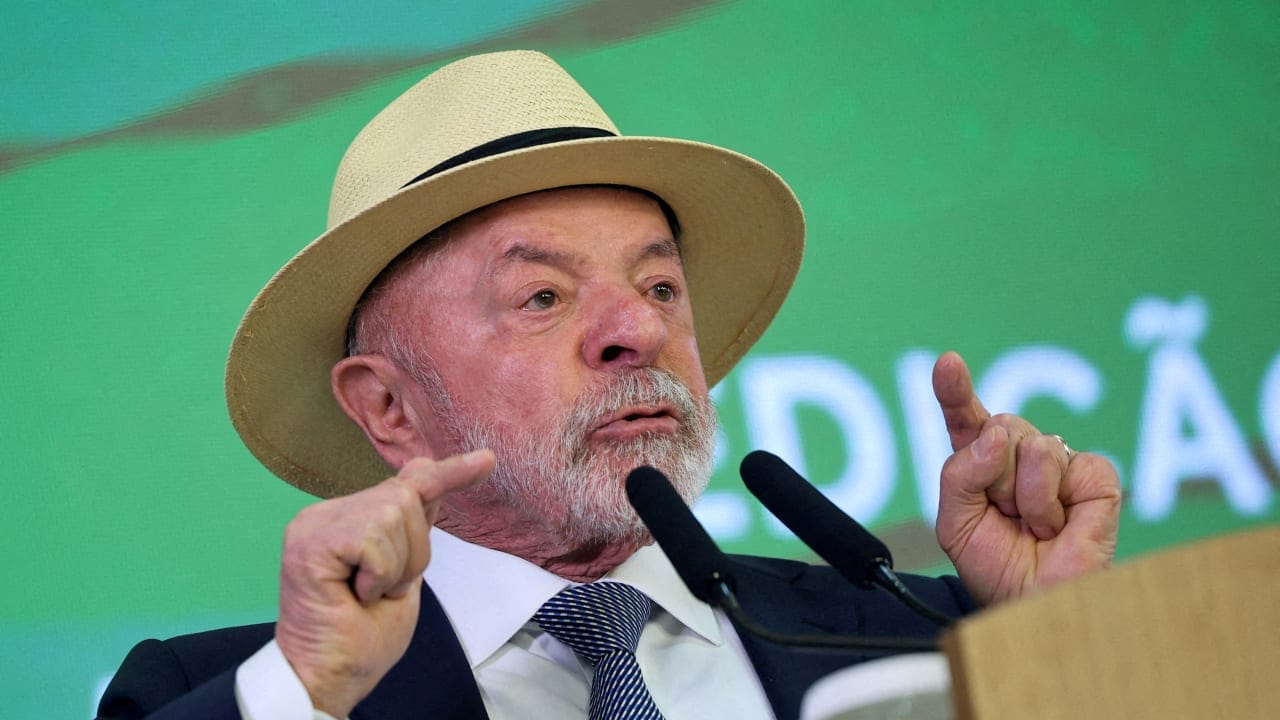
Brazil’s presidential election is heading to a run-off on October 25. The development came after presidential candidate Flavio Bolsonaro won the first round of elections, defeating left-wing President Lula da Silva by several million votes. Bolsonaro is the son of the former president Jair Bolsonaro.
Lula has been a fixture of Brazilian politics for decades and is a well-known figure on the Left. He once led BRICS and has taken a softer stance toward Moscow in the Russia-Ukraine war.
Former president Bolsonaro was a supporter of Israel while he was in office, joining a trend of right-leaning leaders in Latin America who tend to be closer to Israel. This is part of a larger trend in Central and South America, where more right-leaning candidates are winning.
In a January interview with The Jerusalem Post, Flavio Bolsonaro said that, if elected, he would move Brazil’s embassy to Jerusalem within the first six months of his mandate.
In April, Argentinian President Javier Milei and Prime Minister Benjamin Netanyahu announced the launch of the Isaac Accords. This illustrated the growing partnership between Israel and Argentina.

At the time, the Foreign Affairs Ministry noted: “The Isaac Accords constitute a new strategic framework aimed at strengthening cooperation between Argentina, Israel, and like-minded partners in the Western Hemisphere, the descendants of Isaac and nations of the Judeo-Christian tradition, in defense of freedom and democracy, and in the fight against terrorism, antisemitism, and drug trafficking. Participating countries will pursue concrete actions based on these principles.”
Netanyahu, Milei launching Isaac Accords sets foundation for Israel-LATAM relations
Last month, when Netanyahu met with Milei on the sidelines of the UN General Assembly, the Isaac Accords were once again in the spotlight. The two leaders discussed continued cooperation between their countries, which makes an expansion of the Isaac Accords, led by Milei, possible.
“This will deepen security and economic cooperation between Israel and the countries of Latin America,” the Prime Minister’s Office said.
In June, the Post noted that the Isaac Accords have been supported by, or could receive future support from, Brazil, Argentina, Venezuela, Ecuador, Colombia, Honduras, Chile, Costa Rica, Guatemala, Paraguay, Uruguay, Bolivia, and Panama.
The “rightward shift” in Latin American politics is currently getting a lot of attention. Some commentators in the US believe it is due in part to the influence of the Trump administration and the end of USAID in the region. They argue that USAID funded left-leaning programs. Meanwhile, the Trump administration has made it clear that it supports certain leaders, such as Argentina’s president.
The US explicitly supported Abelardo de la Espriella in Colombia, who narrowly won the elections. The Guardian even claimed that the elections in Brazil are part of the US’s search for “control” of Latin America. Some call this the Donroe Doctrine – a new American version of the Monroe Doctrine. The arrest of Venezuela’s Nicolas Maduro in January 2026 was part of this.
The New Arab sees the shifting political landscape as helpful to Israel. It noted that “Nicaragua, Colombia, Mexico, Chile, Bolivia, Cuba, and Belize all intervened in support of South Africa’s case against Israel at the International Court of Justice (ICJ), while Colombia went one step further, placing a total ban on coal exports to Israel and terminating its bilateral free trade agreement.” Now, it argues that Bolivia and Honduras have shifted tack and become closer to Israel. Chile and Honduras have since returned their ambassadors to Israel.
In August, The New Arab noted: “The new president of Colombia, Abelardo de la Espriella, is ready to renew ties with Israel by ramping up security coordination, resuming coal exports, and withdrawing from the Hague Group. This week, the new right-wing government also recognized Israel’s claim to the occupied Golan Heights, which it captured from Syria in 1967, becoming only the second country to do so after the Trump administration in 2019.”
Israel, Venezuela ties improving after Trump admin. ousts Maduro
The ties between Venezuela and Israel have also improved. In August, Reuters noted that “Venezuela’s government, now led by Interim President Delcy Rodriguez, said an Israeli humanitarian delegation visited the country after deadly earthquakes in June, and discussions took place among senior officials from both nations, leading to the deal to resume consular services.”
Colombia has likewise moved to improve ties with Jerusalem. In July, Colombia’s Foreign Minister Omar Bola Escobar met with Foreign Minister Gideon Sa’ar. Sa’ar visited South America in August and went to both Ecuador and Colombia.
Many Middle Eastern countries are watching developments between Israel and Latin America. For instance, Turkey’s Anadolu news agency closely tracked which countries are moving their embassies to Jerusalem. In an April article, it noted that Argentina had joined Honduras, Guatemala, and Paraguay in the move.
The changing political map of Central and South America also has ramifications for Israeli defense ties. Latin America accounted for only 2% of Israel’s defense sales in 2025 and has never been a major market for Israel’s defense sector. Latin America generally prefers not to spend large sums on defense. Brazil, the region's largest spender, ranks 21st globally. This makes its spending less than that of Spain, Australia, Japan, Turkey, and Italy. In fact, Brazil’s defense spending is only 1% of its GDP.
Mexico, Colombia, Chile, and Argentina round out the top five defense spenders in Latin America. In terms of their GDP percentage, Colombia, Uruguay, Ecuador, Honduras, and Chile put 1.3 to 3.3% of their GDP into defense.
In August, Defense Minister Israel Katz “signed a memorandum of understanding (MOU) with Honduras’s Defense Minister Enrique Rodríguez Burchard to deepen defense cooperation between the State of Israel and the Republic of Honduras,” the Defense Ministry said.
It added: “The MOU with Honduras joins a series of defense cooperation agreements advanced by the Defense Ministry over the past year with partners around the world, as part of the ministry’s strategy to expand Israel’s circle of defense partnerships, strengthen strategic ties with friendly nations, and deepen cooperation between Israel’s defense industries and international markets.”
This demonstrates that Israel wants more defense sales in the region. However, the big question is whether Latin America’s political shifts will lead to major changes on this front and others. Although Latin America has seen many changes, their implementation and scope have been narrow. The continent is broadly democratic, except for Nicaragua, Venezuela, and Cuba.
Many countries retain their old political parties, such as the Colorado Party in Uruguay and Paraguay. Argentina's Peronist party was founded in 1946. Over the next decade, it's plausible that the Left may return to power in some of these countries.
Brazil’s election is a veritable juggernaut. With some 110 million voters, it has more voters than all the other countries in South America combined. Central and South America are, in truth, divided almost equally between the Left and Right, and it remains to be seen what Brazil’s elections will bring.