Colombia, the world’s second most populous Spanish-speaking nation after Mexico, has little in common with landlocked Slovenia, the second-smallest of the six republics that once comprised Yugoslavia.
But when it comes to their stance on Israel, the parallels are hard to ignore.
Within one month of each other, leftist, pro-Palestine governments in both countries were voted out of office and replaced by right-wing leaders who vowed not only to restore full diplomatic relations with Israel but also to inaugurate embassies in Jerusalem.
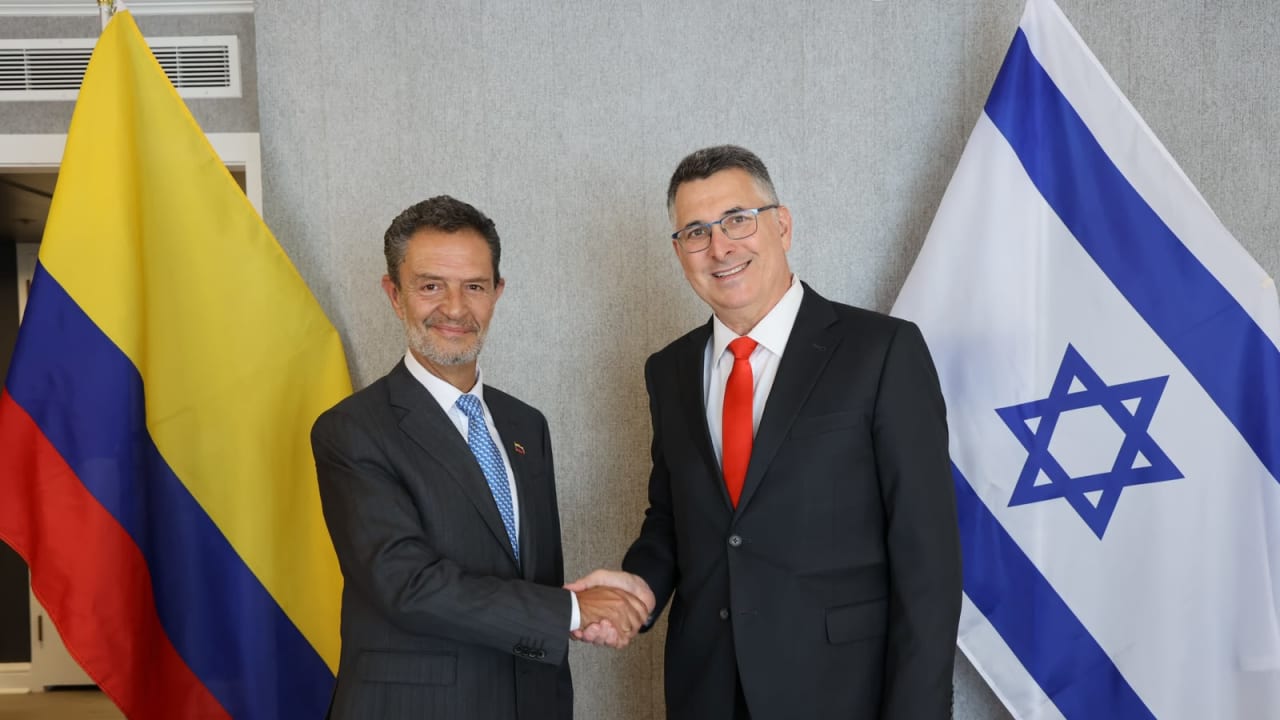
In fact, Colombia’s next foreign minister, Omar Bola Escobar, promised exactly that Wednesday during a meeting in Washington, D.C., with his Israeli counterpart, Gideon Saar. That followed a declaration by President-elect Abelardo de la Espriella that Colombia would establish relations “like never before” with Israel once he takes the oath of office on Aug. 7.
In June 2024, the parliament of Slovenia, an Alpine republic of 2.1 million, voted to recognize a Palestinian state only a week after Spain, Ireland and Norway had done the same thing. But half a year later, it went further. Slovenian public broadcaster RTV, citing the ongoing war in Gaza, became the first in Europe to demand Israel’s exclusion from the 2025 Eurovision Song Contest.

Janez Jansa, leader of the Slovenian Democratic Party, replaces PM Golob
Then last year, Slovenia under Prime Minister Robert Golob banned all imports from Jewish settlements in the West Bank as well as all weapons trade with Israel, the first member of the European Union to do so. And this past June, RTV not only boycotted Eurovision altogether but aired films about Palestine instead.
That anti-Israel campaign made life uncomfortable for the country’s 100 or so Jews, said Robert Waltl, president of the Ljubljana-based Liberal Jewish Community of Slovenia.
But on May 22, Janez Jansa, leader of the Slovenian Democratic Party and an admirer of US President Donald Trump, formed a winning coalition with other right-wing parties following the country’s parliamentary elections, clearing the way for Jansa to replace Golob as prime minister.
In a striking about-face, Janza immediately announced that Slovenia would cancel its previous recognition of Palestine and move its embassy in Israel from Tel Aviv to Jerusalem. That would make it the first country in the 27-member EU to take that step (though not the first country in Europe: Kosovo already has an embassy in Jerusalem).
Likewise, Israel will open an embassy in Ljubljana for the first time.
“That’s an important and welcome milestone, and something many of us have hoped to see for a long time,” Waltl explained in an email. “That said, I still feel it’s too early for me to draw broader conclusions about what this will mean in practice for bilateral relations, or for the Jewish community. I’d rather judge by actions than by first impressions.”
Ernest Herzog, executive director for operations at the World Jewish Congress, said Slovenia’s new direction is a lot more than a foreign policy adjustment; it carries huge historic significance.
“Israel was among the first countries to recognize Slovenia’s independence in 1991” following the breakup of Yugoslavia, he said. Opening an embassy in Jerusalem “would send a clear signal that Slovenia views Israel not only as a key regional partner but also as an important ally in defending the rules-based democratic order at a time of growing geopolitical instability.”
In Colombia, the shift is even more dramatic. Famous for world-class coffee, salsa dancing, beautiful beaches and biodiversity, it’s home to maybe 5,000 Jews out of 54 million inhabitants.
President Gustavo Petro, Colombia’s first left-wing leader in recent memory, is a former M-19 guerrilla leader. He became mayor of Bogotá in 2011 and president in 2022. On May 2, 2024, in the midst of worsening conditions in Gaza, Petro severed diplomatic relations with Israel and stopped lucrative exports of coal to Israel, as well as all weapons deals.
Colombia’s ambassador to Israel closes embassy in Tel Aviv
Margarita Manjarrez, Colombia’s first female ambassador to Israel, stayed on until June 30 of that year, at which point she closed the embassy in Tel Aviv (though consular services remain open).
Petro, constitutionally limited to one term, backed Iván Cepeda as his successor. But Cepeda lost to right-wing businessman Abelardo de la Espriella by the narrowest margin in Colombian election history.
Widely supported by Colombia’s small but wealthy Jewish community, the new president will be sworn in Aug. 7. One of his first acts, he said, will be to open an embassy in Jerusalem. That would make it the ninth embassy in Israel’s capital, along with those of the United States, Guatemala, Honduras, Kosovo, Papua New Guinea, Paraguay, Fiji and Argentina.
Manjarrez, now Bogotá’s ambassador to Singapore, declined to comment. But Harry Toledo, the Israeli-based director of Fuente Latina, an NGO that provides pro-Israel Middle East coverage for Spanish-language media in the United States and Latin America, says he’s not surprised by any of this.
“I don’t think the issue was Israel,” said Toledo, who is originally from Medellín but has spent the last 24 years living in Tel Aviv. “As we’ve seen in recent years, all these governments are taking advantage of the situation here to distract from their problems at home. In Spain, we clearly saw that Sánchez is using the Palestinians to dispel criticism of his own government. Petro in Colombia did the same thing.”
Toledo, one of thousands of Colombians living in Israel, noted that the Trump administration revoked Petro’s US visa last year, and then later added him, his wife, his son and his interior minister to its Specially Designated Nationals list due to their alleged illicit drug trafficking.
“Petro was a criminal and a genocidal guerrilla. He was a real antisemite who even posted ‘Heil Hitler’ online,” said Toledo. “It’s not like he was hiding his position against Jews.”
12 of Latin America’s last 15 elections have been won by right-wing candidates
Michael Shifter, former president of the Inter-American Dialogue, a D.C. think tank, noted that 12 of Latin America’s last 15 elections have been won by right-wing candidates. Voters in only Brazil, Mexico and Uruguay elected leftists.
Shifter said it’s not so much an ideological conservative turn that’s fueling this wave, but more a profound desire for change.
“The recent electoral swings are better understood as a reflection of widespread frustration with governments of different political stripes that have failed to address persistent economic, security and governance challenges,” he said.
Shifter is no stranger to the region. In the early 1980s, when the Dialogue was founded, Latin America’s biggest economies, Argentina, Brazil and Mexico, were cash-strapped, debt-ridden and beholden to the IMF. And the United States under President Ronald Reagan was actively supporting the government of El Salvador in its bloody war against leftist insurgents, while at the same time secretly funding contras hoping to overthrow Marxist Sandinistas in neighboring Nicaragua.
The only country doing well at the time was energy-rich Venezuela, which today is considered a failed state.
Mike Skol, a former US ambassador to Venezuela who has extensive business ties in Colombia, said de la Espriella’s election is certainly part of that Latin rightward shift against socialism.
The question, he poses, is whether he’ll behave more like Argentina’s Javier Milei, a libertarian who is an outspoken supporter of Israel, or El Salvador’s Nayib Bukele, a hugely popular president of Palestinian origin who has on more than one occasion called himself “the world’s coolest dictator.”
“The White House is looking for outspoken allies, on Venezuela, on Cuba, on Israel, and on oil,” Skol said in an email. “Expect Colombia to be unequivocal in all. The payoff will be an important pillar of regime success.”
Ultimately, the real prize for Israel would be a full restoration of ties with oil-rich Venezuela, which were broken by Hugo Chávez in 2009 following an Israeli incursion into Gaza that year. After Trump’s ousting of former president Nicolás Maduro last year and his tacit support for Maduro’s successor, Delcy Rodríguez, anything appears possible.
Just last week, Rodríguez was photographed in a once-unthinkable meeting with uniformed IDF brass overseeing Israeli rescue efforts in the wake of two powerful earthquakes that have devastated Venezuela’s coastal region. The 30-member team’s efforts mark a rare diplomatic thaw following years of official Venezuelan hostility toward Israel.
This raises the inevitable question: Could the Israeli flag one day flutter from an embassy in Caracas?
“Yes, I think it is very possible that Venezuela under Delcy will restore relations with Israel,” Skol said, noting that the US secretary of state is seen as running the show in Venezuela since Maduro’s ouster. “All Marco Rubio has to do is ask.”