
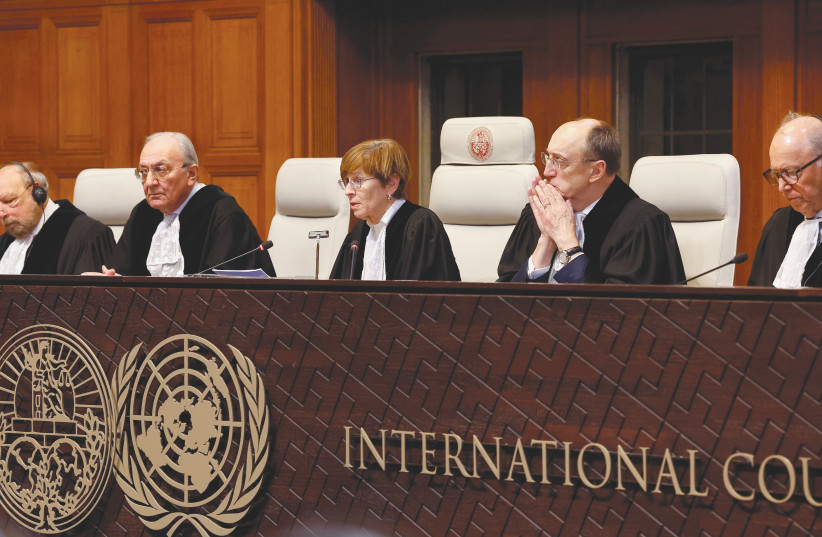
The International Court of Justice (ICJ) is scheduled to deliver an advisory opinion on Wednesday, October 22, addressing Israel’s legal obligations regarding the presence and activities of the United Nations, other international organizations, and third states in east Jerusalem, the West Bank, and the Gaza Strip, the World Court announced on Thursday.
The move comes in response to a request by the UN General Assembly. The ICJ’s advisory opinions, while non-binding, carry significant weight in shaping international legal norms and state practices.
The UNGA’s request follows a previous ICJ advisory opinion from July 2024, which declared Israel’s management of east Jerusalem, the West Bank, and the Gaza Strip unlawful and illegal under international law. It emphasized that Israel must cease its “occupation,” dismantle existing settlements, and refrain from establishing new ones. It also called for reparations for Palestinians who have lost land and property due to Israeli policies.
The ICJ found as well, in the July opinion, that Israeli laws and practices in the territories breach the prohibition on racial segregation and apartheid under the International Convention on the Elimination of All Forms of Racial Discrimination (CERD), which Israel is a signatory to.
Israel firmly rejected this opinion.
Prime Minister Benjamin Netanyahu called it “fundamentally erroneous” at the time, and asserted that the court’s opinion was not free of political motivations, and that it did not reflect the nuanced complexities of the Israeli-Palestinian conflict.
Netanyahu also emphasized that Israel’s security concerns necessitate its presence in these areas, and that any future resolution must come through direct negotiations, not external legal mandates.
Some Israeli legal scholars have further contended that the UNGA’s request for an advisory opinion bypassed the authority of the UN Security Council and was politically motivated.
The United States has previously argued that Israel is not legally obligated to permit the United Nations Relief and Works Agency (UNRWA) or other agencies to deliver humanitarian aid to Gaza, citing security concerns and allegations of Hamas ties to UNRWA staff.
US-brokered peace deal
In a significant development on Thursday morning, Israel and Hamas agreed to the “first phase” of a US-brokered peace deal, aimed at ending the two-year-long war in the Gaza Strip.
The war came in response to the Hamas-led cross-border massacre attack on October 7, 2023, two years ago, on southern Israel. Terrorists killed 1,200 people, mostly civilians, and took 251 people hostage. Israel launched a military campaign against the terrorist group in response, aiming to dismantle Hamas’s military and political infrastructure in the enclave. According to Gaza health authorities, 67,000 Palestinians have been killed, although this figure has not been independently ratified.
The agreement includes the release of all remaining 48 hostages held by Hamas, and the release of thousands of Palestinian prisoners from Israeli jails. It also includes a partial IDF withdrawal from the enclave.
The deal, announced by US President Donald Trump, has been praised internationally, including by leaders from Egypt, Turkey, Qatar, the UN, and the EU, as a step toward broader peace. The initial release of hostages is anticipated by Monday.
The upcoming advisory opinion is anticipated to provide further clarification on Israel’s legal obligations, including examining the extent to which it is required to cooperate with these entities in delivering humanitarian aid and facilitating their operations.