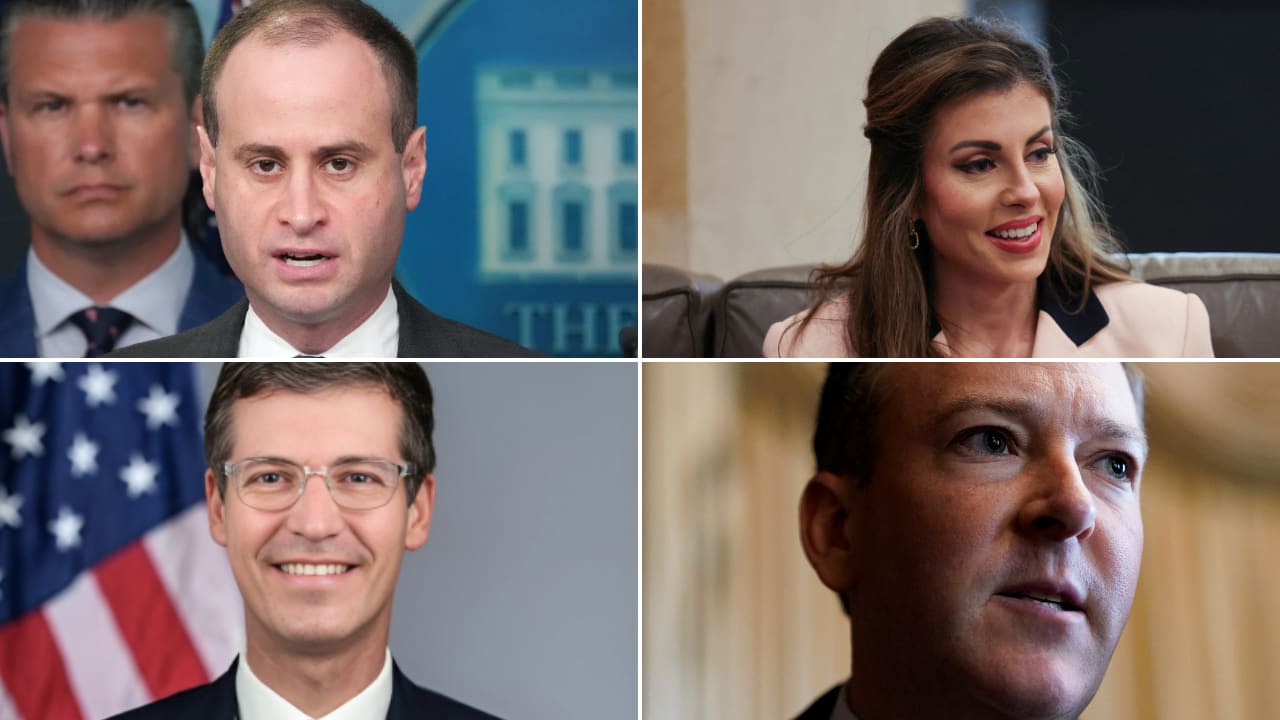
Will Scharf
In the Trump White House, where loyalty often outweighs seniority, Will Scharf has emerged as one of the president’s closest gatekeepers. At 39, the Princeton-educated lawyer has stepped into one of the least visible, yet most influential, roles in American government: White House staff secretary.
Scharf’s position may lack the public spotlight of press secretaries or policy advisers, but insiders know that every memo, briefing paper, and executive order destined for the president’s desk passes through his hands. In the architecture of power, he is the bottleneck and the filter – a role that demands judgment, discipline, and discretion.
Observers have already noted his visible presence in the Oval Office during Donald Trump’s first wave of executive orders. Standing beside the Resolute Desk, Scharf has been seen delivering thick binders for signature and quietly directing the flow of aides. The symbolism is important: Scharf is not just a paper-pusher, but a trusted hand at the President’s side, ensuring that what Trump sees is clear, curated, and politically useful.
Martin Marks
During Trump’s first term as president, unusually, no official liaison was appointed to handle relations with the Jewish community. But four years later, after Trump’s return to the White House – and managing to achieve stronger results among Jewish voters – he decided to recognize the man credited with that success: Martin Marks.
Marks took on the role at a time when the president was waging a determined fight against antisemitism bubbling on American campuses. At the same time, many Jewish communities across the country were living in fear as antisemitism continued to rise. The president’s decision to formally elevate Marks carried a clear message to those communities: “We are with you. This is not merely a Jewish internal issue – I, along with senior members of my administration, intend to fight this phenomenon with full force.”

Morgan Ortagus
When Morgan Ortagus entered the State Department briefing room in 2019, few outside Washington knew her name. Within just a few months, however, she had become one of the most recognizable faces of American diplomacy during Trump’s first term – a sharp, disciplined voice defending US foreign policy in turbulent times. From the daily podium, she sparred with journalists over some of the most sensitive global issues: Iran’s nuclear program, China’s rising power, the Abraham Accords, America’s shifting role in the Middle East – and, crucially, she emerged as a clear and unwavering advocate for Israel.
Ortagus is every bit the professional diplomat, fluent in the careful language of international relations. Yet those who watched her briefings quickly learned that she does not hide what she thinks. She combines formality with blunt honesty, a rare quality in Washington. Her style reflected the Trump administration’s broader approach to foreign affairs: unapologetic, sometimes confrontational, but always direct.
Perhaps the most striking symbol of her personal conviction is the Star of David ring she wears and never removes. It has been present throughout her career, even when she took on one of her most sensitive assignments: serving as the Trump administration’s envoy on Lebanon in meetings with Lebanese leaders.
She has been clear about the Trump administration’s position: Israel has the right to act against any threat emanating from Lebanese soil, and the five IDF outposts along the border will remain in place as long as necessary. In her words and actions, she echoed Prime Minister Benjamin Netanyahu’s doctrine: “If they give, they will receive – if they don’t, they won’t.” That, she stressed, was precisely the message she carried to Beirut.
Lee Zeldin
One of the first actions taken by Lee Zeldin, the first Jewish director of the Environmental Protection Agency (EPA), was to affix a mezuzah at the entrance of his office in the agency’s headquarters, located in the heart of Pennsylvania Avenue in Washington. “I wanted to give people a moment to step away from their routine, to reflect and think about the spiritual aspects of their day and their lives,” said Zeldin – whose two grandfathers were rabbis – when asked why he did it.
Many Jewish leaders praised Zeldin for the move, calling it “a beautiful gesture,” though some argued that the act was intended to obscure policies they claim run counter to environmental protection.
The senior Republican, a close Trump ally, is also one of Israel’s strongest partners, never hiding his pride in his Jewish identity or his commitment to the Jewish state. He has visited Israel numerous times, met with prime ministers and ministers, and consistently defended US military aid and Israel’s right to self-defense.
Today, Zeldin is seen as one of the figures who could play a significant role in the Republican Party in the coming years.
<< No. 24: Norman Brownstein, Debbie Wasserman Schultz, Josh Gottheimer