
The previously unknown author of a postcard sent to Israeli songwriter Naomi Shemer praising her song Yerushalayim Shel Zahav (Jerusalem of Gold) has been revealed to be Six-Day War veteran Aharon Bar-Oz, the National Library of Israel announced on Sunday.
Yerushalayim Shel Zahav was first performed by Israeli artist Shuli Nathan on the eve of Independence Day in 1967. Three weeks later, on June 5, the Six-Day War broke out.
The next day, while traveling to perform for troops stationed in the Sinai Desert, Shemer heard over the radio that the IDF had recaptured the Old City of Jerusalem.
Inspired, she quickly penned the iconic fourth verse of the song in her small address book:
“We have returned to the cisterns, to the market and the marketplace; a shofar calls out on the Temple Mount in the Old City.”

That same day, writing from the frontlines of the war, Bar-Oz sent Shemer a postcard praising the song. He was later wounded fighting in the Golan Heights.
Shemer, Bar-Oz exchange letters
“Well done! And well done again,” Bar-Oz had written at the outbreak of the war, on behalf of a reconnaissance unit in northern Israel. “Your song Yerushalayim Shel Zahav has become part of our life in the outposts."
"Our guys don't stop singing and appreciating it, because a song like this becomes iconic, especially these days when the nation is fighting and winning.”
“At this very moment our aircraft are bombing the Golan Heights, and your song is playing on the radio," he wrote. "Tuesday, 9:35.”
Shemer saved the postcard, and nine days later, after the war ended, wrote back to Bar-Oz.
"I'm glad that you and the entire unit can now be congratulated on your victory,” she’d written back to him. “And it's nice to hear that I could help you from afar, at least by way of the song.”
Bar-Oz, now 89, had kept the response letter framed and hung on the wall of his home.
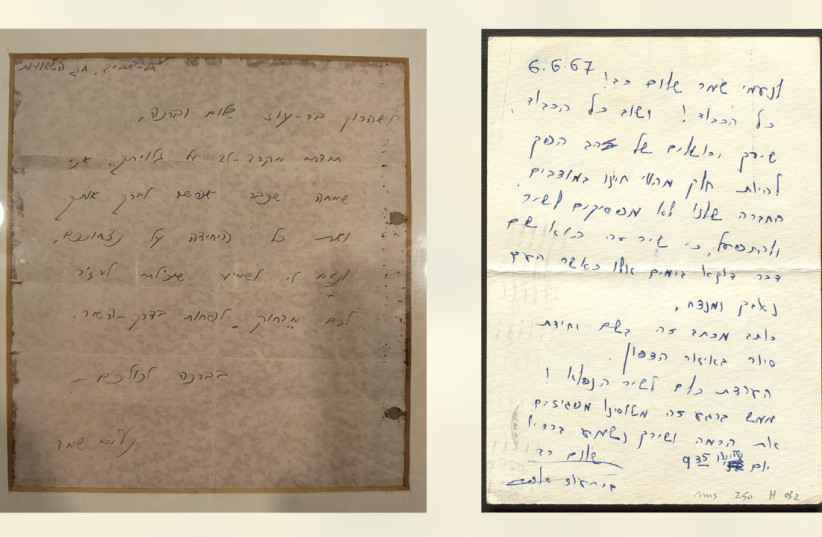
During a recent tour of the National Library’s exhibit featuring a collection of items from Shemer’s personal archives, which included Shemer’s address book, an early draft of musical notations, and the postcard, a participant approached the guide excitedly.
The participant, Bar-Oz’s daughter, had recognized her father’s handwriting in the displayed postcard, solving the mystery of the letter’s after nearly 60 years.
Bar-Oz donates Shemer's response
In mid-August, Bar-Oz donated Shemer’s framed response with the National Library to be preserved, finally reuniting the two pieces of history.
“There wasn’t even a table or chair,” Bar-Oz recalled to Ynet. “I had another soldier stand in front of me and used his back as a writing surface. That’s how I wrote the postcard and sent it to Naomi Shemer’s home in Kibbutz Kvutzat Kinneret, on the shores of the Sea of Galilee."
“What surprised me was that out of hundreds of thousands of mobilized soldiers, everyone was singing ‘Jerusalem of Gold,’ and nobody had written Naomi Shemer a letter of thanks and appreciation. I wrote it simply because it felt right, as we were singing the song all the time.”
He told Ynet about how he had framed the letter, showing it to "everyone who came to our home."
“Now the time has come for it to be at the National Library," he said to Ynet. "It must be there, especially for the grandchildren and for those who say, ‘We'd rather die than enlist.’”