
We all instantly recognize that most terrible, indelible of figures – 6,000,000.
Six million Jews were murdered during the Holocaust, with many more hounded, tortured, and persecuted but miraculously surviving to tell their tale. That’s not just a gigantic, inconceivable number; what is even harder to contemplate is the fact that these were six million-plus individual lives brutally cut short or turned into a living hell.
And there is the additional terrifying aspect of the communities and families that enjoyed a vibrant Jewish lifestyle and social milieu, a way of life that was mercilessly curtailed almost overnight.
That comes across palpably in the synagogue at Yad Vashem, which was opened in 2005 and was significantly augmented by an arresting and emotive permanent exhibition last year. The collection moniker, The Synagogue and the Jewish Yearly Cycle, gives the temporal thematic game away, with the Judaica and other religious observance-related items on display arranged to reflect the chronological order of holidays and traditional events that take place across the Hebrew calendar.
The centerpiece is a reconstructed synagogue that includes a towering, impressively ornamental Holy Ark originally used by a community in Romania. It is now flanked by attractive and evocative large stained-glass windows, with references to holidays such as Sukkot, Yom Kippur, and Rosh Hashanah, made by Dutch Jewish architect-artist Abraham von Osten.
The idea is to convey as much as possible of the spirit of those groups scattered across Europe, in Romania, Poland, Ukraine, Austria, and elsewhere, and to hopefully prompt visitors to reconstruct those busy lives and bustling dynamics in their own heads.
“The artifacts here, along with the synagogue, represent the Jewish communities that were lost,” explains Michael Tal, curator and director of the Artifacts Collection of the Yad Vashem Museum. That is very much the central subtext of the whole enterprise. “It is more about providing information about those communities rather than about the individual artifacts and what purpose they served.”
That makes perfect sense, if one considers that the sacred items were in frequent use by those communities. They provide an echoing resonance of the lives of the people, many of whom did not survive WW II, the people who used the tefillin, blew the shofar, and read from the prayer book or Torah scroll displayed in the showcase cabinets that arc around behind the last row of the reconstructed synagogue.
Time and, more pointedly, keeping time provide the core thread that strings the exhibition continuum together. The artifacts are arranged in alcoves, with the Hebrew months displayed above. Most of the niches contain a Holy Ark, or elements thereof, from various pre-WW II Jewish communities around Europe. Each station also has a touch screen, which visitors can use to access information about artifacts and their intriguing and emotive backstories, view photographs, read testimonies, and, in some cases, learn about religious observance queries raised at the time.
That helps to draw one into the spirit of that desperate passage of the Jewish timeline, and the things that concerned European Jews as their world was collapsing around them. But it also highlights the rare slivers of hope and precious vignettes when they could forget about their existential woes for a transient moment or two, and come together to take part in festive celebrations that would have been par for the course in earlier, more peaceful times.
Time is the operative topic throughout The Synagogue and the Jewish Yearly Cycle, in the sense of a “normal” seasonal schedule, and as a means of somehow generating a feeling of togetherness among the fragmented communities spread across Europe, in concentration camps and ghettos, and hiding in various locations.
“Every object here tells a tale; for example, about how people marked Yom Kippur in different places,” says Tal. “If someone could look down on Europe from above, at all the camps, he would see different people marking the holiday in some place or other. Here, in Yad Vashem, we look at each individual object, which came from all sorts of places, but there is a story here with lots of chapters. It is not a collection of objects. It is a complete story which is told through different sections.”
There is a compelling monochrome print of a photograph taken of a Yom Kippur service held in the Lodz ghetto in Poland in 1940. This was in the early days of the ghetto when prayers, Torah study, and the preparation of kosher food in kitchens were still allowed, under the supervision of the Judenrat and a rabbinical committee.
Two years later, when deportations to death camps began, all religious observance was prohibited by the Nazis. Nevertheless, minyanim were formed, and Torah study continued clandestinely. The textual addendum to the 1940 photo notes that, incredibly, 130-plus prayer services were held on Yom Kippur in 1943.
It is quite astounding to learn of the lengths the Jews went to somehow cling to the sequential flow of the important dates in the Hebrew calendar, to ensure they didn’t miss Purim or Passover and, if possible, obtain the requisite apparatus and dishes associated with the religious holiday in question. In doing so, they created a fleeting communal ambiance reminiscent of happier days gone by.
Holding onto Jewish time
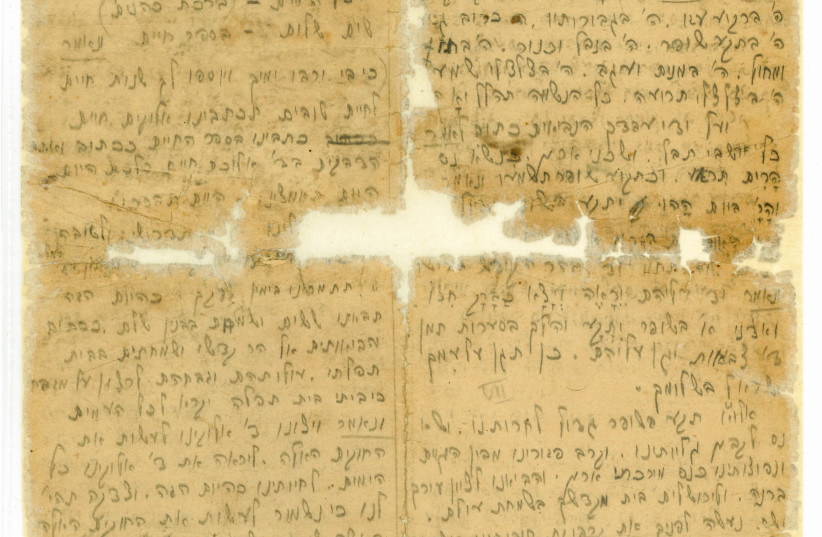
The repetitive cyclical nature of Jewish life paid dividends for those who had managed to learn prayers and biblical texts by heart in the course of their religious routine. There is a charming-looking calendar from 1942 showing the double-page spread of the time or so of Rosh Hashanah. The left-hand column has the word Wrzesien – Polish for “September” – at the top, with Tishrei in Hebrew letters, and the corresponding days of the Hebrew month down the right-hand edge of the pages. The second day of Tishrei, the second day of Rosh Hashanah, has the words “shofar” and “tashlich” in beautiful Hebrew lettering. The next day bears the Hebrew words for the Ten Days of Repentance and the Fast of Gedalia.
It is not just a functional means of keeping abreast of the religious holidays and other important slots in the Hebrew calendar. The person who crafted the calendar did so with great attention to aesthetics and design. It gives the impression of being a prized labor of love.
The accompanying text sheds fascinating light on the backdrop to the delightful exhibit. We are told that the calendar was “formulated and decorated by Shlomo Joseph Sheiner.” This was not the result of hours spent in a graphic design studio with professional appliances readily to hand. Sheiner managed to create the crucial timekeeping aid while he, his wife, Alta Chaya, and their four offspring repeatedly relocated among hideouts until they encountered a Polish farmer by the name of Matjas Franciszek, who hid them in a narrow, walled-off space he had added to his house.
The family spent two years and three months in the impossibly cramped, yet safe, quarters. During that time, the members of the family prayed with tefillin they had managed to take with them, and wrote down prayers and the entire Book of Psalms from memory, in notebooks the generous farmer had given them. Franciszek was subsequently recognized as a Righteous Among the Nations.
That storyline not only offers a glimpse of actual life in one small corner of Nazi-controlled Europe, but it also helps to put names to statistics and enables us to consider the actions of the kind-hearted Polish farmer and how the members of the Sheiner family survived the physical and emotional trials of their refuge.
For some, just having the means for maintaining a religious way of life, even if they were not put to use, helped to keep the spark of hope alive, that someday the nightmare would end. Hungarian-born Avraham Helman took his tefillin with him, in a decorated, dedicated pouch, as he and his family were shunted between death camps. Helman did not actually lay the tefillin, as he had seen Germans shoot Jews caught in the act of praying. However, he believed that his undonned tefillin safeguarded him until he was liberated.
One of the exhibits will, no doubt, be familiar to some of the visitors, that of a Hanukkah candlelighting ceremony that took place at the Westerbork transit camp in the Netherlands in December 1943. The honors were carried out by Leo Blumensohn while children and other youngsters recited the blessings and added to the rare good cheer with festive songs. They got the seasonal ritual in just in time, as the camp authorities banned candlelighting on the morrow. A few days later, many of the Hanukkah event participants were deported to Auschwitz.
Another set that catches the eye comprises a pair of delicately crafted polychromic paper-cut decorations made by Naftali Stern to adorn his sukkah in Satu Mare, Transylvania. He moved there from nearby Baia Mare when he was 17, married a local girl a year later, and had four children. In March 1944, they were all imprisoned in a ghetto there and were deported to Auschwitz two months later. Stern’s wife and children were murdered on arrival at the concentration camp, and Stern was consigned to forced labor.
In June 1944, he was transferred to the Wolfsberg concentration camp in southern Austria and, as Rosh Hashanah approached, he obtained scraps of paper from a bag of cement and wrote down the High Holy Day prayers from memory.
Several horrendous passages of time later, Stern was liberated from the Wüstegiersdorf concentration camp in Poland and rediscovered the sukkah decorations on his return to Satu Mare. He later made aliyah, settled in Bnei Barak, started a new family, and hung up the paper-cuts every year. The ornamental relics of Stern’s pre-Holocaust life became known far and wide. His sukkah visitors over the years included former president Yitzhak Ben-Zvi, then-retired prime minister Menachem Begin, and former IDF chief of staff Moshe Dayan.
There are many more stories in the exhibition waiting to be discovered and, possibly, resurrected by visitors to Yad Vashem. As the Adar alcove came into view, I spotted something that looked like a well-preserved Purim scroll.
This was yet another astounding item that boggles the mind, and leaves the 21st-century visitor to the museum grasping at straws to envisage how the artifact in question came to be in the most challenging of existential circumstances. The scroll was, it transpires, pieced together in Bergen-Belsen, the most horrific of all death camps.
“The Jews made great efforts to find scraps of paper in the camp, and several people wrote out the megillah. They read it out in the evening [of Purim],” Tal explains. Did they know the Book of Esther off by heart? “They at least knew passages of the text,” says Tal, adding an intriguing contemporary slant to the biblical work.
“All the Jews [in Bergen Belsen] knew who Haman was. They created an analogy between their situation and the original story of Purim. It could be [2nd-century BCE Seleucid king and persecutor of Jews] Antiochus, Haman, or Pharaoh.” The parallels, says Tal, were a source of inspiration for the camp inmates and helped to buoy their spirits. “They said, ‘We survived this or that dictator who persecuted us, and we’ll survive this one.’ Some of the prisoners were Zionists, and that helped them imagine making aliyah to Eretz Israel.”
There was another exhibit in the Purim niche with a compelling backstory. “This is called ‘megillat Hitler,’” Tal informs me when I spot a Purim scroll that looks remarkably well preserved. That left me with my jaw well and truly dropped. Presumably, it arrived in Jerusalem with some weighty historical and emotional baggage.
“It was written by a teacher in Morocco. He wrote a text which was based on the Book of Esther, but it relates the history of the Jews following Hitler’s rise to power through to the liberation of the Jews of North Africa in 1944. It ends with the killing of the senior German officers. That is a parallel with the sons of Haman [all 10 of whom, according to the megillah, were executed by hanging]. The teacher who wrote the scroll stresses that it is not a parody of the Holocaust. It is a story of tragedy.”
The importance of keeping to a predetermined schedule, or observing time-honored practices on set dates, of sustaining traditions, comes through powerfully in The Synagogue and the Jewish Yearly Cycle. And, as the exhibits patently impart, Jews in the bleakest of situations performed miracles in an effort to cling to some invaluable vestige of Judaism, which helped some of them to eke out at least a morsel of freedom and survive the hell of the Holocaust.
For more information: www.yadvashem.org/museum/synagogue/adherence-to-jewish-time-during-the-holocaust