
“On May 8, 1947, a unique event took place. A spokesman for the Jewish people, Dr. Abba Hillel Silver, sat in a council chamber together with the official representatives of the nations of the world, and formally voiced the demands of his people for national recognition and for the right to reestablish a national state in the ancestral home.”
In this way, Zionist historian Harold Manson described Silver’s speech before the UN. It was not David Ben-Gurion but Silver, as the spokesman for the Jewish Agency, who made this initial presentation.
The Encyclopedia of Zionism and Israel points out in the “Abba Hillel Silver” entry: “Silver exercised strong leadership in the American Zionist movement during the crucial years of World War II and its aftermath... Unlike other American Zionist leaders, he advocated the energetic pursuit of public opinion and the firm utilization of political pressure to achieve Zionist aims.”
One vehicle Silver used intensively was the American Zionist Emergency Council (AZEC ), which he headed from 1943. Shulamit Schwartz Nardi, a scholar of English literature, told me how Silver recruited her for the educational publication wing of the AZEC. She oversaw two monthly publications, Palestine and Palestine Survey, starting in 1944. (Issues of these publications can be accessed from the National Library in Jerusalem.)
Silver mobilized the forces in America in the firm pursuit of a Jewish state. He was one of the first to criticize president Franklin D. Roosevelt about his inaction regarding the rescue of Jews during the Nazi Holocaust, and about his ineffectual initiatives with Winston Churchill for the establishment of a Jewish homeland. In a 1944 speech at the Zionist Organization of America (ZOA) convention, Silver pointed to the illusions with which many Jews lived.
“There is prevalent among our people a glib notion that ours is just another minority problem, like all others, which will be solved when political progress catches up with it. This is false.”
Then Silver continued with this gripping statement: “Ours is a unique minority problem, for we are a minority everywhere, and we have no national homeland anywhere. Ours is a uniquely abnormal status, and, therefore, anti-minority prejudices have selective killing effect upon us, like some substances which leave normal tissue cells unharmed but are deadly to a specific abnormal tissue. National homelessness is the problem. National restoration is the solution.”
As he concluded his address, he stressed, “We must build upon the broad and secure base of public sentiment, the approval of public opinion, which in the final analysis determines the attitude and action of governments in democratic society.”
FROM 1945, when Silver became the president of the ZOA until the events in 1947 culminating with the vote on November 29, 1947, this American leader was committed to the creation of a Jewish state and believed that only through the efforts of the American government and political leaders would this be possible.
Prof. Frances Wolpraw of Case Western Reserve University in Cleveland, who has studied Silver’s addresses, noted: “Without Silver’s leadership, which was militant, courageous, strategic, and unwavering, the Zionist movement might have lost its historical opportunity.”
From the steps that Silver took from 1945 on, we can see how responsible he was for planning the strategy that would be followed by the Zionist movement in its relations with the government of the US and with the UN. In his addresses and his letters, he stressed that the US was the most pivotal force in pushing for the creation of the Jewish state. Silver watched the rise of the UN in 1945 and sensed that only a world body such as this could provide the forum for the discussions that might lead to the birth of the Jewish state.
When the decision was made in the early months of 1947 to bring the matter of a Jewish homeland before the UN, Silver worked closely with David Ben-Gurion and Moshe Sharett, among others, to prepare for May 8, when the Jewish Agency was scheduled to make its presentation before the world body and call for the immediate establishment of a Jewish state.
By fate of history, in his greatest moment Silver became the first speaker at the UN, then located in Lake Success, New York, to begin the process that would lead to statehood. Why? Because the plane bringing Ben-Gurion from Palestine was delayed.
You can see Silver’s fervor in a YouTube clip as he addresses the UN and systematically presents the case for a Jewish state. “The Jewish people places great hope upon the outcome of the deliberations of this great body. It has faith in its collective sense of justice and fairness, and in the high ideals which inspire it.
“We are an ancient people,” he said movingly, “and though we have often, on the long, hard road which we have traveled, been disillusioned, we have never been disheartened...
“The Jewish people,” he stressed triumphantly, “belong in this society of nations.”
THE FOLLOWING few weeks were key in this process. It still is not known exactly what president Harry Truman did, since secretary of state George Marshall was against permitting a partition plan for Palestine to pass, which would lead to an independent Jewish state.
Truman, in November 1947, seems to have favored the plan. Nardi told me that many individuals – some less known, others more known, Jewish and Christian – were mobilized to convince the various countries that were wavering about how to cast their votes.
Two individuals worked behind the scenes to encourage certain nations to vote for partition: Herbert Bayard Swope, a noted American journalist and financier, and Ralph McGill, editor of the Atlanta Constitution, who had been sent to Palestine in 1946 and wrote six major syndicated articles calling for the establishment of the Jewish state.
What did Silver do? He worked day and night in the New York and Washington offices of the various Zionist bodies in October and November. Silver’s son wrote: “My dad would not compromise. He simply demanded that they press for an independent Jewish state, which eventually they got.
“My father was a shrewd political strategist,” he noted, “very single-minded in developing political pressure in the US so Congress and the president would do what was necessary to allow a Jewish state to exist.”
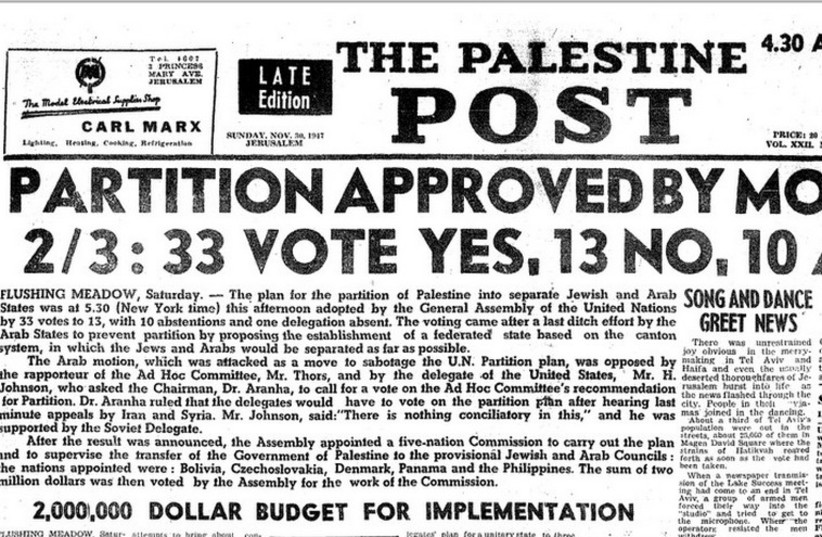
NOVEMBER 29, 1947 – kaf tet b’November – is a day that will be remembered in modern Jewish history and in the history of Israel. The vote on the Partition Plan should have been held earlier in the week, but it was clear to Silver and his forces that the two-thirds vote necessary for passage had not been reached. The actual vote was postponed to Saturday, November 29, which this year falls on the same day of the week.
Finally, the decisive tally for statehood became a reality. Throughout the world, and especially in Israel, celebrations erupted. They were followed by an attack by several Arab countries. The war for the existence of the nation had begun.
What did the world say then in 1947?
The New York Times wrote on Sunday, November 30, “It is the best decision that the great agency of world opinion was able to discover, and we trust that it will have the willing compliance of the two peoples whose future it involves.” How ironic that the newspaper was so positive then.
After all of Silver’s efforts, Prof. Jonathan Sarna of Brandeis University describes what became the reality of all his tireless work. “As an American, a Reform rabbi, and a non-socialist, Abba Hillel Silver threatened Ben-Gurion’s vision of what the Jewish State should be. So Ben-Gurion did everything possible to sideline Silver after 1948.” Ben-Gurion, it should be noted, won.
“The General Zionist party that Silver supported was completely excluded from the coalition that Ben-Gurion cobbled together in 1949,” Sarna continues. “Silver came [to Israel] to assure that the party he supported would be in the government. As a result, Silver returned to his congregation in Cleveland and his scholarly writings. He supported Zionism from afar until his death in 1963.”
We have the state, but could it have been different if Silver’s ideas had been embraced? Sarna raises this important historical conclusion. “As it turned out, some of his ideas were subsequently embraced by Likud.”