
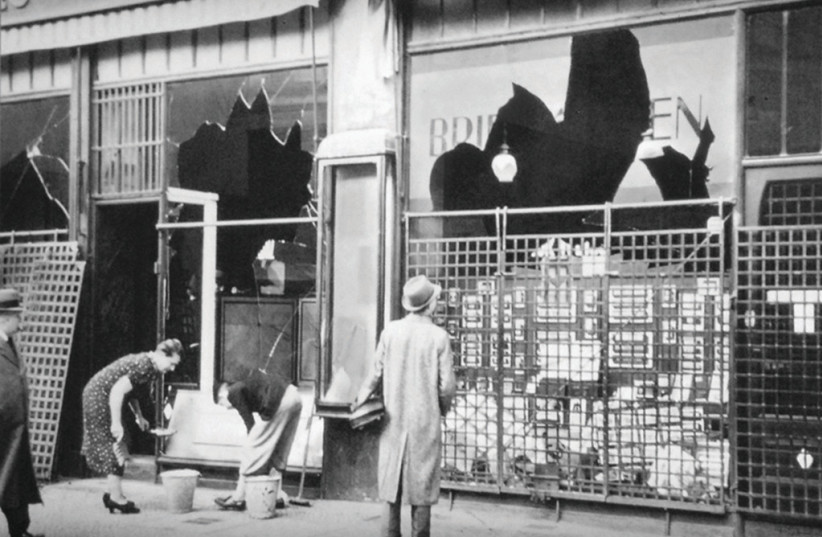
Jewish homes, synagogues, and the few remaining businesses allowed to run in Nazi Germany and Austria were ransacked on November 9, 1938, in a day now remembered as Kristallnacht.
That night marked a turning point from the discriminatory Nuremberg Laws, the Reich Citizenship Law, and the Law for the Protection of German Blood and German Honor, passed in 1935, to the active genocide of European Jewry.
Directly translated from German, the term Kristallnacht means 'crystal night' but is more commonly known as The Night of Broken Glass.
During the Nazi state-sanctioned pogrom, 91 Jews were murdered, and more than 1,400 synagogues across Germany and Austria were torched, according to Yad Vashem. Approximately 300 Jews committed suicide after the attacks, according to the Judisches Museum Berlin.
In the days that followed, 30,000 Jews were arrested without cause and transferred to concentration camps, where many would later perish.
Schutzstaffel (SS) Nazi leadership met earlier that day in Munich as part of an annual event to mark the failed Putsch in 1923, when Nazi leader Adolf Hitler failed to overthrow the Bavarian government. It was during this meeting that Hitler instructed the guards to incite a seemingly spontaneous day of National Rage in response to the death of the secretary of the German embassy to France, Ernst vom Rath.
Rath was shot on November 7 by Polish-German Jewish teenager Herschel Grynszpan in response to the deportation of his parents and growing antisemitism in Germany. Two days later, on November 9, Rath died of his injuries.
Survivors of Kristallnacht speak on growing international antisemitism
The murder of six million Jews during the Holocaust obliterated two-thirds of Europe’s Jewry. Eighty years after the end of the genocide, only a dwindling number of survivors remain alive. Some of the survivors are still able to speak about their experience under Nazi power, and the growing antisemitism experienced internationally since Hamas’s October 7 massacre has stirred old memories.
Walter Bingham, now 101 years old, told The Associated Press last week, “We live in an era equivalent to 1938, where synagogues are burned, and people in the street are attacked.”
Bingham had been a teenager living in Frankfurt at the time of the pogrom. He recounted how on the morning of November 10, he walked to his school to discover the building still smouldering.
“Antisemitism, I don’t think, will ever fully disappear because it’s the panacea for all ills of the world,” he predicted.
While Bingham said he believes antisemitism may never disappear, he told AP that the Holocaust would never be allowed to happen again. “Today, we have, thank God, the state of Israel, a very strong state," he said. "And whereas antisemitism is still on the increase, the one thing that will not happen would be a Holocaust, because the state will see to it" that it doesn't happen.
Fellow survivors George Shefi, 94, and Paul Alexander, 87, said that night also brought the Jewish suffering into European consciousness, allowing the Kindertransport program, which would later save both their lives, along with the lives of many others.
Transferred to Britain, both Shefi and Alexander survived the war, though Shefi never again saw his mother.
“It was because of Kristallnacht ... that the Jewish people in England decided that they must save Jews, families from Germany and get them out as quickly as possible," Alexander said. “I was sent out on the Kindertransport in July 1939, exactly six weeks before the war broke out. So it was because of Kristallnacht that I was lucky and fortunate to escape from Nazi Germany.”