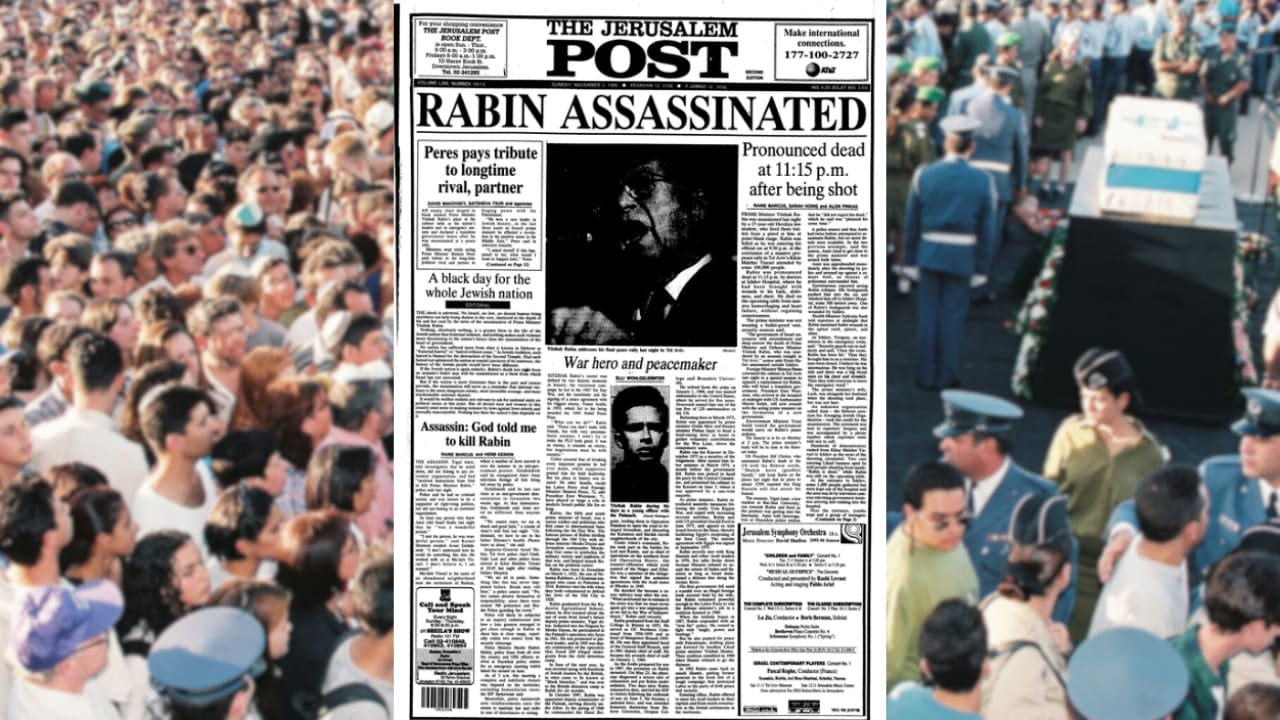
Prime Minister Yitzhak Rabin was assassinated last night by a 27-year-old Herzliya law student, who fired three bullets from a pistol at him at point-blank range.
Rabin was felled as he was entering his official car at 9:50 p.m. at the conclusion of a massive pro-peace rally in Tel Aviv's Kikar Malchei Yisrael attended by some 100,000 people.
Rabin was pronounced dead at 11:15 p.m. by doctors at Ichilov Hospital, where he had been brought with wounds to his back, abdomen, and chest. He died on the operating table from massive hemorrhaging and heart failure, without regaining consciousness.
The prime minister was not wearing a bullet-proof vest, security sources said.
"The government of Israel announces with astonishment and deep sorrow the death of Prime Minister and Defense Minister Yitzhak Rabin, who was murdered by an assassin tonight in Tel Aviv," senior aide Eitan Haber announced outside Ichilov. Foreign Minister Shimon Peres convened the cabinet in Tel Aviv last night in a special session to appoint a replacement for Rabin, who will head a transition government.

President Ezer Weizman, who arrived at the hospital at midnight with US Ambassador Martin Indyk, will now consult with the acting prime minister on the formation of a new government. Environment Minister Yossi Sarid vowed the government would carry on Rabin's peace policies. The funeral is to be on Monday at 2 p.m. The prime minister's body will lie in state at the Knesset today.
US President Bill Clinton, who announced Rabin's death to the US with the Hebrew words, "Shalom haver (goodbye friend)," told Leah Rabin on the phone last night that he plans to attend. CNN reported that King Hussein will also attend the funeral.
Assassin Yigal Amir tells police he did not regret his deed
The assassin, Yigal Amir, a law student at Bar-Ilan University, ran towards Rabin and fired as the premier was getting into his limousine.
Amir told interrogators at Hayarkon police station that he "did not regret his deed," which he said was "planned for some time." A police source said that Amir had twice before attempted to assassinate Rabin, but no more details were available.
In the two previous attempts, said the source, Amir tried to get close to the prime minister and was armed both times. Amir was apprehended immediately after the shooting by police and pressed up against a cement wall, as dozens of policemen surrounded him. Eyewitnesses reported seeing Rabin collapse. His bodyguards pushed him into the car and whisked him off to Ichilov Hospital, some 500 meters away.
One of Rabin's bodyguards was also wounded by bullets. Health Minister Ephraim Sneh told reporters at midnight that Rabin sustained bullet wounds in the spinal cord, spleen, and chest.
'Clear the room, Rabin has been hit'
At Ichilov, Yevgeny, an eyewitness in the emergency room, said: "Security guards ran in suddenly and said, 'Clear the room. Rabin has been hit.' Then they brought him in on a stretcher. His eyes were closed. I believe he was unconscious. He was lying on his side and there was a big blood stain on his chest and stomach. Then they told everyone to leave the emergency ward."
The prime minister's wife, Leah, was alongside her husband when the shooting took place, but was not hurt.
An unknown organization called Ayin — the Hebrew acronym for Avenging Jewish Organization — took the credit for the assassination. The statement was sent to reporters' beepers and was accompanied by a phone number which reporters were told not to call.
Hundreds of demonstrators rushed from Kikar Malchei Yisrael to Ichilov as the news of the shooting circulated.
Two cars carrying Likud banners sped by with people chanting from inside, "Rabin is dead," while Rabin was still on the operating table. At the entrance to Ichilov, some 1,000 people gathered but were kept out of the hospital, and the area was lit by television cameras televising government ministers arriving and rushing into the hospital.
This report is the full text of the article published on the front page of The Jerusalem Post on the morning of November 5, 1995, following the assassination of Prime Minister Yitzhak Rabin.