Oct. 23, 1958:
Boris Pasternak won the 1958 Nobel Prize in Literature for his novel Doctor Zhivago, which was published abroad in 1957 but was suppressed in the Soviet Union. He was forced to decline the award; but after president Mikhail Gorbachev finally allowed the “great novel of the Revolution” to be published in 1988, Pasternak’s son accepted the Nobel on his father’s behalf in 1989.
Oct. 24, 1973:
The CIA reported that the Soviet airlift of weapons to Egypt during the Yom Kippur War had stopped and that it was possible that the planes were being repurposed to bring troops. Responding to this threat, US president Richard Nixon put the military on alert, increasing its readiness for deployment of both conventional and nuclear forces. Fortunately, the Soviets backed down and decided not to send troops.
Heshvan 3, 5626 (1865):
Yahrzeit of Rabbi Yosef Salant, a founder of the Mussar movement, which stressed piety and ethics in addition to scholarship, gaining many adherents among Lithuanian Jews. After immigrating to Jerusalem, he was instrumental in the founding of the Etz Chaim Yeshiva, the Bikur Cholim Hospital, a burial society, and the Rabbi Meir Baal Haness charity, which supported the indigent of the community.
Oct. 26, 1898:
Theodor Herzl arrived in Jaffa on his only visit to the Holy Land.
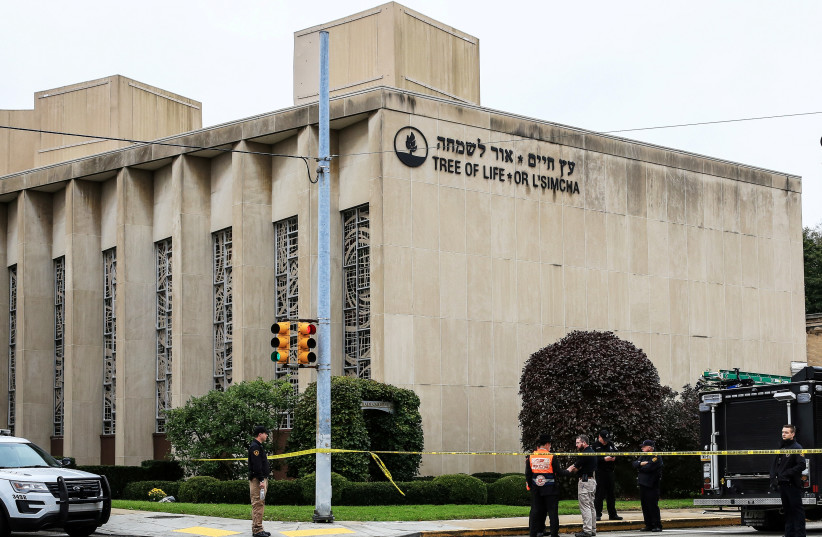
Oct. 27, 2018:
On Shabbat morning at the Tree of Life synagogue in Pittsburgh, Pennsylvania, a white supremacist killed 11 worshipers ranging in age from 54 to 97 and wounded six others in the deadliest anti-Jewish attack in American history.
Oct. 28, 1965:
Passed by a vote of 2,221 to 88 by the assembled bishops at the Second Vatican Council, the Nostra Aetate (“in our time”) declaration stated that the Jews should not be presented as “rejected or accursed by God” and the “Church... decries hatred, persecutions, displays of antisemitism, directed against Jews.”
Oct. 29, 1956:
Israel’s eight-day Sinai campaign (Operation Kadesh) began to reduce attacks from Gaza by the Egyptian-backed Fedayeen (“those who sacrifice”) units. The campaign was coordinated with France and the UK, whose forces were supposed to concurrently occupy the Suez Canal Zone, which had been nationalized by Egypt under president Gamal Abdel Nasser. Massive American and Soviet pressure forced the British and French armies to withdraw from the Sinai back to the original ceasefire line. More than 170 Israeli soldiers died, and 800 were wounded.
Oct. 30, 1991:
The Madrid Conference, co-chaired by US president George Bush and Soviet president Mikhail Gorbachev, opened with the goal of reviving the Israeli-Palestinian peace process. All the parties to the Arab-Israeli conflict gathered to hold direct negotiations – a historically unprecedented event – but as reported, the “symbolic significance of the Madrid Conference far outweighed its accomplishments, which were thin indeed.”
Oct. 31, 1835:
Birthday of Adolf Von Baeyer, German organic chemist whose many discoveries included a derivative for barbiturate sleeping pills and synthetic indigo dye. He went on to correctly theorize the structures of carbon rings and benzene. In 1905, he won the Nobel Prize in Chemistry – the first Jew to do so.
Nov. 1, 2010:
Gett was founded by Israeli entrepreneurs Shahar Waiser and Roi More. The Israeli-developed application connects customers and taxi drivers using its proprietary GPS, enabling users to order a cab with their smartphone or through the company’s website.
Heshvan 11, 2208 (1553 BCE):
Yahrzeit of Rachel, one of the Four Matriarchs. Jacob’s second and favorite wife, she is the only biblical woman whose date of death is commemorated for posterity. She died while giving birth to her second son, Benjamin. Jacob buried her by the roadside in Bethlehem; there, “Rachel weeps over her children, for they are gone [in exile]” (Jeremiah 31:14). Her tomb has served as a place of prayer for Jews for more than 35 centuries.
Nov. 3, 1962:
Birthday of Phillip Katz, American computer programmer who was the co-creator of the ZIP file format for data compression.
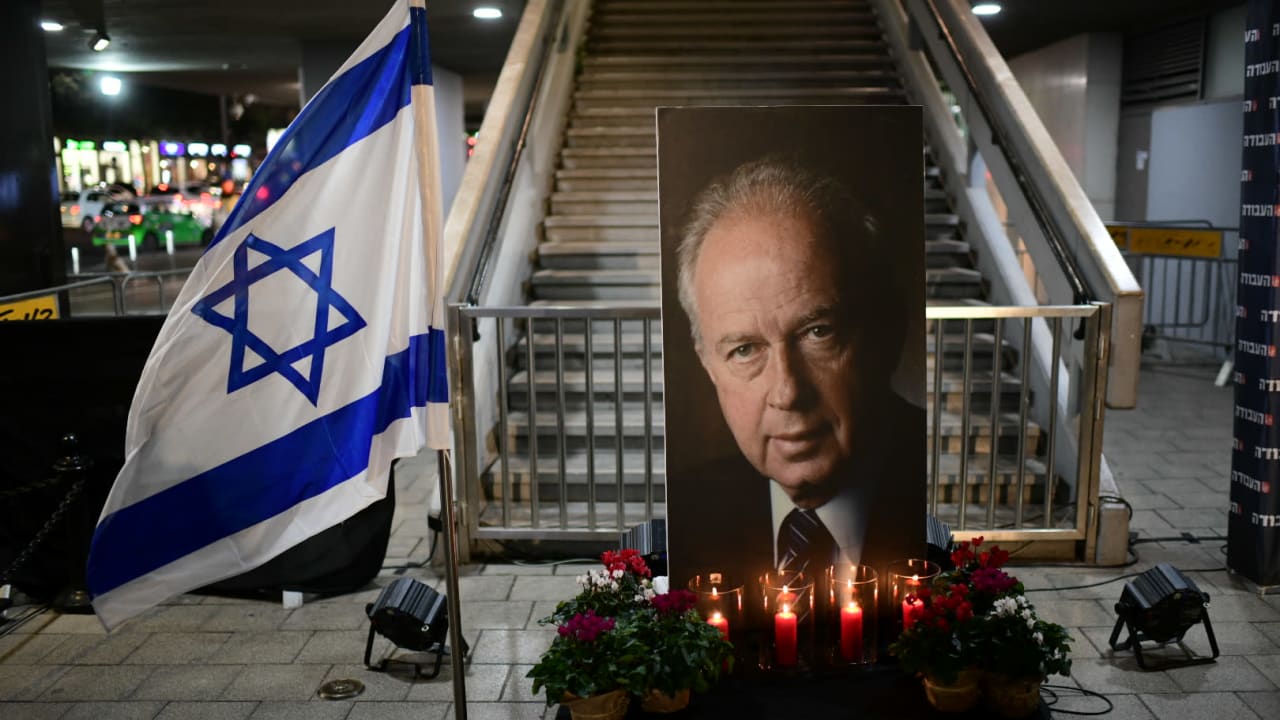
Nov. 4, 1995:
Prime minister Yitzhak Rabin was assassinated by Yigal Amir, a right-wing Israeli. Rabin was the commander of the brigade that broke the Arab blockade of Jerusalem during the War of Independence and was the chief of staff during the 1967 Six Day War. Politically, he served as ambassador to the US (1968-73) and defense minister (1984-1990), and was the first native-born prime minister (1974-1977 and 1992-1995). He was awarded the Nobel Peace Prize in 1994 for signing a peace agreement with the Palestinians.
Nov. 5, 1853:
Birthday of Marcus Samuel, British industrialist, founder of Shell Oil Co., and lord mayor of London.
Heshvan 15, 3622 (139 BCE):
Yahrzeit of Mattathias ben Johanan, leader of the uprising against the Syrian-Greeks. His five sons – the Maccabees: Judah, Eleazar, Simon, John, and Jonathan – carried on the battle after his death. Their eventual victory is celebrated every year by Jews the world over on Hanukkah.
Nov. 7, 1944:
Hannah Szenes, a Hungarian-Jewish poetess who was captured after volunteering to parachute behind enemy lines on a mission to rescue European Jews, was executed by the Nazis in Budapest. The following is her poem “A Walk to Caesarea”:
My God, My God, I pray that these things never end,
The sand and the sea,
The rustle of the waters,
Lightning of the Heavens,
The prayer of Man.
Heshvan 17:
A three-day fast was to be declared in the Land of Israel if no rain fell by this date.
Nov. 9, 1929:
Birthday of Imre Kertész, Hungarian author and recipient of the 2002 Nobel Prize in Literature “for writing that upholds the fragile experience of the individual against the barbaric arbitrariness of history.” The first Hungarian to win the Nobel Prize in Literature, his works deal with themes of the Holocaust (he was a survivor of a German concentration camp), dictatorship, and personal freedom.
Nov. 10, 1975:
The UN General Assembly adopted the notorious Resolution 3379, which defines Zionism as “a form of racism and racial discrimination,” by a vote of 72 to 35 (with 32 abstentions).
Heshvan 20, 5781 (2020):
Yahrzeit of Rabbi Lord Jonathan Sacks, chief rabbi of the United Hebrew Congregations of the Commonwealth from 1991-2013; international religious leader; philosopher; theologian; university professor; life peer in the House of Lords; award-winning author (more than 40 books); and respected moral voice. In addition to 21 honorary doctorates, Rabbi Sacks was awarded the 2016 Templeton Prize in recognition of his “exceptional contributions to affirming life’s spiritual dimension.” He leaves behind a legacy as one of the greatest Jewish thinkers of the 20th century, who bridged the religious and secular worlds.
Nov. 12, 1841:
The Jewish Chronicle, the oldest Anglo-Jewish newspaper, was published for the first time in London.
Nov. 13, 1866:
Birthday of Abraham Flexner, whose “Flexner Report” in 1910 indicted medical education as poorly supervised, poorly taught, and having no standard curriculum. As a result of his work, medical education throughout the US was completely revised, leading to the modern medical school as we know it.
Nov. 14, 1900:
Birthday of Aaron Copland, one of the most celebrated composers in American history, recognized with such high honors as the Pulitzer Prize in 1944 for Appalachian Spring; the Presidential Medal of Freedom; and the Kennedy Center Award.
Nov. 15, 1996:
Initial release of ICQ, an instant messaging software developed by the Israeli company Mirablis and later purchased by AOL. At its peak around 2001, ICQ had more than 100 million accounts registered.
Nov. 16, 2015:
The Israeli cabinet unanimously voted in favor of allowing the last group of Falash Mura (10,300 people) to emigrate from Ethiopia to Israel over a five-year period. This was in addition to the more than 90,000 Ethiopian Jews who had arrived in Israel from 1980-2013.
Nov. 17, 1944:
Birthday of Lorne Michaels, Canadian-American comedian, television producer, and screenwriter best known for creating and producing Saturday Night Live and producing the Late Night series. He has received 19 Primetime Emmy Awards from 91 nominations, holding the record for being the most nominated individual ever.
Nov. 18, 1906:
Birthday of George Wald, American scientist who was awarded the 1967 Nobel Prize in Physiology or Medicine for his work with pigments in the retina.
Heshvan 28, 5023 (1263):
Yahrzeit of Rabbeinu Yonah of Gerona, a Talmudic scholar and moralist from Catalonia, Spain. He is most famous for his ethical works The Gates of Repentance; The Book of Piety; and The Epistle on Repentance, which have inspired Jews in their practice of social justice throughout the ages.
Nov. 20, 1977:
President Anwar Sadat of Egypt, on his historic and unprecedented visit to Jerusalem, addressed the Knesset with these words: “Today I tell you, and I declare it to the whole world, that we accept to live with you in permanent peace based on justice.”
The above is a highly abridged monthly version of Dust & Stars – Today in Jewish History. To receive the complete newsletter highlighting all the seminal events and remarkable Jews who have changed the world: dustandstars.substack.com/subscribe. Special arrangements available for organizations.