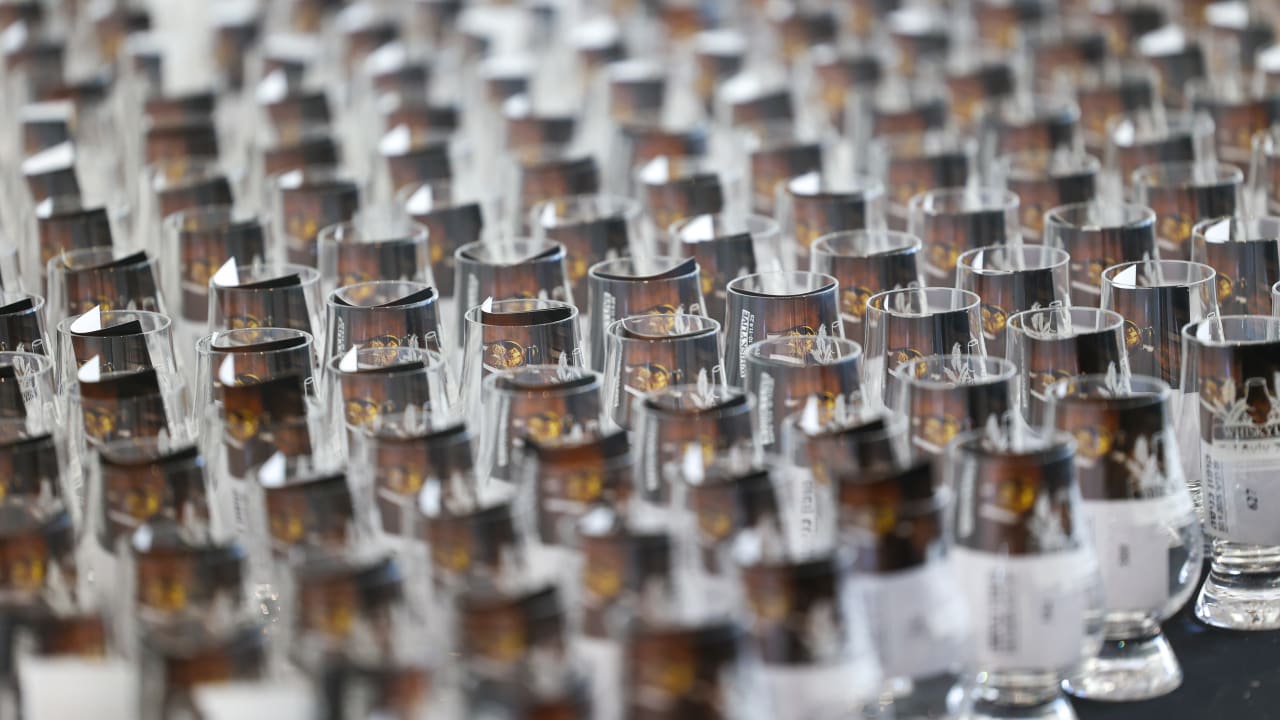
The Whisky Live 2025 exposition in Tel Aviv last month showcased the very best of Israeli spirit, distilling the ambition and innovation of the country into an Expo Tel Aviv pavilion.
The lively event celebrated whiskies from around the world with workshops and taste testing, set in a hall that also allowed participants to lounge and savor their glass or dine on barbecued meats. The pavilion had the atmosphere of one giant cocktail party.
Vendors had their wares available for tasting and purchase; mostly whiskies, with all the standards like Glenlivet, Glenfiddich, Singleton, and Milk and Honey (M&H).
M&H has become a mainstay of the Israeli whisky scene since establishing itself in 2013, now offering a series of different whisky and gin varieties.
The titans shared the stage with new and smaller distilleries that made their own unique contributions to the Israeli whisky market.
Stories behind the spirits
Not everyone is an expert or a fanatic who can detect the different tones that various wooden casks impart, but everyone can understand a story. Bottles of whisky often tell the story of their makers and making, providing context to the subtleties of flavor on the tongue and warm cheer in one’s chest.
The stories shared by new distillers at Whisky Live engaged with tales of overcoming tragedy, pursuing passions, and seizing the reins of opportunity.
Perhaps this was no better exemplified than by Single Beeri, a single malt whisky created by Kibbutz Be’eri, which was ravaged during the Oct. 7 massacre. After M&H welcomed kibbutz members to its Tel Aviv distillery in the wake of the disaster, the idea was born for Be’eri to grow its own barley and make its own whisky. With no malting plant in the country, the first 139 tons of barley grown by Be’eri were shipped to Germany and Austria for malting.
The malt was transported back to M&H’s distillery for aging in ex-bourbon, Pedro Ximénez (PX) sherry, and shaved, toasted, and re-charred (STR) barrels. An early edition was made available with whisky not grown in Be’eri during the maturation process. The result is a single malt with a light body that goes down smooth but leaves a strong burning finish. The alcohol by volume of Single Beeri is 47.1%. Only 710 bottles will be sold from each batch – set as such so that each drink is a toast to the memory of those lost on Oct. 7, 2023.
At the exposition, Legend Distillery was the first booth at the entrance of the pavilion, setting standards high for what to expect from Israeli vendors. Legend offers the first Israeli bourbon. It represents the fruits of five years of study in the US by co-founders Noam Cohen and Alan Cohl.
Bringing American-style whiskey to Israel was a passion for the distillers, and it shows in the final product. The flagship Legend product is Slingshot, named for the battle between David and Goliath, whose battlefield lies near the Ella Valley distillery site. Future products will also have names related to Jewish heroes, Cohl teased.
Slingshot has a few varieties. The double oak barrel variety, with a 62.6% ABV, could knock you down like a double-barreled shotgun. Yet for its strength, the dark amber liquid doesn’t burn at all; it just glides down your throat, leaving a smooth American oak on your tongue and the warmth of a hearth in your belly.
Drunken Owl distillery is another story of passion in the Ella Valley, starting as a hobby for co-founders Nir Dotan and Ofer Ronen. Dotan and Ronen created the first rye whisky in Israel, a dark, small-batch 64% ABV beverage with a rich and robust body. Drunken Owl also distills a sweet rum using Peruvian sugar.
But the surprise star of its booth might have been an arak that isn’t yet featured on its website. Using anise brought from Syria through a Druze village, the Zahle-style arak is the best arak I’ve ever had. While the smell and flavor of arak are obnoxiously overpowering, the delicious Drunken Owl variant manages to be bold and smooth in a manner I didn’t think possible for the popular Middle Eastern spirit.
Another whisky first in Israel is Yerushalmi’s smoked whisky. The Burnt Offering whisky, which was being served straight from the barrel at the expo, smells like a wildfire but is less aggressive on the tongue than in the nostrils. It is sweet with a spiced, pungent clove taste. Aged in beer and oak casks, the single malt is distilled from Israeli grains in Katzrin with its twin Golani distillery. Golani makes its own peated whiskies, as well as arak and gin. Yerushalmi offers its own variants of gin and rum.
Ruach Distillery in Pardes Hanna brought its own innovations to the Israeli scene with a whisky produced through slow water reduction, a process influenced by the maturation of cognac. The product is a “very Israeli product” that seeks to be “strong, unapologetic, and mindful,” according to one representative. The golden Ascent whisky is sweet, fruity, and warming.
While whisky was the main focus of the exposition, Israeli distillers showed that their entrepreneurial energy had no bounds, offering new beers, agave spirits, and mead.
Negave Estates has brought the blue weber to Israel, planting 200 dunams (20 hectares) – with the goal of 600 dunams – of the hardy desert plant in the Negev. Decorative varieties already exist in Israel, adorning gardens throughout Jerusalem, noted a representative of the distiller. Former prime minister David Ben-Gurion saw an agave variant being planted in the Negev to make rope, but the introduction of synthetic rope materials made the idea redundant.
“There’s no reason agave shouldn’t do well in Israel,” said the Negave representative.
Coming in bottles shaped like agave hearts, Negave has already produced several varieties of agave spirit. Each one can be enjoyed neat and will be available in the US this fall.
The aptly named Mead in Israel presented for the first time at the exhibition. The Rishon Lezion-based distillers brought with them samples of their delicious mead: A bourbon barrel-aged metheglin with the spicy taste of cumin and turmeric was gentle but packed a wallop; the classic mead was half-dry with a complex sweet golden honey flavor; and a lovely melomel that was dangerous – one couldn’t sense the alcohol beneath the beautiful fruit tones.
Like with Single Beeri, other Israelis sought to work through the destruction of the Oct. 7 massacre by building.
Golani Sgt. Tomer Nagar fell in battle at the Kissufim base during the massacre, holding his ground and fighting off squads of terrorists to give his friends the precious time to respond. The light machine gunner expended hundreds of rounds before he was killed in action.
The story of Nagar was sobering. A young community-oriented man with hobbies, he had so many dreams cut short. One of those dreams, exemplified by a three-week trip in Europe, was to create his own beer. In his honor, his family commissioned a beer through the Yeroham Glentz brewery. Everyone working the booth to share Nagar’s dream was a volunteer, a family member who wanted his memory to live on. Three Tomer beers were available at the expo, which included a light and sweet wheat beer and a poignant, rich, chocolaty dark beer.
I left the expo with barely legible notes and on unstable legs, but I was sobered by the extraordinary stories of the Israelis behind the bottles, who sought their dreams in a manner that demonstrated what the country had to offer. ■