The Beer Market (“Shuk HaBira”) held last month in the Jaffa Port brought together 15 micro- and home-brewers to introduce their beers to the wider public. The event was held over a two-day period in the Beit Hamecholot (Container House), and attracted thousands of Israeli beer lovers.
“We deliberately aimed our publicity for the Beer Market at regular beer drinkers, not the ‘beer geek’ types,” said Yarden Peled, who was in charge of marketing and digital media.
“Our aim was to strengthen the Israeli craft-beer scene. We did street research with self-defined beer drinkers. We gave them beers to taste and asked them which countries they thought they were from. We got answers like America, Belgium, Holland, etc. They were surprised to learn that all the beers were from Israel – that Israeli craft breweries are capable of such quality.”
Peled believes that the Israeli craft-beer market is currently “undergoing a very similar transformation to what the wine industry experienced 15 years ago. Just as Israeli wine broke through and reached international standards, our local craft beer scene is now flourishing, offering high quality, diverse products that rival global standards.”
In the days following the Beer Market, Peled was able to find out if her publicity campaign was a success. With the assistance of Amit Hajbi, head of the production company she worked with, Peled analyzed the data for attendees. The results made her very happy!
“Our analysis showed that most participants who commented, shared, or engaged with the event were indeed from the broader public – and not only beer geeks,” she said, smiling.
By comparing the data with attendees of other beer events organized by Hajbi, Peled discovered that her publicity reached 93% of new audiences who previously had not been involved in beer events.
“I was personally happy to see significantly more unfamiliar faces than familiar ones,” she concluded.
I also did some “informal research” by speaking with some of the exhibitors. Most of these were well-known craft breweries: Emek Ha’ela, HaGibor, Meltzer, Oak & Ash, Ronen, Schmulz, Schnitt, Shapiro, Tomer, and White Rabbit. Yet, I was more interested in getting to know the smaller brewers and telling their stories.
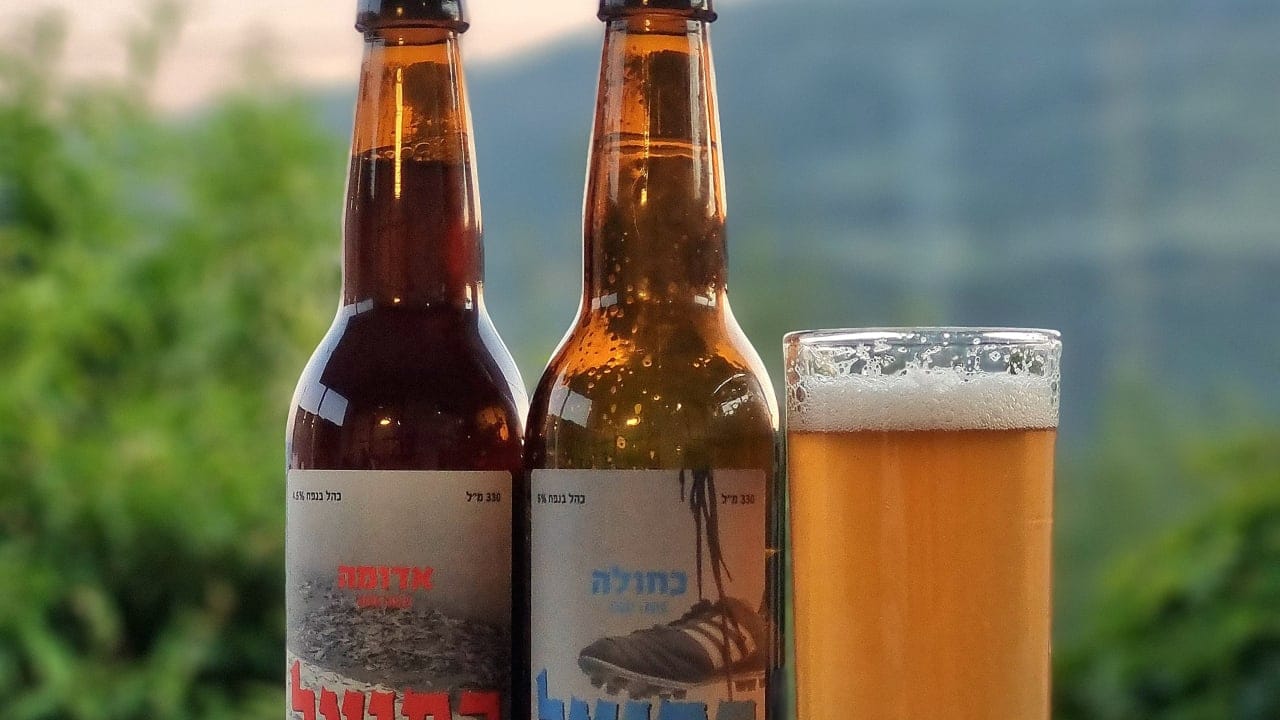
For example, Ben Rabayov of Tel Aviv brews his beers under the name of HaPoel (The Worker). He uses the facilities of the Oak & Ash Brewery in Beit Shemesh.
“I got the impression,” he told me, “that only about 25% of the visitors to the Beer Market really understood beer. Most of the others didn’t understand beer at all – and to me that was a very positive element of the event.”
Like almost everyone else in the business, he started brewing at home for himself, family, and friends, and was surprised that his beer was so popular. “I brewed 200 liters and sold them all to friends and shops in 24 hours,” he enthused. “Then I brewed 400 liters and sold it all in four days! That’s when I realized we had a good beer.”
After the Covid crisis, Rabayov started brewing commercially again. “I understood the market better, and improved my branding,” he explained. He brews two kinds of beers, both lagers, a Dark and a Light. They are for sale in markets and bars in the Tel Aviv area, and he also participates in beer festivals.
Unlike other small brewers, Rabayov doesn’t have a day job. He devotes all of his time to his brewing and beer. “When you do something you love, you have to do it 100%,” he concluded.
Yoni Goren
Yoni Goren home-brews in Ramat Gan, but collaborates with craft breweries to produce commercial quantities of his beer. At the Beer Market, he was pouring a Pale Ale made with mango, and an American Lager that contained guava and kaffir lime leaves. I asked him about the visitors to his booth.
“If I have to give a percentage,” he answered, “I would say that only about 30% were beer geeks, and the rest were the average public. It’s easier to deal with the regular beer lover since they just come to drink and enjoy the beer. The geeks ask a lot of questions.”
Goren began experimenting with brewing and fermenting cider at age 16, “because I was too young to buy alcohol.” After several more years of home-brewing and working for other breweries, he opened his own Goren’s Brewery. He also qualified as one of more than 6,300 beer and cider judges with the worldwide Beer Judge Certification Program.
In addition to his own beers, Goren has also collaborated on eight commercial beers with Israeli craft breweries, such as Oak & Ash, Chalutz Chadash (New Pioneer), and the now defunct Hatch. “Most of our joint beers were pastry sours,” he said. “I also collaborated on a Hazy IPA with a brewery in Finland, but that never made it to Israel.”
Recently, Goren has begun to produce and market candy that is flavored with hops, the plant that gives beer its bitterness and some of its flavor. “We are doing this together with the Tomo Candy Company in Ra’anana,” he explained. “The challenge was to extract the flavor from the hops, without the bitterness. We named the candies LollyHop, and we are currently producing them in three hop favors: Comet, Saaz and Mosaic.”
I’ve tried some and can attest that they are very good. My grandchildren were hesitant at first, thinking they were alcoholic, but I explained that hops have nothing to do with alcohol, and now they can’t get enough of them.
Goren has plans to bring beer flavors to other products as well; he mentions cheese and marshmallows! “But I am also continuing to brew the most interesting and different beers I can,” he concluded.

Noam Erlich - Beerlich
Noam Erlich was brewing beer in his home on Kibbutz Menara in the Upper Galilee until Hezbollah rockets forced him and thousands of others to evacuate. Since the start of the war, he has moved to 10 different places, and his home in Menara suffered a direct hit. “Yet in every place I’ve lived in, I continued to brew beer,” he said.
From his current location on Kibbutz Misgav Am, he is brewing in commercial quantities, using the facilities of Oak & Ash (Beit Shemesh) and HaGibor (Carmiel).
He brews six kinds of beer under his own “Beerlich” label, and home delivers them to his customers. At the Beer Market, he was selling a Wheat Beer with honey, a Wheat Beer with chili, and a traditional IPA. He also brews a classical Bavarian Wheat Ale, a Blonde Ale and a Lager.
Concerning visitors to the Beer Market event, Erlich says that on the first day (Thursday), around 80% could be defined as real beer geeks, but on the second day the crowd was more mixed, with half being your average beer drinkers.

Asaf Levi - Heisenberg
Asaf Levi, on the other hand, who was pouring his “Heisenberg” brand beers, thought that no more than 10% of the attendees could qualify as geeks.
Levi, who lives in Or Yehuda, began home-brewing around 10 years ago after visiting the Corona Brewery in Mexico. That was also where he got the name for his brewery. He explained: “In Mexico, I wore a shirt with the face of the Heisenberg character from the popular TV series, Breaking Bad. Everybody started calling me ‘Heisenberg,’ so I kept the name when I started brewing.”
In recent years, Levi took on the challenging task of brewing Sour (or “Wild”) Ales, Lambics and American Wild Ales. He painstakingly collected the proper bacteria from empty bottles of Belgian lambic beers, and used it to sour beer in his own oak barrel.
He has recently brewed a barrel-aged Doppelbock, Kriek Lambic aged with cherries, Wee Heavy (a strong Scotch Ale rarely brewed in Israel), and a New England IPA, which he served at the Beer Market.
Levi has no plans to go commercial with his beers. “It just gives me great pleasure to participate in these festivals so I can share my beers with the public and get to talk about them.”
Papa Beer
Another new name at the Beer Market was Papa Beer: a new name, but not a new beer.

Two years ago, Yehi BenShoshan had “exited” from his hi-tech company and was looking for something to do. A lawyer friend introduced him to Amir Lev, who had founded the Mosco Brewery in Beit Shemesh in 2012. Although he was more of a whisky fan than a beer lover, BenShoshan decided to become involved with Mosco.
“Today, I own a majority of the company,” he explained, “and we have moved the brewery to Even Sapir. We also built a distillery in the same facility, and will produce alcoholic drinks under the brand name of Ercogen.”
Amir Lev has recently announced that he will be leaving the day-to-day activities at the brewery. He thanked all of his customers and friends “for allowing me the privilege of doing what I love. Thank you all for drinking, for visiting, for responding. Nothing should be taken for granted.”
One of the things BenShoshan set about doing was to rebrand the beer. “I didn’t think the name ‘Mosco’ had a positive meaning to Israelis,” he continued. “Amir mentioned Rav Papa, a rabbi from the Talmud who was a professional brewer. He was also known for his wise counsel and perceptive decisions. So we decided on the new name of Papa Beer.”
The new labels show caricature faces of old guys – not Rav Papa. The beers are the same as Mosco’s – Stout, Wheat, Red Ale, Pale Ale, Pilsner, Smoked, Juicy New England IPA – and just recently, a new Summer Ale has been added to the line.
“We are making plans right now to increase our marketing operations,” he concluded,” and we are negotiating with several companies to do our distribution. You should see the results of all this activity very soon.”
The writer is the owner of MediawiSe, an agency for advertising and direct marketing in Jerusalem. He writes a weblog on Israeli craft beers, called “Israel Brews and Views,” which can be found on Facebook.