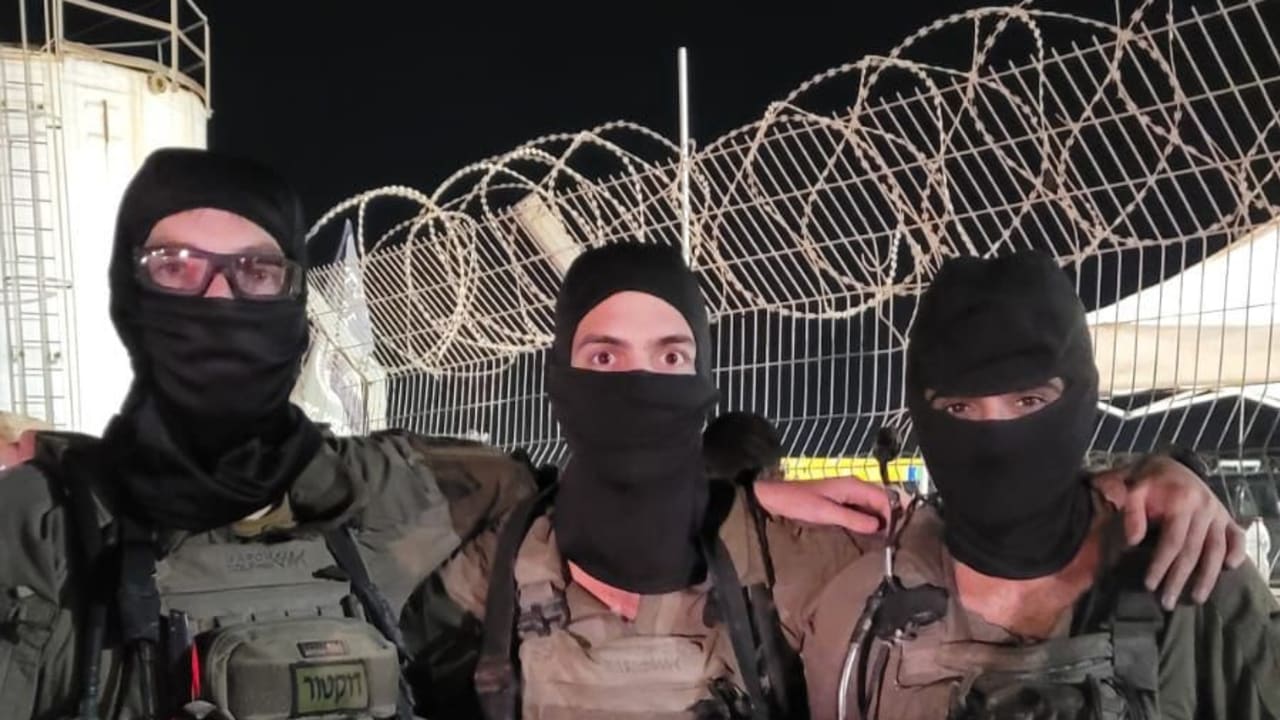
“Being a medical officer in a combat unit, especially Golani’s 51st Battalion, has been a dream,” said Capt. Dr “N.,” 31, in a conversation with The Jerusalem Post.
N.’s journey to being a medical officer in the IDF began in a small city in the countryside of São Paulo, where he grew up. Instilled with strong Zionist values as a child, N. knew he wanted to move to Israel and experience life there himself. He first moved to the Jewish state in 2009 to go to high school at a youth village. Here, he said his Zionism just grew “bigger and bigger,” and he fell in love with the country.
However, N. had another dream – to become a doctor – so he returned to Brazil and started medical school. After his fourth year, he was able to transfer to an Israeli medical school. While there, he began pestering the army to allow him to serve in an infantry battalion.
Because of his age (25 at the time), he wasn’t conscripted, but he told them he was a doctor and wanted to make use of his skills and abilities, and he was ultimately successful.
N.’s first position was as a primary doctor at a training camp. From there, he went through a five-month medical officer course where he learned how to become a technical doctor and how to become an IDF officer. This included learning how to treat wounds in the field and manage the medical needs of a battalion. N. then requested to become the medical officer of the 51st Battalion and was accepted. He has been in the position for over a year.

His role is very complex.
“We are infantry, we are always on missions – tactical campaigns – and we are in the fight zone, really on the front line,” N. told the Post. “You have to understand the tactical aspect of the job to understand how to treat injured soldiers in that environment. And then there is the medicine, ‘normal medicine,’ let’s call it that. The soldiers still have health problems. They still need someone to examine them, to give them medicine, or to send them to physiotherapists – and care for them.
“So it’s a role that has three aspects: You have the combat medicine, which is a science by itself – to also treat the injured in a tactical environment; you have the medicine, taking care of the soldiers’ health [on base]; and you have the command role, which means you are a staff officer. So you also have your own platoon, your medical platoon. You have medics and paramedics under your command. You have to care for them. You have to teach them. You have to command them.”
N joined the IDF following the October 7 massacre
N.’s entire service as a medical officer has been during wartime. On October 7, he was interning at a hospital in northern Israel where he treated wounded soldiers, and after that, he joined the army.
“Right now is the first time I’m feeling what it is like to be a doctor at a calmer time,” he said. “Now we have more time to take care of the soldiers themselves, to take care of their health.”
Serving as a doctor in the army has naturally influenced the type of doctor he wants to become after he leaves.
“At the hospital, I have been to many surgeries and many trauma cases. There was a lot of pressure, and still I kept calm. But when you are in a very complex situation and under fire, and you still have to be calm and make the right decisions, that’s another level. So I feel much more secure to go back to the hospital and still treat patients and keep calm.”
He also speaks resolutely of the IDF as “the most ethical army in the world.”
“As a doctor, I can say that we have a whole protocol for treating the Palestinian population. We have to treat someone who is actually supposed to be our enemy. We can treat them, and we can give them [medical] care because that’s the ethical thing to do.”
N. spoke very fondly not just of his own soldiers, but also of combat soldiers in general, calling them “the most precious population at this age in the country.”
“I’ve met soldiers from all kinds of populations. Those soldiers are the most precious children of this country.”
He sometimes jokes that he’s a pediatrician, given the over 10-year age gap between him and most of his soldiers. Yet they are a close-knit group. They often host Shabbat together as a battalion. “It’s very emotional for me to be in the Shabbat meal with the battalion – every time,” he said. “It’s like having a family of a couple of hundred soldiers.”
N. puts on tefillin and prays every day.
“I don’t feel like there is a lack of Judaism in my life, because I really feel like a Jew here. It’s in all the stuff I do every day. Being in the army, being an Israeli citizen, being a Jew in a Jewish society.”
While he said he hadn’t encountered much antisemitism when he was younger, it was nevertheless “very hard to be the only Jewish family in the city.”
“When you come to Israel, you are not just part of the Jewish community,” he said, “You are part of the Jewish country. You have a whole country. You become like a normal Jewish citizen in a Jewish country. It’s very different.”
What kind of advice would he give to someone considering a similar path?
“I tell this to every medical student I meet: Since I decided to study medicine and become a doctor – and of course become an army doctor – every day since then has been better than the day before. It’s really amazing the evolution you undergo during this journey. It’s like an ultra-marathon. And every day since then, I’ve been happier the following day than the previous one, because every day you learn something new. Every day you become another person. Every day you grow up, and the challenges are big, but when you get there, it’s really worth it.”
Coming to Israel as a new immigrant can be challenging, and some new immigrants struggle to feel “Israeli.” But for N., he accepts both parts of his identity.
“If you take all the years I’ve been in Israel, it’s almost 13 years. When I go to Brazil, I feel very Israeli. When I’m here, most of the time I feel Israeli. But sometimes I feel Brazilian. I would say there are those two parts. They will always be present. There was a time when I used to fight my Brazilian part; I wanted to be more Israeli. Today, I just accept it. There are things that I see differently from [many] Israelis. And I think it’s good. It’s a positive thing.”
For N., the most precious moments are not in combat.
“It’s when I sit with a soldier who has some kind of chest pain, or he’s nervous, or something like that, and you know it’s like psychological, he just needs someone to talk to.
“To be a doctor, to be in those places and still do good medicine, to give them a smile and a shoulder they can lean on, it’s amazing. It’s amazing to be in this place, and to be there for these precious children,” N. said.