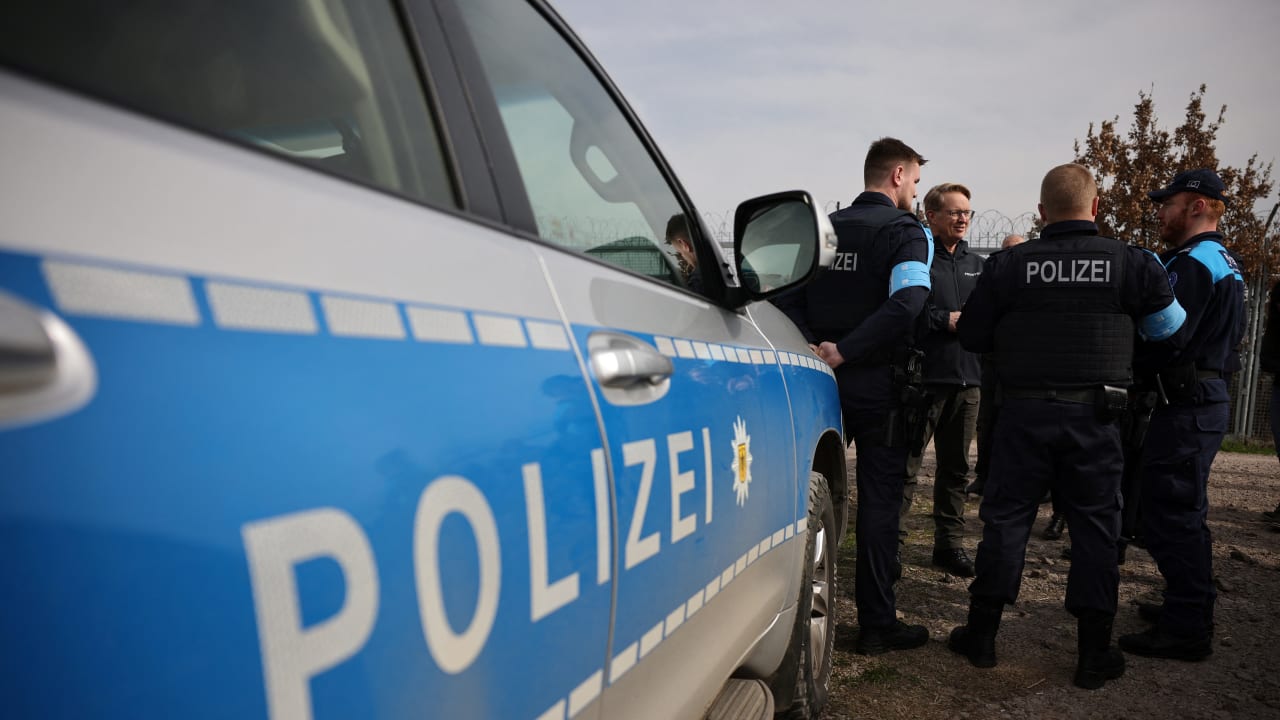
A Bavarian police bodyguard cannot be fired from the service despite a history of antisemitic and racist comments, the Munich Administrative Court ruled.
The police officer worked as a personal protection officer between 2016 and 2020, at which point he was banned. He had been deployed on many occasions to guard the president of the Jewish Community of Munich and Upper Bavaria, Charlotte Knobloch, who is also a Holocaust survivor. Additionally, the officer guarded the Israeli consul general in Munich, Dan Shaham.
During this time, the officer frequently complained to a friend via WhatsApp about Jews, including wishing that Knobloch would be sent to a concentration camp. While protecting Shaham, the officer told his friend he preferred Dachau as a destination to Auschwitz or Flossenbürg, because he would be able to return home “earlier.”
While the ruling was made in February, the details were only published this week.
The court said that the defendant “showed a closeness to right-wing radical and National Socialist ideology,” and made statements that “were said to be incompatible with the special position of trust and guarantor of a police officer.”
His chat showed multiple uses of the abbreviations “SH” and “HH” as codes for “Sieg Heil” and “Heil Hitler.”

“Moreover, Hitler’s voice was imitated in a voice message, and two statements indicated that the protected person was to be gassed or taken to a concentration camp.
“By expressing his intention to take to the streets on Kristallnacht, as well as the socialization of the use of language from the Third Reich and the dispatch of right-wing extremist, National Socialist, and antisemitic images, he also trivializes the death and suffering of the victims of National Socialism.”
The court added that this was especially pernicious given that he was tasked with ensuring the safety of Jewish persons.
The Munich police headquarters tried to remove him from civil service. However, they were blocked by the court, which wrote it off as an “internal misdemeanor.” During proceedings, the officer said his statements were made in “the closest circle of family or friends” and were not meant to be made known to third parties.
Officer demoted, allowed to stay in police service
The court found that it was to be considered off-duty misconduct as the incriminated statements were made only in the closest circle of family or friends without a real intention to disclose, and that this relates to fundamental rights to freedom of expression.
The officer has been demoted from chief criminal officer to senior investigator, but can remain in the police service.
When the allegations were first published in 2023, Knobloch told Judische Allgemeine that she was “horrified to learn of reports about a former bodyguard who is said to have made antisemitic and hateful statements in conversations with colleagues.
“Even though the missions in question in my environment were a long time ago, this news hits me personally hard. It affects not only my own safety, but also the relationship with the police as a whole.”
President of the International Auschwitz Committee Eva Umlauf said, “In the face of this shameful and sad verdict, survivors of the Holocaust from all over the world convey their solidarity and thanks to Charlotte Knobloch.”
The antisemitism commissioner of the Bavarian state government, Ludwig Spaenle, said, “We must be able to expect our police officers not to make or share anti-Jewish or racist statements on their private platforms.
“I find it intolerable when a policeman wishes people he is supposed to protect a fate like in the Nazi dictatorship. Therefore, I very much regret the consideration of the Bavarian Administrative Court, which confirmed the decision of the Administrative Court.”