
If Malik Faisal Akram wanted people’s attention, he got it. Targeting Jews gathered at synagogue for Shabbat prayers has, after all, become the ultimate deed for anti-Jewish extremists, and a surefire entry-ticket into mainstream media.
Writing for The New York Times following the Colleyville attack, Deborah Lipstadt asked if, finally, “the eyes of our non-Jewish friends and neighbors, particularly the ones who didn’t call to see if we were OK, have been opened just a bit.”
But after 11 Jews were murdered in Pittsburgh’s Tree of Life synagogue; after a machete-wielding antisemite cracked open Rabbi Josef Neumann’s skull in Monsey, New York; after a neo-Nazi shot up a synagogue in Poway, California; after a Jewish man was viciously beaten in Times Square while being subjected to antisemitic slurs; after the FBI revealed that American Jews are the target of more than half of all the country’s religiously motivated hate crimes despite making up just 2 percent of the population, claims of blissful ignorance can no longer be offered.
People hear our cries, but they neither listen nor care.
Of course, it’s unfair to expect individuals to educate themselves seriously on every form of bigotry, and unfortunately, this leaves us with many well-meaning people who simply don’t understand anti-Jewish racism, as The Atlantic’s Yair Rosenberg astutely explained.
But that’s no longer an excuse for silence. When Jews were accused of kidnapping and murdering Christian children for their blood, people stood by and did nothing. When Cossacks raped Jewish women and their daughters in pogrom after pogrom, people stood by and did nothing. When a rampaging mob in Baghdad left nearly 200 Jews dead and 600 injured, people stood by and did nothing. When Nazis incinerated the bodies of Jewish men, women and children in Auschwitz and Majdanek, the world stood by and did nothing.
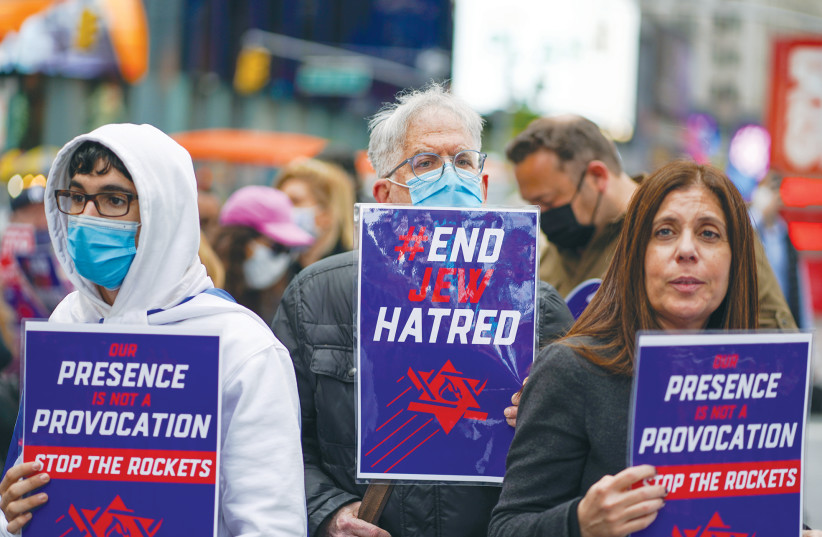
Welcome to the long arc of Jewish history. Not everything bends toward justice.
Citing the American Jewish Committee’s recent findings that nearly one-in-four American Jews has been victim to antisemitism in the past year, and that 39 percent “changed their behavior in the past 12 months to avoid antisemitism,” MSNBC’s Aaron Gilchrist asked Rabbi Rick Jacobs, in light of the Colleyville attack, what the “correction” is that “we can make as a society” to better combat the world’s oldest hatred.
That question doesn’t belong in 2022. For years, Jews have been sounding the alarm about the ascension of anti-Jewish racism into the mainstream. For years, we have been crying out about the unrelenting attacks on our communities. And for years, society has ignored us. The fact that, in 2022, the media still has the gall to ask what can be done to combat antisemitism is a shameful indictment on society.
But this is no surprise – at least not to anyone who’s paying attention. During Israel’s conflict with Hamas in May last year, American Jewry witnessed a 115 percent increase in antisemitic incidents compared to the same period in 2020, according to the Anti-Defamation League. The media’s silence could be heard like a thunderclap.
The media isn’t so silent, however, when the opportunity arises to blame Jewish victims, as was seen after a 2019 shooting at a kosher supermarket in Jersey City, in which the attackers packed their van with enough explosives to kill people five football fields away – very plausibly intended for the Jewish school neighboring the supermarket.
As Dara Horn recalls in her widely acclaimed book People Love Dead Jews, news outlets showed little interest in reporting on an anti-Jewish terror attack that, if not for the miracle of the explosives not detonating, could have left hundreds dead.
Rather, Horn writes, “The Associated Press explained in a news report about the Jersey City murders that was picked up by NBC and other news outlets, ‘The slayings happened in a neighborhood where hassidic families had recently been relocating, amid pushback from some local officials who complained about representatives of the community going door to door, offering to buy homes at Brooklyn prices.’”
The media, Horn explains, framed the attack as a response to gentrification in Jersey City (that the attackers were not from Jersey City was irrelevant to news outlets). The gentrifiers, of course, were hassidic Jews – described by one attacker as “imposters who inhabit synagogues of Satan.” But of course, as Horn sardonically notes, these Jews had been driving up house prices, “so it kind of made sense that people wanted to murder their children with high-impact explosives.”
In a society increasingly sensitive to all kinds of microaggressions, phobias, -isms and biases, such abhorrent framing of explicit anti-Jewish racism can no longer be attributed to an innocent mishap; there’s something far darker at play. And so, as the rest of the world forgets about Colleyville, leaving behind those traumatized by the continued murderous attacks on Jews and those too scared to wear Jewish symbols in public, many of us will be forced to reckon with Horn’s blunt assessment. “People love dead Jews,” she writes. “Living Jews, not so much.”
And that, ultimately, is what drives the anxiety and fear for so many Jews. It’s not that we’re desperately wondering when the world will wake up; it’s that deep down, we know it never will.
The author is an Australian writer who focuses primarily on Israeli and Jewish issues. Twitter: @joshrfeldman.