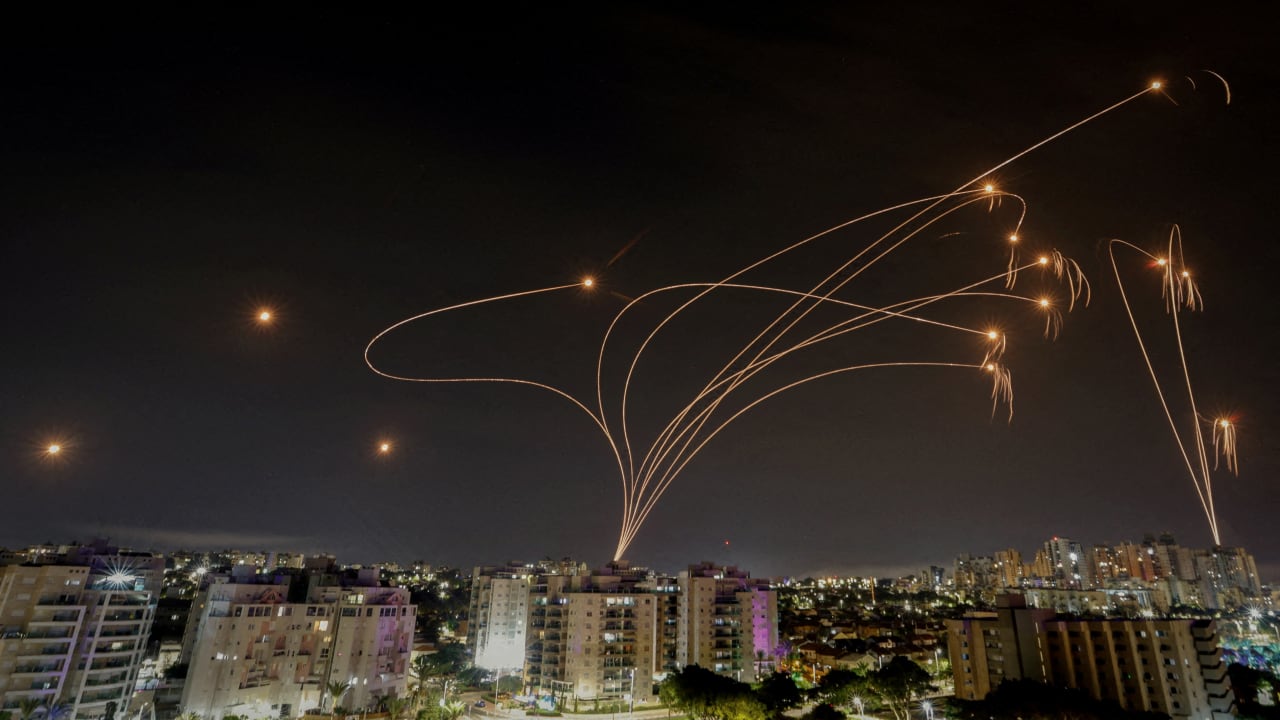
WASHINGTON - Rafael Advanced Defense Systems emerged from Israel’s recent wars with Iran with more Tamir interceptors in stock than it had when the fighting began, despite thousands of interceptors being fired to defend the country against missiles, rockets, and drones, according to CEO Yoav Tourgeman.
"We ended the war with more Tamir interceptors than before," Tourgeman told Defense & Tech by The Jerusalem Post in an exclusive interview at the Association of the United States Army (AUSA) Annual Meeting & Exposition in Washington, DC.
For decades, air-defense development focused primarily on improving the performance of individual systems with greater range, better accuracy, and higher interception rates. But recent conflicts in Ukraine and the Middle East have exposed a significant challenge where even the most advanced interceptor is of limited value if a defending country cannot produce enough of them to sustain operations through a prolonged campaign.
For Rafael, the Israeli defense company behind the famous Iron Dome and David’s Sling, industrial capacity is becoming inseparable from operational effectiveness.

The challenge is building an architecture that can handle them all, including simultaneous attacks designed to overwhelm defenses through sheer volume. The company’s answer is a layered approach to air defense, matching different systems to different threats, from inexpensive drones and rockets to ballistic missiles and emerging hypersonic weapons.
No single interceptor can economically or effectively address every threat, Tourgeman argued, adding that “we are building the right solution for the right threat.”
The Israeli company's combat credentials remain central to that argument. According to Tourgeman, Iron Dome and David's Sling have intercepted more than 11,000 threats together since becoming operational.
“There would have been a lot more blood in the streets without the Iron Dome,” he said. “These systems have proven themselves in situations we once thought impossible.”
1,000 interceptors a year
But intercepting incoming weapons is only part of the equation. Replenishing inventories during a sustained conflict requires manufacturing capacity, reliable supply chains, skilled workers, and the ability to expand output without compromising quality.
That has been driving Rafael’s international expansion across 48 different countries, and with governments increasingly looking not only for advanced technology but also for confidence that suppliers can deliver when demand surges, Rafael has subsidiaries worldwide.
Rafael has also increased automation across its manufacturing operations and is expanding production partnerships overseas. Its new facility in Arkansas is expected to have the capacity to produce roughly 1,000 interceptors annually for both the United States and Israel. It will also provide a US-based manufacturing source as Washington and its allies seek to rebuild munitions stockpiles and strengthen domestic defense production.
Tourgeman also told D&T that Rafael is willing to transfer intellectual property and deepen cooperation with American industry. And for end-users, that appeal extends beyond delivery timelines because domestic production can reduce dependence on overseas supply chains and give governments greater control over critical defense capabilities during a crisis.

As European governments confront a more threatening security environment and the prospect of sustained high-intensity warfare, the continent is another major market. Germany, in particular, has been rebuilding its long-term air and missile-defense requirements.
In September, the German state of Lower Saxony, Rafael Advanced Defense Systems, and Aurelius Capital signed a letter of intent to purchase Volkswagen’s Osnabrück plant, allowing the Israeli defense company to establish the production of Iron Dome components in Germany.
That, Tourgeman confirmed, was the first step towards Berlin acquiring the Iron Dome.
“What we’re doing in Germany is bringing confidence and safety to the population,” he said.
He also suggested that civilian industrial sectors, particularly automotive manufacturing, could play a larger role in defense production. Car plants already possess expertise in high-volume manufacturing, quality control, and supply-chain management, which could help governments rapidly scale weapons production during periods of crisis.
Staying ahead of the next generation of threats
Beyond today's missile threats, Rafael is preparing for the next generation of challenges.
At AUSA the company showcased a full-size model of Sky Sonic, its interceptor designed to counter hypersonic missiles. The interceptor was first announced over three years and Tourgeman dismissed the idea that hypersonic weapons represent an entirely new category of threat, arguing that many of the technologies needed to defeat advanced missiles already exist within Rafael's portfolio.

More pressing, he suggested, is the rise of coordinated attacks involving large numbers of inexpensive drones operating alongside traditional missiles.
Such attacks can expose critical infrastructure and create a difficult economic and operational problem for defenders, and the West has already seen how using costly interceptors against cheap drones can quickly strain inventories.
Countering the threat will require systems that can coordinate sensors, weapons, and decision-making across a network rather than operate as isolated platforms.
At AUSA, the company showcased solutions designed to operate within networked defense architectures and is advancing concepts such as Hunter Eagle, which Tourgeman described as a platform capable of functioning within a mesh network against drone swarms, both offensively and defensively.
That approach reflects a broader change in the economics of air warfare. The side launching an attack can increasingly draw on large numbers of relatively cheap, expendable weapons. The defender, meanwhile, must preserve enough interceptors and other capabilities to protect cities, military assets, and critical infrastructure over days, weeks, or longer.
For Rafael, the next contest in air defense will therefore be measured not only by interception rates or technological sophistication, but also by production lines, supply chains, and the ability to replenish stocks while fighting continues.
In a prolonged war, the decisive advantage may belong not simply to the country with the best interceptor, but to the one that can keep producing it at scale.