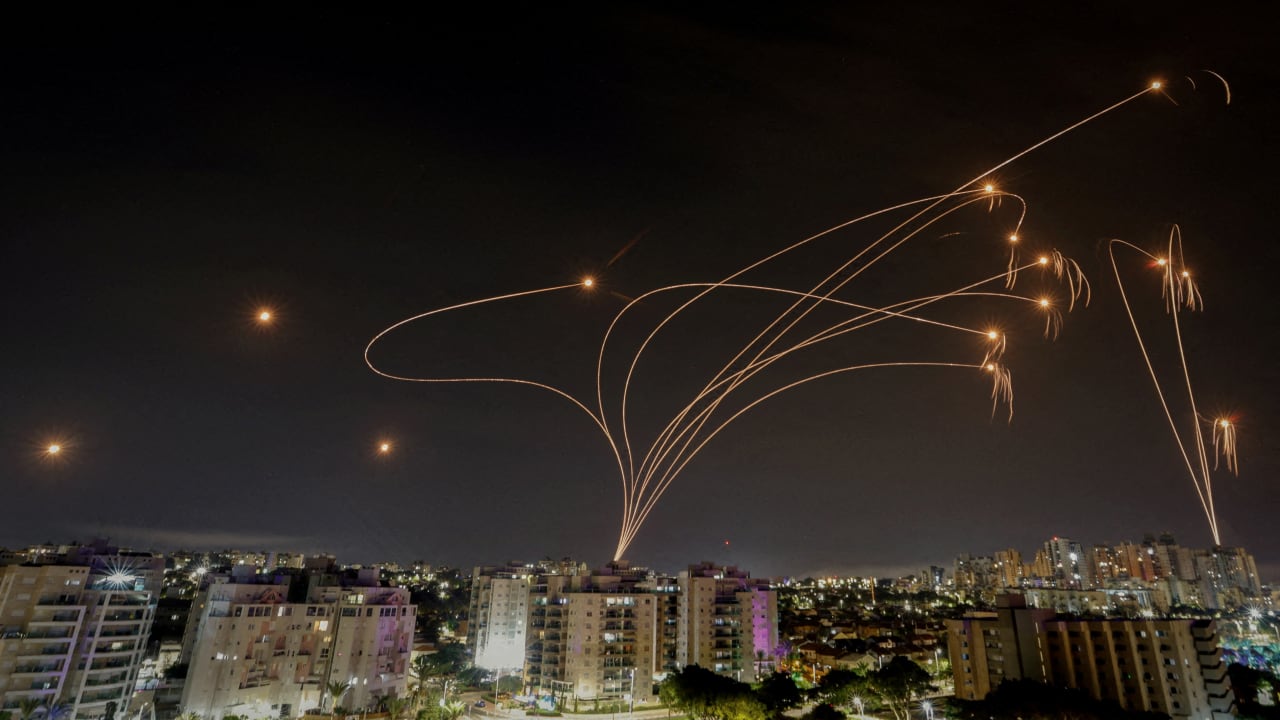
On April 7, 2011 at 6.20PM I was in the southern city of Sderot when the incoming siren blared. Hamas had fired a Grad missile towards the city of Ashkelon. Running to the safe room, I heard a sound that was different than a rocket slamming into the ground-it was the first interception by the now famous Iron Dome missile defense system.
Air defense soldiers gave the call sign “Alpha”- the signal for a successful first intercept of a rocket toward Israel. That interception, 15 years ago today, has changed the face of active defense around the world- especially here in Israel where it fundamentally redefined Israel’s defensive doctrine and its ability to counter rocket threats.
The system has logged more than 10,000 combat intercepts and sustained success rates exceeding 90%.
“Over the past 15 years, the system has changed the face of the battlefield and shielded Israel’s civilians from relentless threats coming from multiple adversaries. Iron Dome is a first-order strategic asset and a central pillar of Israel’s national defense doctrine,” said Prof. Yuval Steinitz, Chairman, Rafael Advanced Defense Systems.

Hilla Haddad Chmelnik was on the Iron Dome’s development team during her service in the Israel Air Force and recalled her first encounter with the system.
“I met Iron Dome a year before it became operational. It was in advanced development of the first interceptor batteries. I was in the Air Force, at the test range, and Rafael and MAFAT came to the Air Force to make it operational with an acceptance test. We had to think: how do we check the system and make sure it works well?”
The primary contractor for the development of the Iron Dome is Rafael Advanced Defense System. The MMR radar is developed by ELTA, a subsidiary of the Israel Aerospace Industries (IAI), and the command and control system is developed by mPrest.
Its development was completed in roughly two and a half years, an exceptional engineering feat by any international standard.
“It immediately became a different kind of project, a sort of paperless project, because it was developed so fast. It was extraordinary because it required a whole new way of thinking about how an interception system works. It changed the way we test systems,” she told Defense & Tech by The Jerusalem Post.
The first test of the system took place in February 2011 and two months later the first interception took place.
“The interception happened an hour before my wedding in Herzliya,” Haddad Chmelnik recalled. “It was a double celebration. It was amazing.”
Layered defenses
Initially designed to shoot down short-range rockets, the Iron Dome has become an integral component of Israel's multi-layered defense array.
The system’s modular architecture enables seamless integration with additional defense layers, and it can operate independently or as part of a broader air defense network that includes the the Arrow (Arrow-2 and Arrow-3) system which intercepts ballistic missiles outside of the Earth’s atmosphere and the David’s Sling missile defense system which is designed to intercept tactical ballistic missiles, medium- to long-range rockets, as well as cruise missiles fired at ranges between 40 to 300km. There is now also the Iron Beam laser defense system.
The system’s early years were defined by rapid operational learning. Iron Dome took part across a long series of conflicts and operations, from Operation Protective Edge, Operation Guardian of the Walls, Operation Breaking Dawn, Operation Shield and Arrow, the Swords of Iron War, and Operation Roaring Lion where it is serving alongside the Arrow and David’s Sling as a central pillar in the protection of Israel’s home front.
Each round of fighting exposed new patterns in adversary tactics, and each ceasefire was followed by a new wave of software updates, radar refinements, and interceptor improvements.
It quickly became evident that the system was a flexible defensive layer capable of handling dense salvos, more complex trajectories, and a wider range of threats. The system’s radar was upgraded to track more targets simultaneously, its algorithms became faster and more selective, and its interceptors were refined to handle longer ranges and more demanding engagement profiles.
“What made Iron Dome special from the beginning was the goal of creating a much cheaper interceptor than systems like Arrow. The system’s ‘brain’, the software, is extremely advanced, and today it’s being used against threats far more sophisticated than what it was originally designed for,” Haddad Chmelnik said. “Iron Dome has become so capable that its interception envelope has expanded. That wasn’t the intention at the start, but the system has grown because of its core design.”
According to Haddad Chmelnik, “many of the components, software, and know-how feed into other systems that Israel is developing. It’s like cyber-the knowledge moves across the Israeli ecosystem.”
The unprecedented barrages of October 2023 marked another turning point. Iron Dome performed effectively under enormous pressure, but the sheer volume of rockets launched in extremely short time windows revealed the inherent limits of any kinetic interceptor system. No matter how advanced the radar or how fast the interceptor, a saturation attack of sufficient scale can strain even the most sophisticated defenses.
But these episodes did not undermine Iron Dome’s reputation; instead, they clarified its role. It is a highly capable layer within a broader defensive ecosystem, not a standalone shield. And that understanding has driven the next phase of its evolution.
“Fifteen years ago no one imagined Iron Dome would handle such a wide range of threats. It can do so now because the basic approach-the way it calculates interception points and approaches targets-is unique and allows the system to grow,” Haddad Chmelnik said.
But the system will never replace the Arrow or David’s Sling.
“At the end of the day, physics still sets the limits. It will not replace Arrow, and it shouldn’t. Arrow exists for different reasons. Iron Dome provides an economical solution for the mass rocket fire from Lebanon and Gaza, and it also supports Arrow by reducing the number of threats that reach the higher layers,” she told D&T.
Upgrades and adaptations
Over the years, Iron Dome has undergone sustained upgrades and adaptations in response to evolving threats.
According to Yoav Tourgeman, CEO, Rafael Advanced Defense Systems, “we continuously update and upgrade its capabilities- and there is no doubt that what it can do today, across the full spectrum of threats it faces, exceeds what it could do when it was first handed over to the IDF 15 years ago by an order of magnitude.”
Not only are there over a dozen land batteries, the Iron Dome family extends to the naval domain through C-Dome, declared operational in November 2017. C-Dome conducted its first operational intercept on April 9, 2024, during the Swords of Iron War. The system is currently deployed aboard the Israeli Navy’s Sa’ar 6 corvettes, providing protection against rockets, cruise missiles, and UAVs.
The system’s radar, battle‑management algorithms, and interceptor missiles have all been refined to improve accuracy, response time, and resilience under heavy barrages.
These figures reflect not only the frequency of rocket attacks but also the system’s central role in Israel’s defensive strategy. Its ability to selectively engage only those rockets posing a threat has been a defining feature, allowing it to conserve interceptors while maintaining high effectiveness.
“After 15 years of operational activity, and all the more so in these days of intense fighting across every front, Iron Dome continues to prove itself day after day, under complex conditions and against shifting threats. It would be no exaggeration to say that tens of thousands of Israelis owe their lives to this invention,” Tourgeman said.
The Iron Dome’s operational successes have also influenced Israel’s broader air‑defense architecture. It forms the lowest tier of a multilayered system that includes David’s Sling for medium‑range threats and the Arrow 2 and Arrow 3 systems for long‑range ballistic missiles. This layered approach has become increasingly important as Israel faces threats not only from Gaza but also from actors in Lebanon, Syria, Yemen and Iran.
The integration of these systems has allowed Israel to counter a wide spectrum of aerial threats, from short‑range rockets to ballistic missiles launched from thousands of kilometers away.
While the Arrow is the main system during Operation Roaring Lion, the Iron Dome still plays a central role, Haddad Chmelnik told D&T.
“The Arrow is the main player in this war. Arrow was developed before Iron Dome, but Iron Dome became more famous. Still, Iron Dome complements Arrow by preventing large fragments from falling. It’s not the main system against Iran, but in the north-parallel to the war with Iran-where Hezbollah is launching huge numbers of missiles and drones, Iron Dome is the main player and it is doing a great job,” Haddad Chmelnik said.
Global interest
Its battlefield record has drawn broad international interest, including from the United States Marine Corps, which selected the system to strengthen its own air defense capabilities. Taiwan has also jumped onto the Dome wagon, with the T-Dome envisioned to protect the island nation from aerial threats.
“Beyond being the best and most reliable intercept system in the world, Iron Dome is the only one capable of engaging rockets and missiles across short and medium ranges- and doing so at a cost that makes large-scale deployment feasible,” Steinitz said.
According to him, “nations around the world watch its performance with awe- it has become a generic name synonymous with air defense, and by a considerable margin it is the most combat-proven system in the world, having logged more intercepts than most other defense systems combined.”
Beyond its operational achievements, Iron Dome has become an international symbol, a brand, not only of technological boldness and innovation, but of an advanced defensive philosophy.
“When people in the US talk about the ‘Golden Dome,’ that brand didn’t come from nowhere. The reputation has value, and many systems have benefited from that first interception 15 years ago,” Haddad Chmelnik said.
The Iron Dome’s success has also contributed to broader interest in Israel’s air‑defense ecosystem. Germany’s 2023 agreement to purchase the Arrow 3 system and Finland’s acquisition of David’s Sling reflect a growing recognition of Israel’s expertise in this field.
No sign of slowing down
As Operation Roaring Lion and the fighting against Hezbollah show no signs of deescalation, Iron Dome continues to prove itself day after day, under complex conditions and against evolving threats.
It remains a central layer in Israel’s multi-tier defense concept, and a testament to the country’s enduring commitment to the security of its citizens in the face of future challenges. Yet, despite its successes, the Iron Dome is not infallible.
Israeli officials have consistently noted that no air‑defense system can guarantee complete protection. Some rockets inevitably penetrate the system’s defenses, underscoring the continued importance of measures such as early warning sirens and reinforced shelters.
Nevertheless, the system’s high interception rate has significantly reduced casualties and property damage during periods of conflict, altering both military calculations and civilian life in Israel. Fifteen years after its first interception, the Iron Dome will remain a central component of Israel’s national security strategy.