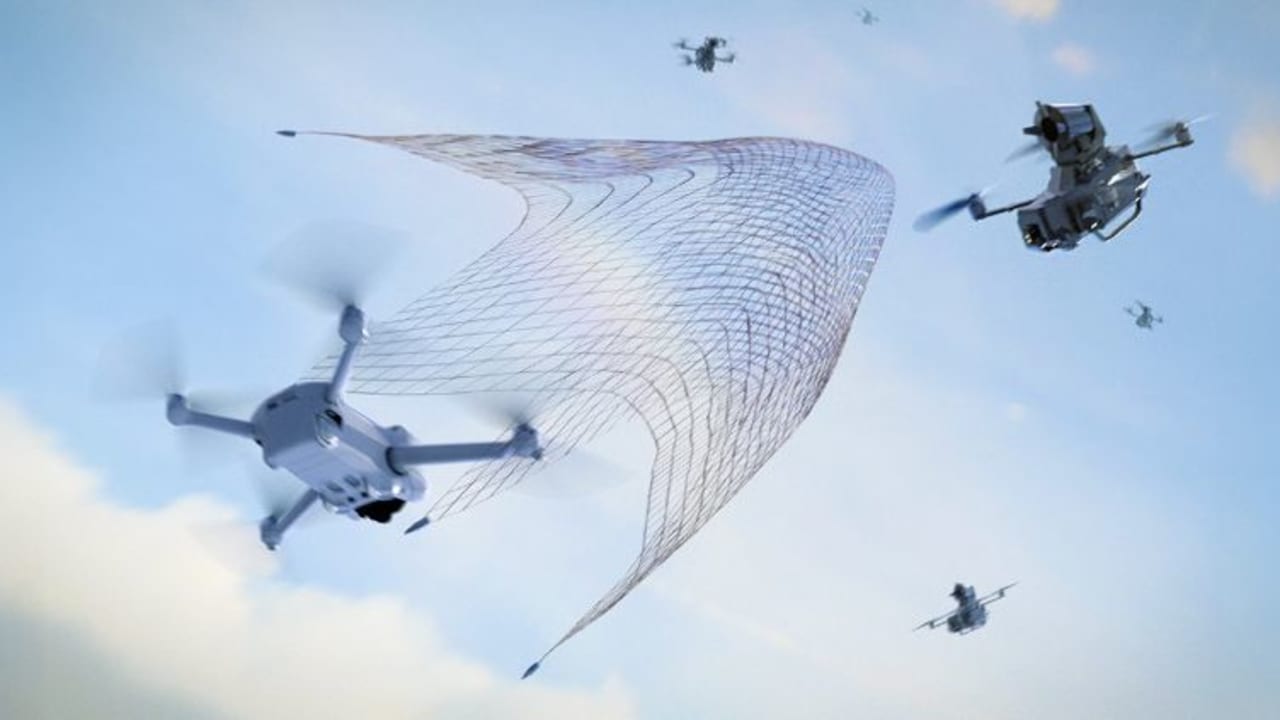
Two Israeli defense-tech companies, XTEND and ParaZero Technologies, have announced a strategic partnership aimed at fielding a next‑generation autonomous counter‑UAS (C‑UAS) solution. The collaboration integrates ParaZero’s DefendAir net‑launching interceptor pod with XTEND’s Scorpio 1000 tactical drone, creating a fully autonomous system designed to detect, pursue, and physically capture hostile drones with minimal collateral damage.
The integrated system pairs the high‑speed maneuverability of the a versatile AI-powered Scorpio 1000 designed for multi-domain missions with the kinetic interception capabilities of the DefendAir pod, enabling the drone to autonomously pursue, capture, and secure an enemy UAS by using a physical net launched for capture.
The companies describe the result as a fully autonomous interception chain, from detection and tracking through to physical capture, designed for both battlefield and urban environments where collateral damage must be minimized.
The collaboration brings together two innovative Israeli defense tech companies at a time when militaries around the world are seeking scalable, low‑collateral solutions to counter the rapid proliferation of cheap and hostile unmanned aircraft.
“We are proud to partner with XTEND, a leader whose drones are proven in real-world operations,” said Ariel Alon, CEO of ParaZero. “We believe that this combination strengthens our position as providers of advanced defense solutions and offers military users more effective and safer interception capabilities against drone threats.”

Founded in 2014 and headquartered in Kfar Saba, ParaZero’s DefendAir system incorporates patented net-launching technology. The net-pods are engineered by the company for its integration across various platforms to deliver precise and effective neutralization of hostile drones. The technology integrates sensors, real‑time monitoring, and automated deployment mechanisms.
These systems rely on autonomous guidance and net‑based interception rather than kinetic or explosive methods, making them suitable for urban environments, airports, and sensitive facilities where traditional counter‑drone solutions pose unacceptable risks.
“As warfare becomes increasingly complex and multi-domain, the need for agile, scalable solutions that leverage AI-driven autonomy will only grow,” said Aviv Shapira, CEO of XTEND. “This partnership with ParaZero accelerates our vision of a future where autonomous systems collaborate seamlessly across air, ground, and maritime domains, offering unprecedented speed, precision, and adaptability in real-time operations.”
Founded in 2018 in Tel Aviv by Aviv Shapira (CEO), Matteo Shapira (CXO), Rubi Liani (CTO), and Adir Tobi (CQO), XTEND develops autonomous drone systems and AI-powered operating platforms for defense and security applications.
XTEND’s drone command-and-control (C2) systems are used by militaries around the world and are designed to operate in harsh and contested environments, including scenarios in which GPS signals are denied or communications are jammed. The company says its XOS allows new operators to conduct missions at near expert-level proficiency, reducing training time while increasing operational effectiveness and informed decision-making.
The integration also reflects a broader shift within Western militaries toward distributed command-and-control architectures capable of operating in highly contested environments, where centralized control and uninterrupted communications cannot be assumed.
The company operates globally, with offices in Israel, the United States, Singapore, and Latvia. The company announced in February that it plans to go public and list on the NASDAQ through a merger with JFB Construction Holdings in a transaction that includes a $152 million strategic investment, expected to close in mid-2026. XTEND is expected to trade under the ticker XTND.