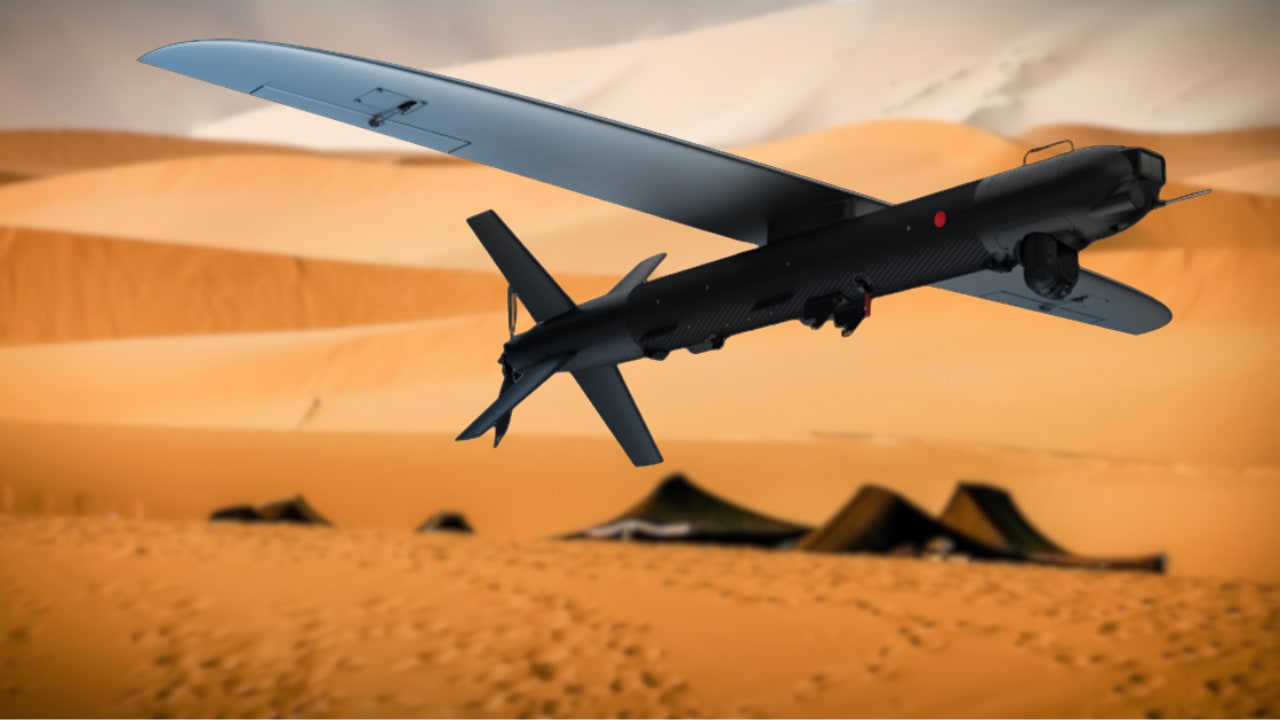
Israel’s BlueBird Aerosystems has expanded its footprint in Morocco with the opening of a factory to produce SpyX loitering munitions, strengthening the kingdom’s ambition to build a sovereign defense industry.
This move represents the first time such advanced drone technology will be produced locally in North Africa.
While BlueBird has not made any official statement regarding the factory, numerous local reports indicated that the project includes technology transfer, training of Moroccan technicians, and the integration of advanced kamikaze drones into Morocco’s growing automated aerial vehicle (UAV) arsenal.
Rabat is rumored to be interested in additional platforms, such as the Harpy and Harop loitering munitions.
The plant in Benslimane, Morocco, will focus on producing SpyX drones, which are lightweight, portable loitering munitions designed for precision strikes. With a two-hour endurance and a range of 50 kilometers, these drones can carry a variety of warheads up to 2.5 kg. and enable tactical teams to detect, confirm, and strike targets.

Like other loitering munitions, they can hover over a target area before engaging, offering tactical flexibility for modern battlefield scenarios.
Growing local defense industry
Morocco has significantly increased its defense budget over the past year, and the proposed 2026 budget is estimated at around $19 billion. This increase is part of the country’s effort to modernize its military and build a domestic military industry to reduce its reliance on foreign imports.
The establishment of this factory is part of that broader strategy. By hosting production facilities, Morocco not only gains access to cutting-edge drone technology but also builds local expertise and industrial capacity.
Moreover, the new plant is expected to create jobs and foster technological know-how within Morocco, while also serving as a potential export hub for African and Middle Eastern markets. For BlueBird, the facility represents an opportunity to expand its reach and demonstrate the adaptability of its drone systems in diverse operational environments.
A report by FesNews detailed the business dealings between BlueBird and Rabat, noting that the company started its operations in the kingdom after the Abraham Accords were signed in 2020. In June 2023, the aircraft conducted its first global deployment in Morocco and its first successful field tests, and in March 2024, the SpyX destroyed an unused armored vehicle.
The factory was announced in April 2024, and in November 2025, Moroccan technicians are said to have visited BlueBird factories in Israel.
Regional and strategic implications
Morocco has had close economic, diplomatic, and military ties for years with Israel. Jerusalem and Rabat reestablished relations under the Abraham Accords along with the United Arab Emirates, Bahrain, and Sudan in 2020 during US President Donald Trump’s first term.
A year later, the two countries signed a memorandum of understanding surrounding arms deals, intelligence cooperation, and joint military projects. The North African kingdom has since signed several deals with Israeli defense companies, among them for Israel Aerospace Industries’ Barak 8 missile defense system, Elbit System’s ATMOS Howitzer, 20 radars manufactured by Elta for its F-5e fighter jets, and Elbit’s EXTRA rockets.
The production of loitering munitions in Morocco carries significant regional implications. Drones are increasingly seen as game-changers in modern warfare, offering cost-effective precision strike capabilities compared to traditional airpower. Morocco’s acquisition of local production capacity enhances its deterrence posture.
Furthermore, the move underscores Israel’s growing role as a defense partner in the region. By transferring technology and establishing production lines abroad, Israeli firms like BlueBird are expanding their global footprint while strengthening strategic alliances.
According to a report in Africa Intelligence, a delegation of senior Moroccan military officers was reportedly invited in August by the Directorate of Defense, Research and Development within the Israeli Defense Ministry. The delegation is said to have met officials from the IAI, Sentrycs, D-Fend Solutions, and Smart Shooter – all companies that specialize in counter-UAS (unmanned aerial system) solutions.
The article noted that several months earlier, in March, another delegation visited Israel in coordination with the IMOD’s International Defense Cooperation Directorate and met with officials from Elbit Systems and Steadicopter.
Defense & Tech could not corroborate those visits.