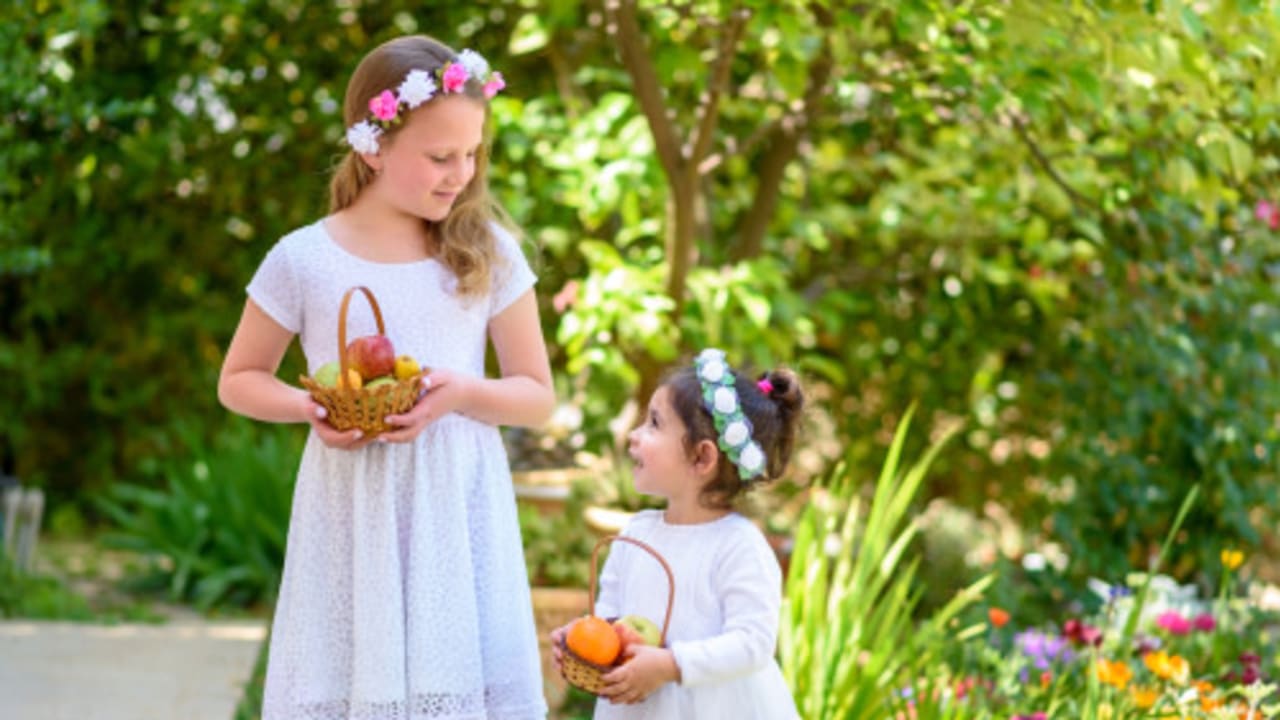
If there is a place where the Shavuot holiday still feels like the old days – with pioneer dances, local produce, cheeses, wine, and open fields – it is the Jezreel Valley.
Shavuot this year falls right at the end of spring, and this is an opportunity to get to know and also support businesses in the north as part of the Milk and Honey festival (May 13–23, 2026) that will take place in the expanses of the valley (it is a dream). We visited several places that offer their wares for the whitest event before summer begins.
Golda Bahazer, Kibbutz Merhavia
In Kibbutz Merhavia near Afula (there is also a moshav with the same name opposite it), one of the most unique forms of settlement in the country took place – the "Cooperation" (1910–1918) – which indeed failed but advocated for equality among its members, profits, and ownership of the means of production. In the "Great Yard," which is a nickname for a large square complex surrounded by arched walls, the public life of the residents was conducted. In later years, even Golda Meirson (Meir) arrived at Merhavia and lived in the settlement prior to the establishment of the kibbutz in 1929. As part of the festival, a public sing-along evening and a fair with stalls will take place in the yard.
Today, in the structure of the machine shed that became the old children's house of the kibbutz, Golda Bahazer was opened – a charming cafe with a coffee cart yard dotted with seating areas amidst growing greenery – where they prepare everything themselves, including cakes on weekends. On the menu: Breakfasts of shakshuka or eggs, various salads, and more. Closed on Sunday, 052-3767150.

Happy Moments studio and Nacca studio, Kibbutz Merhavia
Still in the yard, 10 meters from there, is located the Happy Moments studio, and as its name suggests, it promises happy moments to whoever enters the studio of Kathy Cohen, who created workshops that combine phototherapy and psychology. She has two children with special needs and through them she discovered that "the documentation helps me cope," she says. "I researched the subject and thus workshops were born, and I found that one needs to be in the memory of the here and now."
Her studio looks like a warm and inviting living room, with music, cookies, and seating sofas. One of the workshops she offers is "Catch the Moment," in which exciting moments in the daily routine are identified, photographed, and remembered later. "In the workshop, one learns to identify the moments when writing on a postcard 'what is the exciting moment' and going outside to photograph. Afterwards, everyone shares what moved him/her." A workshop in a small group will cost NIS 250 per person, 054-6279902.

Right below Kathy, is located the studio of Ruti Ben Artzi – Nacca (the surname of her late mother from Argentina but originally she is Syrian). Ruti produces natural soaps. "60% of the soap is from olive oil from Tel Adashim in the valley, shea butter, and coconut oil," she makes sure to mention regarding its high-quality ingredients. She prepares the soaps using a cold method, with almost no heating. "It is a process of about a month and a half," she explains and adds that "the soaps have essential oil and there are also products based on camel milk." Workshops at NIS 250 per person, NIS 180 for a child over the age of 6, also on Saturday.

Nachmani Winery. Yes, Kibbutz Merhavia
18 wineries from the valley will open the wine festival, with local performances, food stalls, and more. But if already in the Merhavia yard, it is worth checking out Nachmani Winery – three generations of winemaking in the valley.
Today, Shaked Nachmani (33) is entrusted with the production of this wonderful liquid, who since age 10 has been producing wine with her father, David. "It all started with Grandpa (Heinz Kurt) who was a vine-grower in Germany," she tells. "In the 80s he wrote a book about making wine at home and drew illustrations on the subject that are found in the book she presents at the winery. In later years, she studied winemaking in Tel Hai and Tel Aviv, and today the labels on the wine bottles are the drawings from Grandpa's book.
20 years after they began producing, Nachmani's wine began to win prestigious awards. When Shaked's father retired, she began with her husband Shlomi to produce about 4,000 bottles, but today they already make 15 thousand bottles. They grow the grapes in the Upper Galilee and produce several types of wines from them, for example: White from Sauvignon Blanc, Grenache Noir 2024 red that is served cold, and there is also a red of Grenache Syrah and Mourvèdre 2023.
Tastings: NIS 90 for five types of wine, 050-9349111.
The Valley Museum, Yifat
Well, we finally left Merhavia and got on Route 73 which cuts through the valley (partially) from east to west. The destination: Kibbutz Yifat which has many good things but the Valley Museum is perhaps the tourism heart within it.
In this museum that preserves the pioneer days, their lifestyle, a dining hall, the agricultural tools, and the lifestyle of the kibbutzim of the past, family activity will take place during the festival days consisting of several experiences, among them Kumu Vena'ale – a ritual dance for Shavuot – which will be performed (May 23) by the Poalot group led by Noam Edri and Nicole Mahler. The dance will be performed with the involvement of the audience who will learn the dances that symbolize the connection between the farmer and his land, between Zionism and agriculture, between deep-rootedness and taking hold of the soil. This pioneer artistic tradition was created even prior to the establishment of the state by the poet and composer Matityahu Shalem and the choreographer Leah Bergstein.
Beyond the dance, the museum will offer operation of agricultural tools with surprises, baking pitas in a tabun with labneh and spices, workshops, and the junk yard with ride-on toys by John Deere for children.
If already in Yifat, at the entrance to the kibbutz is located the Mishka cafe of Itamar Sharabi, who in honor of Shavuot will offer the public four special cheesecakes. Itamar also holds in his possession the Yanek Yard complex in Ein Hashofet and is a partner in the Temerlin meat restaurant in the nearby Moshav Nahalal. Additional details about them in the next paragraph.
Temerlin, Nahalal
So Temerlin is probably one of the best restaurants in the Jezreel Valley, certainly among those open on Saturday. The place in the Nahalal fields overlooking the Carmel, was established five years ago on the remains of the Octagon restaurant that was here for 20 years.
After years in Tel Aviv, Nir Tamir (changed from from Temerlin), a daughter of the moshav, decided to open the place with her father and uncle "the real cowboys," she says. At the end of the pandemic they joined Itamar Sharabi (from the previous paragraph), who probably knows something about culinary arts, and decided to open a "restaurant that is a home," according to her. "Our vision was a meat shop and deli, and after I studied butchery – the restaurant also arrived."
In Temerlin there is a large space for diners, tables outside and inside, and there is also a private room for events. But it is not just a meat restaurant that serves steaks at lunch and evening. In the mornings, from 07:00 to 12:00, the place turns into a bakery with coffee, sandwiches, and salads. At noon the restaurant opens as well as the butcher shop. At the festival they plan a fair on May 19 from five in the evening with all the good that businesses in the north have to offer.
Morning: Monday–Saturday | 07:00–12:00.
Lunch/Evening: Sunday–Saturday | 12:00–22:30.
Ktofoti,Beit Lehem Haglilit
The following activity probably needs no introduction, but still it is enjoyable every time anew, in every season and every period. For 14 years Ktofoti in Beit Lehem Haglilit has offered all the valley's harvest in the palm of your hand, in the mouth, and also in a basket.
The self-picking in the wide fields of Rami Horev changes according to the season. "I have worked in agriculture since age 10, but I am more of a farmer today than in the past," he says. This week, for example, you will find in the picking the fruit of the Pakistani mulberry and loquat. And there are also sunflowers, colorful carrots, beets, fennel, cabbage, garlic and onion, cherry tomatoes, Maggie, and cucumbers. In the summer you will have eggplants, peppers, and corn.
On weekends there is also a wagon pulled by a tractor and one can board it for a tour among the fields, while hearing explanations about the moshav and agriculture.
Entrance to picking on site: NIS 60 per person (from age two). Basket for a family: NIS 70 and you can fill everything in it.
The 25th Milk and Honey festival in the Jezreel Valley will take place between May 13 and 23, 2026. Do you feel like it? There are more details here.