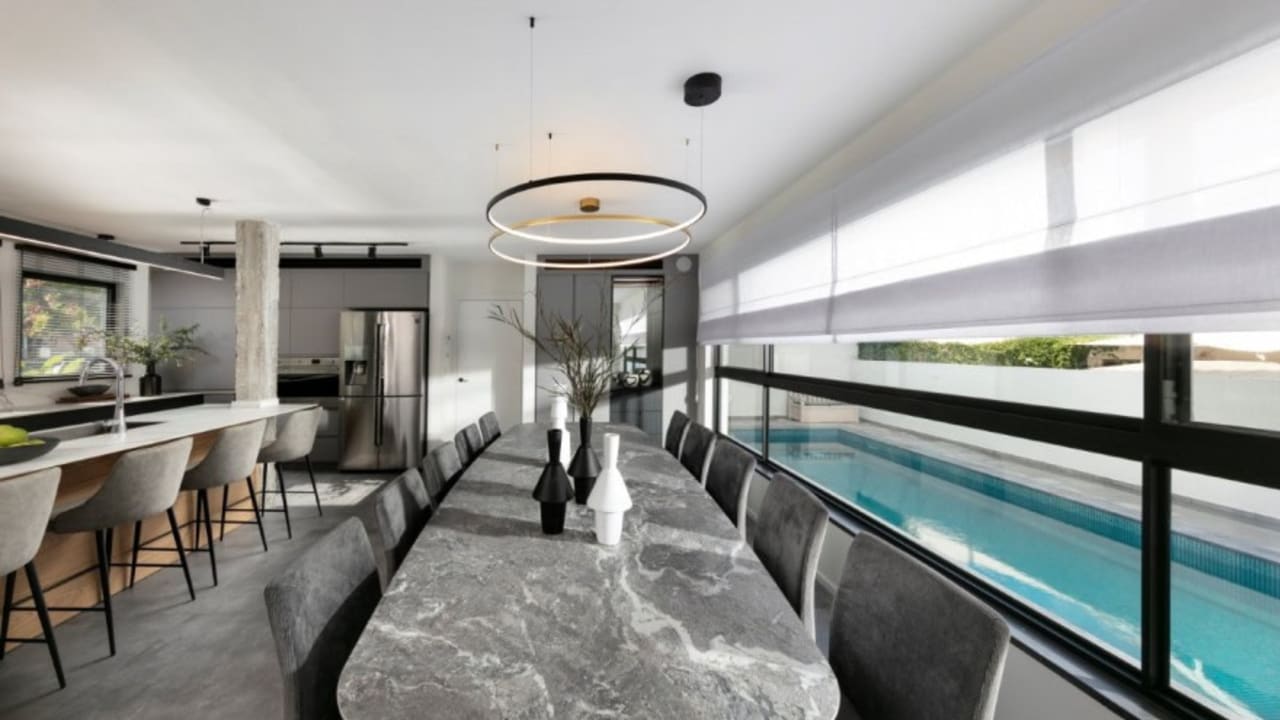
In Ra'anana, on a plot of approximately 480 m², stands a private house that underwent a comprehensive architectural transformation after being purchased by a religious family who immigrated from Australia. The old house required significant renovation and expansion, during which a new wing was added alongside a pool and a redesigned garden. The result is a spacious home, planned around family life, hosting, and large Shabbat gatherings.
The planning and design were led by Bazelet Architects, headed by architects Shira Drori and Anouk Ron. The house spans approximately 260 m² of built area and is divided into a basement and two floors, each designed to support the family's lifestyle.

"The family loves to host, especially on Shabbat when the house fills with guests," says Drori. "Therefore, it was important to create wide central spaces and a large dining table that allows everyone to sit together."
Monochromatic Color Palette and Wooden Accents
The entrance floor opens to a public space with modern lines and a monochromatic color palette of gray, white, and black, combined with wood accents that add warmth. A staircase with an asymmetrical railing and golden light fixtures leads to the living room, where a fireplace and custom carpentry were integrated along the walls. The cabinetry also includes storage solutions, a reading bench by the window, and a dedicated cabinet for Judaica and beverages. White wooden beams in the high ceiling soften the modern aesthetic.

The kitchen, designed at the request of the homeowner - a professional nutritionist - became one of the central spaces in the house. A wide island was planned to serve both as a family work surface, and a station for small cooking workshops, with seating around it. The kitchen itself is adapted to the family's religious lifestyle, featuring full separation between dairy and meat, with dual work areas and appliances. Near the large dining area, a dedicated niche was designed for lighting Shabbat candles, with soft LED lighting.
During the renovation, a support column was discovered in the center of the kitchen. Instead of hiding it, the architects decided to leave it exposed in natural concrete - a decision that gave it design presence and harmonized with the concrete-look floor and the home’s neutral tones.

The new wing added to the house includes the master suite, designed around a feature wall combining concrete, wood, and golden-toned lighting. From the room, there is access to an open closet and a bathroom in warm sand tones, featuring a black marble countertop, wooden cabinetry, an open shower, and a freestanding bathtub.
The children's wing was organized according to the family's needs: The two daughters received a private area with separate rooms and a shared bathroom designed with pink terrazzo tiles and white marble. The boys' rooms are located on the master floor and include a bathroom in geometric tones with black fixtures.

The basement was designed as a spacious family area for hosting and leisure. It includes a library for religious and leisure books, a workspace, a play area, and a pull-out sofa for guests. The garden and pool were also designed as a direct extension of the home’s architectural language, ensuring a natural and seamless transition between indoor and outdoor spaces.