For years, automakers told us they were selling the safest cars they could possibly build. But it was only in the early 1990s that Euro NCAP, the European crash test program, began operating. Its results were public and its testing format was far stricter than the U.S. federal crash test at the time (which still hasn’t changed).
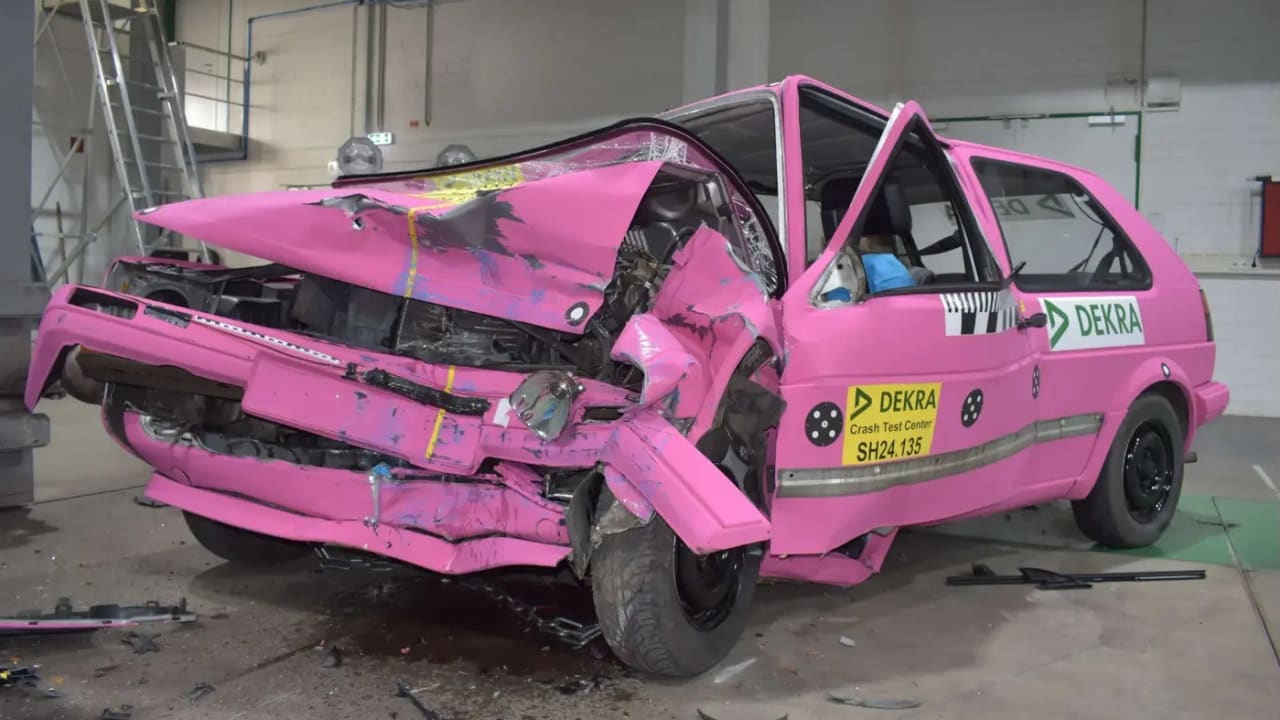
Technological advances and the fact that there were no longer secrets in the field led to huge improvements in vehicle safety levels. Now, Germany’s DEKRA Institute provides further proof, by testing a second-generation Volkswagen Golf (1983–1992) under modern crash test conditions.
The Golf 2.0 was considered one of the safest cars of its era, but by today’s standards it and its passengers stood no chance. To compare it with a new Golf currently on sale, the Germans even granted the classic compact a slight concession: They tested it under the frontal crash conditions used by Euro NCAP until 2020, which have since been made tougher. The eighth-generation Golf, produced since 2019, was tested under the same conditions.
In this test, the car collides with a barrier at 64 km/h with 40 percent overlap. A deformable element is mounted on the barrier to simulate the energy absorption of the opposing vehicle, mimicking a head-on collision between two cars traveling at about 50 to 55 km/h.
While the Golf 8.0 earned the maximum five-star rating and an 88% success rate in passenger protection, the Golf 2.0—without airbags, seatbelt pretensioners, and with outdated crumple-zone design—collapsed completely. DEKRA experts estimate that the passengers of the old Golf would be unlikely to survive such an accident.
“In the second-generation Golf, the passengers had little chance of surviving this frontal collision due to the collapse of the passenger compartment, the deep intrusion of vehicle components into the cabin, the deceleration, and the impact with the steering wheel,” DEKRA explained. “In a modern Golf, by contrast, it is likely that the passengers would escape with minor injuries in the same scenario. The entire cabin remained completely intact, and the occupants were well protected by the front and side airbags in combination with the seatbelts, pretensioners, and load limiters.”
But the gaps do not end with passive safety. To demonstrate the impact of technical progress in vehicle construction on road safety, DEKRA compared a 1989 Golf with a 2024 model in a series of braking tests at different speeds, on various surfaces, and under different road conditions. In all cases, the braking distance of the new car was about 30 percent shorter than that of the old one.
In another test, the cars were examined for their ability to avoid an obstacle, swerve out of their lane, and then return to it. Here the old Golf’s lack of modern assistance systems, such as stability control (ESP) and wider tires, was obvious. The maximum speed at which a professional test driver could safely perform the maneuver was 65 km/h in the Golf 2 compared to 75 km/h in the Golf 8. While the old Golf dipped heavily into the outer part of the front bend, causing the inner rear wheel to lose grip, the drop was far less noticeable in the new Golf, which maintained traction. “However, this test drive also made clear that even modern technology has limits, beyond which skidding can no longer be prevented,” said Egelhoff.
Another gap was measured in the headlights: Halogen lamps in the old Golf compared to LEDs in the new one. “At the time, halogen headlights represented a major improvement over earlier technology, as they offered a much greater range and improved asymmetric road illumination. However, the LED headlights that come standard in the Golf VIII are in a completely different league. They provide far better and more uniform illumination of the road—a clear advantage for spotting pedestrians and cyclists, for example. Unlike halogen lights, the bright, nearly white light color is striking. It resembles daylight and enables more relaxed, less tiring night driving,” Egelhoff explained.
The two cars also differ at the rear. The smaller taillights of the Golf 2 are less visible in the dark compared to the corresponding lights of the Golf 8. With LED elements, the latter are much brighter. The third brake light was also not yet mandatory when the 1983 Golf was launched, and it too increases rear visibility and helps drivers better follow traffic flow.
These gaps are not unique to the Golf, and would likely show up in a comparison between a Subaru DL and a modern Impreza, a Peugeot 305 and a 308, or any other comparison between a family car from the 1980s and one from the 2010s or 2020s.
“It is important that the high standards set by legislation, and especially by automakers, for the safety of their products remain at this level and not be sacrificed in favor of electronic gadgets and increased smartphone connectivity,” Egelhoff concluded.
The leap in car safety began with passive safety in the mid-1990s, though even in the last decade some European cars—and especially Chinese ones—still failed in this regard. At the same time, ABS systems to prevent wheel lock under braking became widespread, and from the mid-2000s traction and stability controls followed. A decade later, autonomous emergency braking became common.
This test reminded us of one conducted by the U.S. IIHS about 20 years ago, where a 1959 Chevrolet Bel Air was crashed into its modern counterpart, the 2009 Chevrolet Malibu. The gap then was just as dramatic.
So, to our friends in the “Club of Five”: drive carefully. And for used car buyers: Even for less than NIS 20,000 you can find cars with a reasonable level of safety, even if not as safe as a brand-new one.