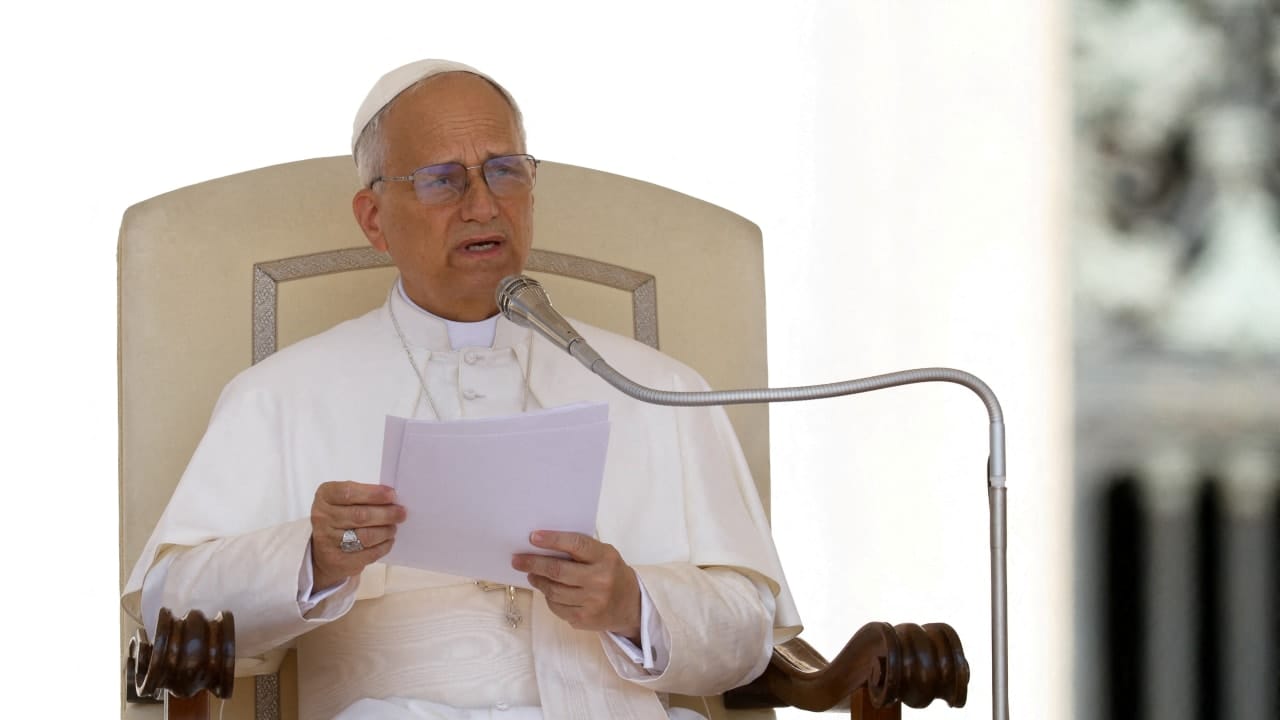
When Pope Leo XIV ascended to the papacy, many had great hopes. With his robust interfaith credentials from the Catholic Theological Union in Chicago—a vibrant hub for Jewish-Christian dialogue—Leo XIV seemed poised to renew Catholicism's commitment to interreligious solidarity, especially with Judaism. These relationships had been severely compromised and put at serious risk due to the moral ambiguity and cautious approach of Pope Francis during Israel-Gaza war, which drew significant criticism from the Jewish world. Early in his papacy, Leo XIV boldly declared that "all Christians have a special relationship with Judaism." But when missiles began raining down on Tel Aviv and Tehran in June 2025, those hopes were quickly tested.
As conflict erupted, Pope Leo XIV urged Israel and Iran to exercise "responsibility and reason," emphasizing that "no one should ever threaten the existence of another." Furthermore, following the United States’ strike on Iran’s nuclear reactors, instead of expressing satisfaction at the removal of the nuclear threat, the Pope continued along a pacifist line, stating: “Today more than ever, humanity cries out and invokes peace,” and adding: “Every member of the international community has a moral responsibility: to stop the tragedy of war, before it becomes an irreparable abyss.” This was the Pope’s fourth appeal for peace since Israel first attacked Iran on June 13. On June 18, Leo called on world leaders to reject the temptation to use “powerful and sophisticated weapons.” “We must not get used to war,” the Pope said, warning against a descent into “barbarism.” His call came as President Trump signaled that the United States might join the war on Israel’s side if Iran did not agree to an “unconditional surrender.” Though seemingly balanced, his statements were notable for what they omitted: explicit acknowledgment of Israel’s justified right to defend itself against existential threats.
This hesitancy echoed Pope Francis's cautious stance during Gaza-Israeli war, proving inadequate and morally unclear at a critical moment. It threatened to continue in the troubling direction set by the previous Pope, further eroding decades of progress in Jewish-Catholic relations since Nostra Aetate—the Vatican’s landmark 1965 declaration repudiating antisemitism and affirming Christianity’s foundational ties to Judaism—especially at a time when Iran clearly emerged as the aggressor, openly threatening Israel’s existence with nuclear ambitions and its proxies Hezbollah, Hamas, and Yemen.
If the Vatican’s response was muted, mainline Protestant churches reacted with troubling predictability. The World Council of Churches condemned Israel’s military response as violations of international law, conveniently ignoring Iran’s aggressive provocations, nuclear ambitions, and sponsorship of terrorist groups like Hamas and Hezbollah. Such selective outrage dangerously simplifies complex realities and perpetuates moral confusion within Christian discourse.
The inability of so many Christians to acknowledge the legitimacy—let alone the obligation—of Israeli military action against Iran’s nuclear program inevitably raises a theologically significant question: Could it be that Christianity, at its core, contains an inherent opposition to the use of force—one that leads to moral paralysis in times of crisis?
Surprisingly, the Evangelical Christian community presents a resolute moral alternative—one that demonstrates it is indeed possible to formulate a stance that recognizes the necessity of using force, even from within Christianity itself. Franklin Graham, an American evangelist and missionary in the evangelical movement, explicitly identified Iran’s role, asserting, "Israel has been forced into defending itself and needs our prayers." Pastor Greg Laurie, an American evangelical pastor, evangelist, and author, rallied his congregation to pray fervently for Israelis under missile attacks and added: "The regime in Iran has long supported terrorism around the world—especially against Israel. They have been developing a nuclear [weapon] for some time now, and their leaders have repeatedly threatened to use it to 'wipe Israel off the face of the Earth.'" Dr. Susan Michael of the International Christian Embassy Jerusalem similarly supported Israel's decisive actions to prevent a nuclear-armed Iran, calling such a scenario "a threat not only to Israel but to global peace and security," and urged Americans to pray for the protection of Israel’s civilians and armed forces, wisdom and strength for Israeli leaders, as well as "peace, justice, and the restraint of evil."
The contemporary Catholic Church’s ambivalence sharply contrasts its decisive commitments following the Holocaust, exemplified in Nostra Aetate. Moral authority, however, cannot rely solely on historical declarations—it requires constant reaffirmation, particularly in crises.
For global Christianity to remain relevant and authoritative in addressing war, peace, and justice, it must reject ambiguity and reclaim moral courage. Pope Leo XIV and his counterparts must unequivocally name evil when confronted by it. The evangelical response demonstrates clearly that this lack of moral clarity is not inherent in Christianity itself; indeed, evangelicals illustrate that such clarity remains achievable—and desperately needed—in our troubled times.
Dr. Ghila Amati is a Research Fellow at JPPI, The Jewish People Policy Institute