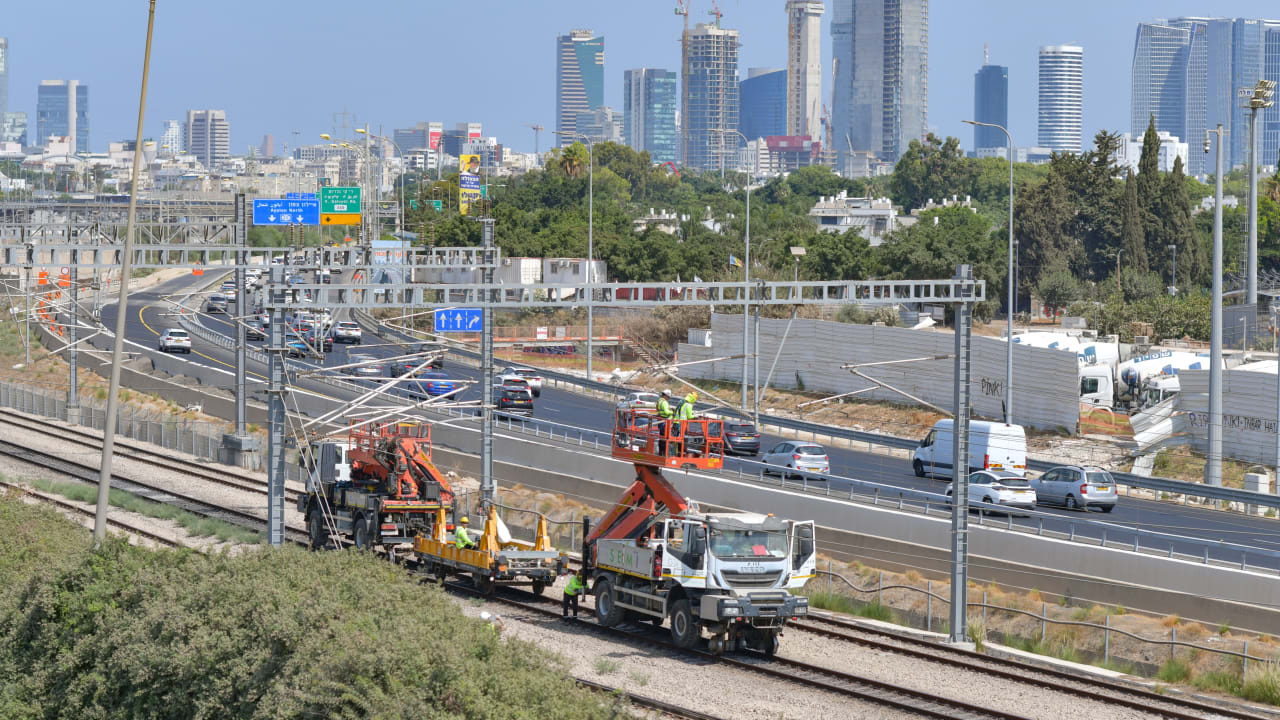
Israel Railways and the Israeli start-up Exodigo have introduced a new AI-driven remote-sensing system designed to map underground infrastructure with unprecedented accuracy.
The technology was unveiled at the annual CES innovation conference in Las Vegas last week.
Exodigo, a rapidly growing start-up specializing in non-intrusive subsurface mapping, has been conducting advanced underground surveys along multiple Israel Railways track segments. The goal is to cut development costs, shorten project timelines, and prevent unexpected damage to buried infrastructure. This last is one of the most common causes of delays in rail construction and maintenance.
To make this possible, Exodigo’s platform underwent extensive engineering adaptations so it could be mounted directly onto Israel Railways’ railcars. The result is a multi-dimensional digital model of the railway corridor, providing engineers and planners with a single, highly accurate source of truth about what lies beneath the tracks.
The partnership with Exodigo emerged from the “Innovation Challenge Tender,” a competitive process aimed at identifying the most advanced global solutions for underground mapping. Exodigo was selected after outperforming several Israeli and international contenders in a rigorous pilot along the railway corridor.
Israel Railways officials say this new capability will streamline maintenance, improve safety, and support long-term planning across the national network.

Showcased on the global stage
At CES, one of the world’s largest technology exhibitions, senior Israel Railways leaders, including chairman Moshe Shimoni, acting CEO Avi Elmaliach, and innovation manager Hagay Rosenfeld presented the results of the collaboration.
Elmaliach emphasized the project’s strategic importance, noting that Israel Railways is committed to adopting technologies that enhance service reliability and operational efficiency. He described Exodigo’s results as having “significant potential” not only for Israel but for rail operators worldwide.
“Israel Railways continuously works to identify and develop technological solutions that improve passenger service and maintenance efficiency,” Elmaliach said. “The collaboration, which was a part of the Innovation Challenge Tender, allowed us to closely examine cutting-edge technologies, and the results presented by Exodigo demonstrate significant potential, not only for Israel Railways but also for railway operators worldwide. Israel Railways is proud to support and promote Israeli innovative technologies.”
Exodigo’s CEO and co-founder, Jeremy Suard, echoed that sentiment, pointing out that railways everywhere face similar challenges: maintaining punctuality and safety while expanding aging networks. He said the new system would enable Israel Railways to map its assets “efficiently and systematically,” laying the groundwork for future AI-driven decision-making in infrastructure management.
“Israel Railways faces challenges similar to those of railway operators around the world, such as the need to maintain schedule accuracy and high-quality service while maintaining and expanding the existing network,” Suard said.
“The proposed solution will enable the railway to efficiently and systematically map all existing rail assets and introduce new capabilities for digital asset management in a dynamic environment. This will allow future integration of AI tools into infrastructure-related decision-making processes, with the goal of maximizing services for the public.”