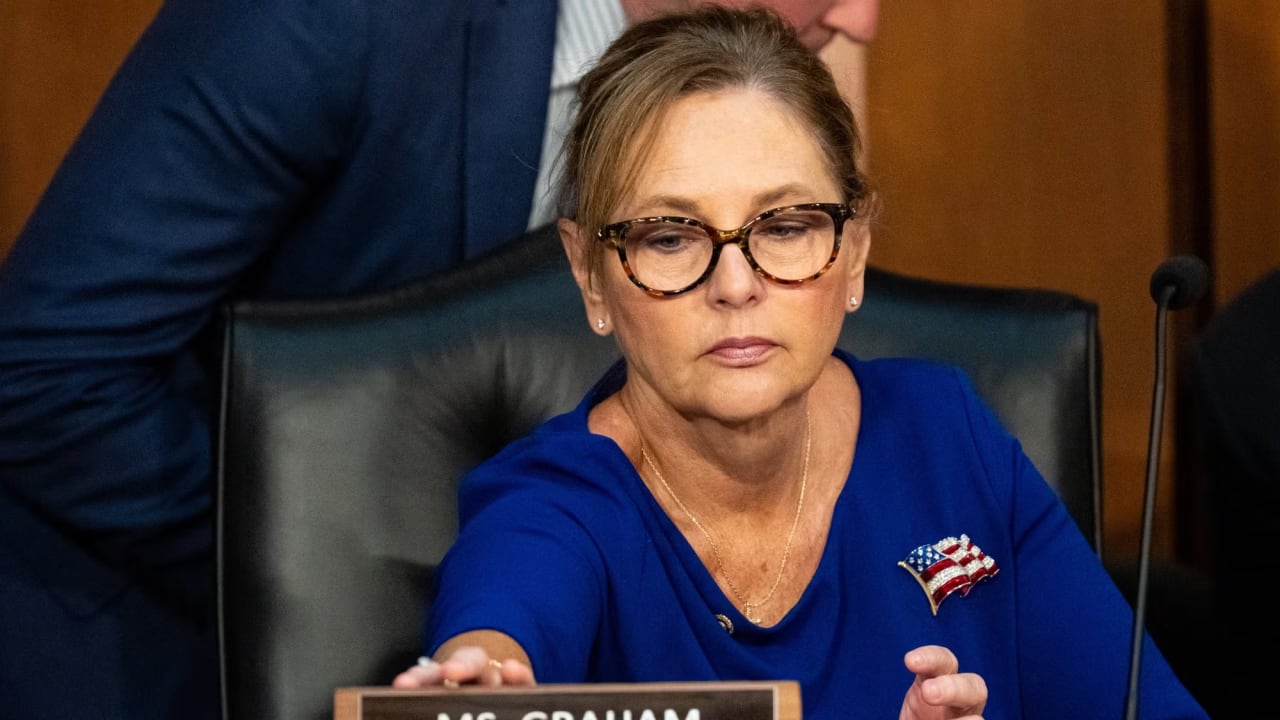
A crowded field of candidates will compete in South Carolina’s special primary this Tuesday, with hopes of securing the Republican nomination for a US Senate seat long held by the late Lindsey Graham, one of Israel’s strongest allies on Capitol Hill and an advocate for military action against Iran.
There is little doubt that the winner will be supportive of Israel, but it remains to be seen just how high the Jewish state will rank among the candidate’s priorities. Matching Graham’s level of foreign policy experience and focus on the Middle East, a region he often visited, would be difficult.
“If other people are quite that hawkish, then they just don’t have the platform and power to say it. Whereas, he did,” Scott Huffmon, a professor of political science at South Carolina’s Winthrop University, told the Jewish Telegraphic Agency.
Graham died suddenly on July 11 from an aortic dissection, at 71 years old, after serving 23 years in the Senate and eight in the US House. He was a longstanding member of the Senate’s Armed Services and Budget committees and had traveled to Israel about a dozen times since Hamas’s Oct. 7, 2023 attack on Israel.
Having grown up in the Cold War era, Graham was an anti-Soviet and then anti-Russia conservative who was always solidly pro-Israel, said Huffmon, who also directs Winthrop’s Center for Public Opinion and Policy Research.

“He viewed peace in the Middle East through the lens of a protected Israel,” Huffmon said, noting that Graham made Israel a priority issue. “It would be really tough for a new person to have the traction to do that, even if they believe just as strongly as the late Senator Graham.”
Darline Graham quickly earned Trump's endorsement
Just a few days after his death, South Carolina Gov. Henry McMaster, a Republican, appointed the late senator’s younger sister, Darline Graham, to complete the rest of his term. Despite having limited policy experience, including previously serving on the South Carolina Commission for the Blind, she quickly earned President Trump’s endorsement and announced she would be running in Tuesday’s special primary.
Graham will be up against nine fellow Republicans, with her biggest challengers including Ralph Norman and Russell Fry, who are both currently serving in Congress, as well as Mark Sanford and Mark Lynch.
A recent Emerson College poll showed Graham and Norman vying for the lead, with 19% and 22% support, respectively, while Fry had 12%. Sanford is a former congressman and South Carolina governor, while Lynch is a businessman.
Among Norman’s top priorities is the Safeguard American Voter Eligibility Act (SAVE America Act), a bill he co-sponsored in the US House that would require voters to provide identification at the polls – and a top priority for Trump. He also has pledged to reduce spending, secure the US borders, fund law enforcement, protect gun ownership rights, restrict women’s sports to assigned females at birth, support veterans and strengthen the military.
“We should be slow to send America’s sons and daughters into harm’s way, but when we do, they deserve every advantage to accomplish the mission and return home safely,” the campaign stated.
Darline Graham revealed her platforms less than a week ago on Fox News, noting that the SAVE America Act is her first co-sponsored bill in the US Senate. Her other policies were similar to those on Norman’s list, though she also expressed specific support for the right to life. She slams diversity, equity and inclusion, and two bugbears of the left: progressive leader Rep. Alexandria Ocasio-Cortez of New York and Anthony Fauci, the former top federal health official Republicans say bungled the COVID pandemic. Graham earned the backing of the Republican Jewish Coalition shortly after announcing her candidacy.
Fry’s campaign also promotes the Trump-branded “America First” agenda, focusing on securing borders, ending the fentanyl crisis, lowering costs, advocating for farmers and rural communities, honoring veterans, confronting China’s communist party and advancing US oil, gas and nuclear energy development.
Sanford’s top priority, as highlighted in bold and red on his website, is the “nation’s debt and the spending that drives it.” His campaign focuses on reversing the “financial tipping point” that has threatened the country’s “ability to sustain the American Dream.” Sanford, whose governorship was plagued with scandals, briefly ran against Trump in the 2020 presidential primaries.
Lynch’s focuses are fairly similar to those of Norman, Graham and Fry, with stronger language on foreign policy that demands a “lethal military focused on defending the homeland,” an end to “American involvement in open-ended foreign conflicts” and formal congressional authorization for new military engagements.
Israel has not been an active issue in the campaign.
Although Graham earned Trump’s endorsement, Huffmon said that supporters of Norman and Fry also see them as candidates who “will help push Trump’s agenda.” Norman has a strong track record and statewide recognition as a fiscal conservative, while Fry has “solid conservative bona fides” but less notability, according to Huffmon.
In his own past polls of South Carolina Republicans, Huffmon said he found that the most conservative voters tended to have high approval ratings for Trump, McMaster and former governor Nikki Haley, but they saw Lindsey Graham as “too moderate.”
“The people who want the Trump agenda to succeed the most were not always Graham’s biggest fan,” he added. “So they might not automatically say, ‘Well, Graham’s sister is the natural candidate.’”
Christopher Cooper, a political science professor at Western Carolina University, predicted that “she will be fairly close to her brother on most issues,” noting that this is in some ways “her feature as a candidate.” But like Huffmon, he stressed that “Lindsey Graham was not that popular,” even if he was expected to win reelection.
South Carolina still a conservative, Trump-supporting state
That said, Huffmon stressed that South Carolina “is still a conservative, Trump-supporting state” and that “his endorsement still matters a lot.”
Cooper agreed. “I think you’d rather have it than not have it, but it’s no longer a guarantee for victory,” he said.
The Emerson poll — which included about 500 GOP primary voters — also asked respondents what issues the next senator of South Carolina should prioritize. Just 3.5% chose foreign policy, while 59.5% picked the economy, 18.7% immigration, 8.3% healthcare and 10% “something else.” On the other hand, 56.1% said they “strongly support” US military action in Iran, with only 14.6% voicing strong opposition.
Huffmon said that when a poll asks for a voter’s top priority, the respondent’s second most important issue could be “millimeters behind,” but they can only name one. Voters right now might feel like a strong foreign policy approach “is necessary but not sufficient,” he said.
Huffmon characterized Israel as “a threshold issue,” meaning that voters would view anti-Israel, pro-Palestinian sentiments as disqualifying factors, but the issue is not as high priority in comparison to other concerns, like the economy.
Cooper agreed. “GOP voters are going to be fairly hawkish, but if you ask any group of people right now, what’s your most important issue, it’s going to be the economy,” he said.