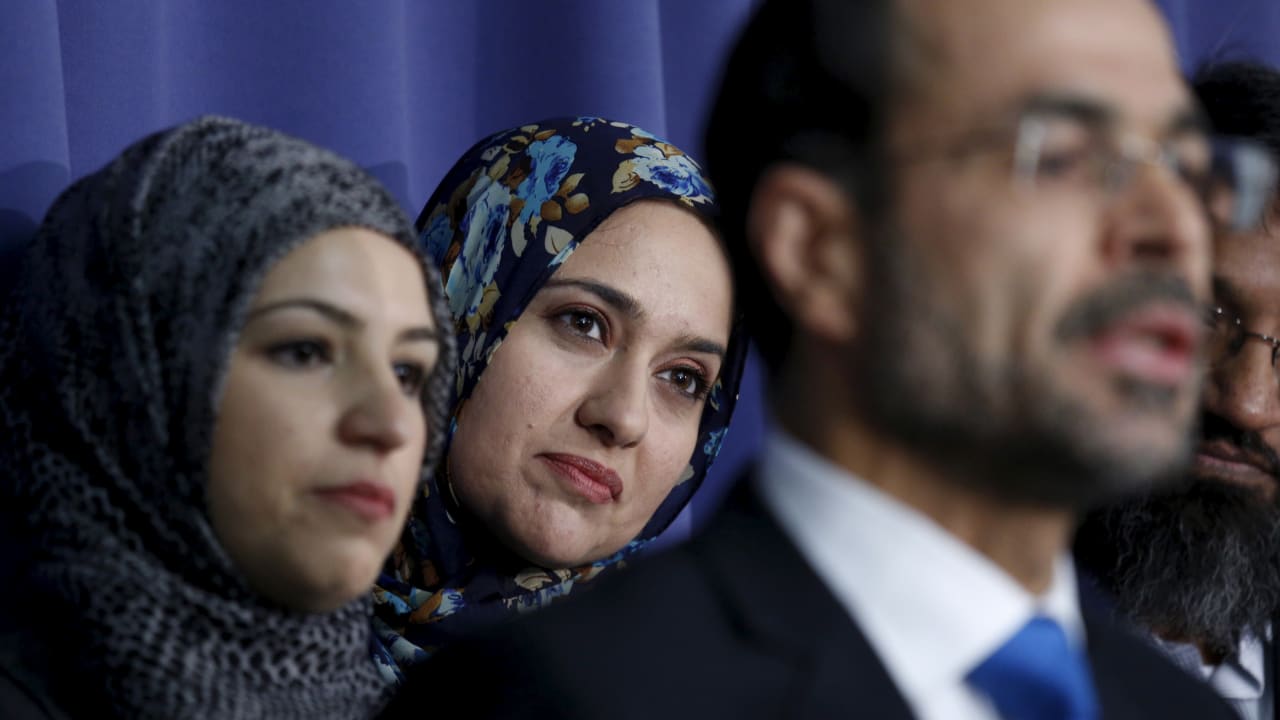
The Council on American-Islamic Relations (CAIR), a Muslim civil rights nonprofit based in Washington, DC, and operating in about 20 states, aims, according to the organization, to “enhance understanding of Islam, protect civil rights, promote justice, and empower American Muslims.”
CAIR was founded in 1994 with the mission of fighting anti-Muslim discrimination in the US by creating initiatives to educate and inform the public about Islam and combating Islamophobia. Yet, all three of the founders have alleged ties to terrorism.
During the course of its roughly 30 years of existence, CAIR has promoted itself as standing up for the rights of Muslims in America, but it has also faced extensive criticism over ties to extremist movements and ideologies. According to the Anti-Defamation League (ADL), “key CAIR leaders often traffic in openly antisemitic and anti-Zionist rhetoric.”
During the past years, as the Israel-Hamas War grabbed global attention, CAIR has come into the spotlight for its involvement in pro-Palestinian and anti-Israel advocacy.
In the lead-up to the November New York City mayoral election, Muslim-American activist Linda Sarsour claimed that CAIR was a main backer of Zohran Mamdani’s winning campaign. The Washington Free Beacon reported that Mamdani’s campaign received $100,000 from a CAIR-affiliated PAC.

Mamdani has been accused by many Jewish and pro-Israel organizations of holding antisemitic positions, including defending calls to “globalize the intifada” and a refusal to recognize Israel’s right to exist as a Jewish state.
How does CAIR operate?
CAIR is organized by state, with about 32 chapters across the US. On its website, it lists work in civil rights, media, countering Islamophobia, and youth work as some of its current initiatives.
CAIR’s legal work
According to CAIR, the organization “provides legal representation on behalf of Muslims and others who have experienced religious discrimination, defamation or hate crimes.”
Earlier this year, CAIR-MI filed a lawsuit against the Oakland County Sheriff’s Office in Michigan on behalf of a Muslim woman who was forced to remove her hijab during her booking.
Since the start of the Israel-Hamas War, CAIR’s legal department has focused heavily on defending anti-Israel activists from legal action. For example, over the past six months, CAIR has taken legal action against tech companies such as Meta and Apple, as well as universities such as the University of Missouri and Northwestern University.
CAIR has also voiced support for activists such as Mahmoud Khalil and Rumeyza Ozturk, non-citizen anti-Israel students whom President Trump’s administration attempted to deport.
CAIR in politics
CAIR, headquartered in the nation’s capital, is also deeply involved in US political activity. The organization lobbies the government through its political section, CAIR Action.
According to CAIR’s government affairs partner, “CAIR representatives have testified before state legislatures and Congress and sponsored initiatives designed to bring Muslim concerns to their elected representatives.”
Although CAIR can’t legally endorse candidates, CAIR Action does so, maintaining lists of state and federal endorsements. Notably, it refused to endorse a major presidential candidate in the 2024 election, citing dissatisfaction with both Trump’s and Kamala Harris’s support for Israel.
Instead, the group encouraged voters to vote for third-party options such as Green Party candidate Jill Stein, whose vocal anti-Israel viewpoint resonated with many American Muslims.
According to CAIR polling, a slight majority of Muslim voters preferred Jill Stein over any other candidate.
Controversial founders
Co-founders of CAIR Omar Ahmad, Nihad Awad, and Rafiq Jaber have all faced government scrutiny over their ties to Islamist terrorism. Ahmad, Awad, and Jaber co-founded CAIR together, and Ahmad served as chairman of the board of directors until 2005. Awad currently serves as the organization's Executive Director.
Ahmad, according to the FBI, led a pro-Hamas conference in Philadelphia in 1993, where he and Holy Land Foundation for Relief and Development (HLF) and Islamic Association of Palestine (IAP) members discussed how to best support Hamas while concealing their true beliefs, such as support for Hamas conquering all of Israel, from the US.
Awad worked as the public relations director at the IAP and supported Hamas before its designation as a terrorist group, although he publicly withdrew his support for Hamas in 2006.
Jaber served as president of the IAP, where he refused to condemn suicide bombings, saying that, “I don't believe we are in a position to judge the people [for] what they do and what they do not do. Because the one in the field is different than the one sitting in the chair like me here.”
IAP and HLF: what are they?
The IAP was founded by senior Hamas member Mousa Abu Marzook. He has called for donations to Hamas-affiliated charities. In 2004, both the HLF and the IAP were found liable for aiding Hamas in the murder of 17-year-old David Boim, whom Hamas members shot at a Jerusalem bus stop in 1996, leading to the IAP’s closure.
The HLF was designated as a terrorist organization by the US in 2001. In 2004, five HLF officers were charged with providing material support to Hamas, accused of collecting money for charity in the US and distributing it through Hamas-controlled charities in the West Bank and Gaza.
In 2008, all five were convicted of funneling over $10 million to Hamas. CAIR was named as an unindicted co-conspirator in the HLF case, avoiding prosecution.
Current criticism of CAIR
Local leaders of CAIR chapters have also made controversial statements against Israel and Jews, dating back years before the Israel-Hamas War.
In 2021, Zahra Billoo, Executive Director of CAIR’s San Francisco Bay Area chapter, claimed that 'Zionist synagogues' were behind Islamophobia, leading to pushback from Jonathan Greenblatt, CEO of the ADL.
CAIR backed Billoo after her remarks, calling the condemnation a “smear campaign.” Two years earlier, Billoo was reportedly kicked off the Women’s March board over antisemitic statements.
Ibrahim Mossalam, Vice President of the Board of Directors of CAIR-NY, made statements online praising the October 7 attacks. Mossalam, a commercial pilot, was suspended by United Airlines but still serves in his CAIR-NY role.
After the October 7 attacks, Nihad Awad, founder and leader of CAIR since 1994, made a statement commending the massacres. This led to condemnation from the Biden administration, which called his words “antisemitic.”
What’s next?
Despite decades of relatively low scrutiny, there have been instances where CAIR has been targeted for its ties to extremism.
In August of this year, Sen. Tom Cotton (R-Ark) asked the IRS to investigate CAIR’s tax-exempt status, citing ties to Hamas and the Muslim Brotherhood. CAIR rejected Sen. Cotton’s claims as “debunked conspiracy theories and half-baked legal arguments.”
Months earlier, in June, Rep. Randy Fine (R-Fl) introduced a bill to the House of Representatives proposing the designation of CAIR as a Foreign Terrorist Organization, again citing ties to terrorist groups.
Three decades after its founding, CAIR currently stands at a crossroads. To its critics, the organization is a front for Islamist terrorist groups, while to many American Muslims, it’s a valuable resource and a defender against Islamophobia.